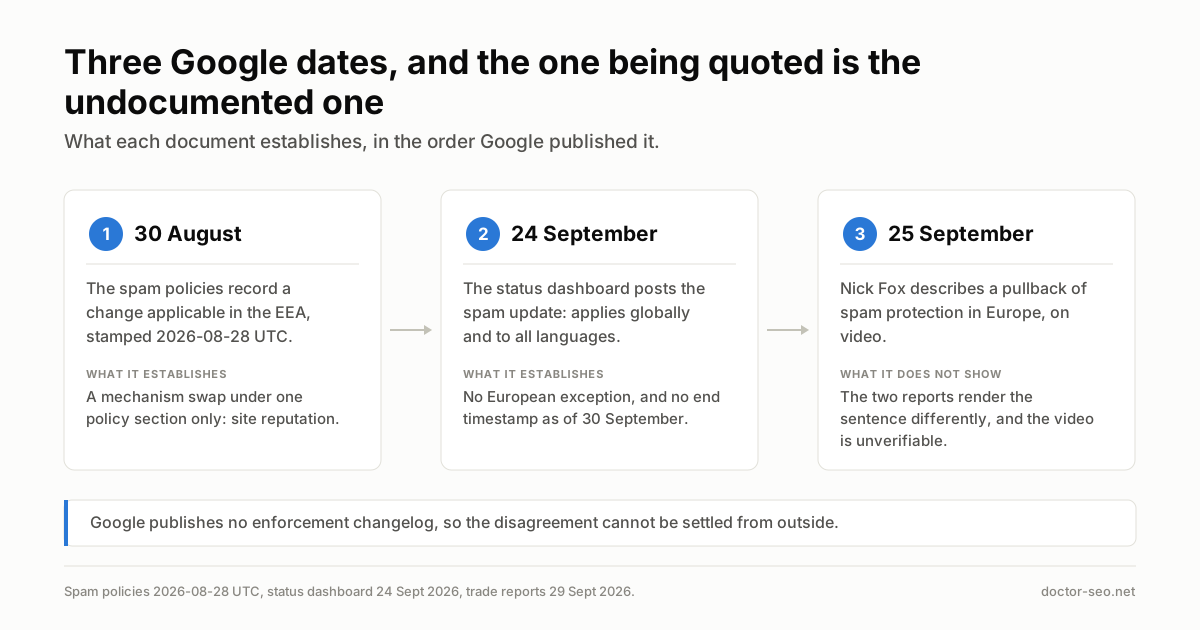
Nick Fox, Google’s senior vice-president for knowledge and information, said in a recorded interview that Google has pulled back spam protection in Europe and that European searchers see lower-quality results as a result. That is an unusual sentence from the person who runs Google Search.
It is also narrower than it sounds. On 30 September 2026 I checked four Google documents for a record of that pullback. One contains it. One announces the underlying change without naming Europe. One has not been revised since December 2025. And the spam update Google is rolling out at this moment says it applies globally and to all languages, with no European exception.
The gap between what a Google executive describes and what Google’s own documentation records is the story, and it is the part you can check yourself in four minutes. So this post leads with the documents rather than the quote.
What Google has actually documented about Europe
One Google document records a European spam-enforcement change: the Google Search spam policies page, last updated 2026-08-28 UTC. Checked on 30 September 2026, the European Economic Area appears there under exactly one policy section, the site reputation policy, and under no other. The page states: We have made changes applicable to the policy in the European Economic Area (EEA).
The operative distinction on that page is territorial. Outside the EEA, Google says, If a site is found to be out of line with this policy, relevant pages may be subject to a manual action.
Within the EEA, When pages appear in Search results shown to users within the EEA, relevant pages may be categorized as separate
from the main domain, without the manual action. The same section adds a new EEA reconsideration request process and access to alternative dispute resolution.
So the documented change is a swap of enforcement mechanism, not an absence of enforcement: a manual action becomes a ranking separation. Site reputation abuse, the practice the SEO industry calls parasite SEO, is still a policy violation in Europe. What changed on 30 August 2026 is what happens to you when Google decides you committed it.
Every Google document checked during this run, with its own date stamp:
| Google document | Date stamp, checked 30 Sept 2026 | Records a European spam pullback? |
|---|---|---|
| Search spam policies | Last updated 2026-08-28 UTC | Yes, under the site reputation policy only |
Search Central blog, Update to the Site Reputation Policy |
28 August 2026 | Announces the update; its feed summary names neither the EEA nor the Digital Markets Act |
| Spam updates documentation | Last updated 2025-12-10 UTC | No. Europe, the EEA and the DMA appear nowhere on it |
| Search Status Dashboard, September 2026 spam update | Begins 2026-09-24T16:15:00+00:00, no end timestamp | No. The entry reads applies globally and to all languages |
That last row matters most. Google’s dashboard entry, timestamped 16:15:47 UTC on 24 September 2026, reads: Released the September 2026 spam update, which applies globally and to all languages. The rollout may take up to two weeks to complete.
As of 30 September 2026 it carries no end timestamp, so the rollout is on day six of a stated two-week window. Google published globally and to all languages
four days before its own search executive described a European pullback.
What Nick Fox said, and how this site knows it
Fox spoke in a video interview with Pietro Valetto, which PPC Land dates to 25 September 2026 and which Fox shared on his LinkedIn profile. Search Engine Roundtable and PPC Land both wrote it up on 29 September 2026.
This site could not fetch the primary source: the interview is a video and the post sits on LinkedIn, neither of which is machine-readable here. That has a consequence readers deserve: the two trade reports do not render Fox’s sentences identically.
Search Engine Roundtable, 29 September 2026, renders the spam sentence as: we’ve had to pull back on sort of spam protection…we show, you know, lower quality results in Europe as a result.
PPC Land, the same day, renders it as: We’ve been forced to pull back on spam protections.
On the degradation point, Search Engine Roundtable gives It literally makes me sad that we need to degrade our product in this way
and PPC Land gives It’s the biggest degradation ever. It literally makes me sad.
Both reports agree on the substance and disagree on the wording, and neither transcript can be checked against the recording from here. The widely repeated line about the biggest quality drop
in Google’s history is weaker still: secondary reports give the company’s age as 28 years and as 29 years, and no Google document checked during this run contains the phrase.
Google’s own on-the-record statement on the enforcement change is cleaner, because a named spokesperson gave it to Search Engine Roundtable on 28 August 2026: Our European users are no less frustrated by parasite SEO and other deceptive, pay-to-play tactics that degrade search results, and we stand by our Site Reputation Policy. While we remain concerned about efforts to weaken our spam policies, we’ve agreed to make changes to our enforcement approach for users in Europe and clarify our policies to address the European Commission’s concerns.
What the community measured
Separately from spam enforcement, the visible European results page changed twice in September. PPC Land’s Luis Rijo, reporting on 29 September 2026, dates a redesigned results page across the European Economic Area to 8 September 2026, with vertical search services repositioned and real-time pricing removed from hotel, airline and restaurant carousels. The same report dates the disappearance of free product listings and popular product carousels from EEA results to 17 and 18 September 2026, and cites tracker data showing declines of 90 to 100% in Germany, France, Belgium, Sweden and the Netherlands.
Treat that last figure carefully. The report names no tracker, discloses no sample size and describes no methodology, so a 90 to 100% decline is an observation rather than a measurement. It is consistent with the visible removal of a SERP feature, which is what makes it plausible, and it is not a number anyone can reproduce.
On clicks, Fox is reported as saying In terms of clicking through to the web, people still click through to the web a lot.
Google has published no European click-through figures alongside that statement.
Where the industry genuinely disagrees
Two questions raised by this story have no settled answer.
Whether an executive’s description of enforcement is evidence about enforcement. One camp holds that the person who runs Search knows what Search does, that Google documents only a fraction of its enforcement behaviour, and that refusing to credit him is pedantry. The other holds that a documented change covering one policy cannot support a plural claim about spam protections
, that Google’s simultaneous globally and to all languages
notice contradicts it, and that a claim in a video nobody can re-verify is not a citable fact. Nobody can settle this: Google publishes no enforcement changelog, so there is no record against which an executive’s characterisation could be checked.
Whether documented reduced enforcement should change what you do in Europe. One camp reads the carve-out as a real change in the risk calculus: if the sanction for site reputation abuse in the EEA is a ranking separation rather than a manual action, the downside of the tactic falls and competitors will price that in. The other reads it as almost nothing: the policy still applies, the algorithmic systems are unchanged, the September 2026 spam update is global by Google’s own notice, and a ranking separation can cost more traffic than a manual action ever did. No published study isolates the effect of the EEA carve-out on any site’s rankings, so both positions are arguments from first principles.
What this changes in practice
For a site inside the EEA that hosts third-party content, the sanction has changed shape. A manual action is a discrete event visible in Search Console and appealable through a reconsideration request. A ranking separation is gradual and invisible in the interface, though the spam policies page now documents an EEA reconsideration process alongside it.
For a site competing against parasite placements on large European domains, nothing about the policy changed. The practice remains a violation. What changed is the enforcement route, and a gradual separation takes longer to show up in a competitor’s rankings than a manual action would have.
For everyone, the September 2026 spam update is still rolling. Six days into a two-week window with no end timestamp on the dashboard, ranking movement in Europe has at least two candidate explanations, and attributing it to either is a guess until the rollout closes. The diagnostic discipline for this is the same one that applies to any spam and grey-hat question: separate what the platform documented from what you measured on your own property.
What to do this week
- Read the source, not the coverage. Open the Search spam policies page, find the site reputation policy section, and read the two EEA paragraphs. It is the only version nobody has paraphrased.
- Annotate 30 August 2026 in your reporting. If you host third-party content on an EEA-facing domain, that is the date the sanction changed shape. Mark it so a later drop is not mis-dated.
- Annotate 24 September 2026, 16:15 UTC, separately. That is the spam update boundary from Google’s dashboard. Keep it distinct from the policy date, because the two events have different causes.
- Segment European traffic by country, not by region. The SERP-feature removals reported for 8 and 17 September were EEA-wide, but product carousels were not equally present in every market beforehand.
- Do not rebuild your off-page strategy on this. One policy section changed its enforcement mechanism in one territory. That is not a licence, and Google’s own spam update notice this week says the update applies everywhere.
What is still unknown
Google has not said which spam protections beyond the site reputation policy were pulled back, if any. It has published no European enforcement figures, no timeline and no reversal condition. The September 2026 spam update has no end timestamp, so its European behaviour cannot yet be compared against the documented carve-out. And no independent measurement exists of what a ranking separation costs a site relative to a manual action, which is the number an affected publisher most needs.
Txema Hermoso’s opinion
I hold a position on the documentary gap and on nothing beyond it. The gap is real, it is dated, and anyone can check it: one Google document records a European spam-enforcement change, it covers one policy, and the spam update Google announced four weeks later says it applies globally and to all languages. Reporting Google has pulled back spam protection in Europe
without that context turns a documented mechanism swap into an undocumented retreat.
I will not say whether Fox overstated it. He may be describing internal changes Google has chosen not to write down, and Google’s silence is not evidence that nothing else happened. I will also not tell European site owners that the risk of parasite tactics has fallen. The policy still calls the practice a violation, and a gradual ranking separation is a worse outcome than a manual action for a site that depends on one domain.
What I defend is the habit: when a platform executive and a platform document disagree about scope, publish both with their dates and let the reader see the distance. That ages better than a prediction, and it is the method the advanced strategy level applies to every platform claim, not only this one.
Sources
- Google Search Central,
Google Search spam policies
, last updated 2026-08-28 UTC, checked 30 September 2026 — developers.google.com/search/docs/essentials/spam-policies - Google Search Central blog,
Update to the Site Reputation Policy
, 28 August 2026 — developers.google.com/search/blog/2026/08/update-site-reputation-policy - Google Search Central,
Google Search ranking and spam updates
, last updated 2025-12-10 UTC, checked 30 September 2026 — developers.google.com/search/docs/appearance/spam-updates - Google Search Status Dashboard,
September 2026 spam update
, begins 2026-09-24T16:15:00+00:00, no end timestamp as of 30 September 2026 — status.search.google.com/incidents.json - Barry Schwartz, Search Engine Roundtable,
Google’s Nick Fox Feels Sad & Terrible For European Searchers After DMA
, 29 September 2026 - Barry Schwartz, Search Engine Roundtable,
Google Won’t Enforce Its Site Reputation Policy In The European Economic Area
, 28 August 2026, carrying the Google spokesperson statement quoted above - Luis Rijo, PPC Land,
Google drops live prices and trip dates in EU Search, then blames Brussels
, 29 September 2026 - Luis Rijo, PPC Land,
Google drops EEA search penalties under site reputation policy August 30
, 28 August 2026
The Nick Fox interview itself, conducted by Pietro Valetto and shared on LinkedIn, could not be fetched during this run. Every quotation attributed to Fox above is attributed to the trade report that rendered it, not to the recording.