Google is paying about 100 publishers for content that feeds its AI answers. Some have received less than $1,000 across several months; one early participant reportedly earns more than $1 million a year. Those figures come from The Information of 29 September 2026 and reached the industry through trade reports on 30 September and 1 October.
The checkable part is different. The pilot’s rules live in one Google document, and if you are not already enrolled you cannot read it. On 1 October 2026 I fetched five Google sources a site owner would reasonably monitor. The pilot appears in one, and that one returns navigation with no article body.
What happened
The Information reported on 29 September 2026, in an article by Alix Coutures and Catherine Perloff, that roughly 100 digital publishers are in Google’s AI contribution pilot and that payments for several small and midsize sites amount to less than one-tenth of 1% of their advertising revenue. Search Engine Roundtable and PPC Land covered it on 30 September 2026, Search Engine Journal on 1 October 2026.
The pilot is not new. Digiday reported it first on 14 September 2026, in an article by Jessica Davies and Sara Guaglione, describing a pay-per-value licensing programme surfaced inside Google Search Console and saying that “at least dozens of publishers have been approached”. Google confirmed to Digiday that it is an early-stage learning pilot to test how best to reward high-quality content, on top of the traffic and tools Google already provides, and pointed Digiday back to a blog post from June 2026.
What Google’s documentation says
Google’s description of the pilot sits in a Search Console help topic, reproduced by Barry Schwartz at Search Engine Roundtable on 14 September 2026. The definition:
“The AI contribution pilot allows you to earn money when your content contributes significantly to the creation of AI-generated responses shown to users in participating products.”
Two further sentences from the same help text matter more, because they narrow what counts:
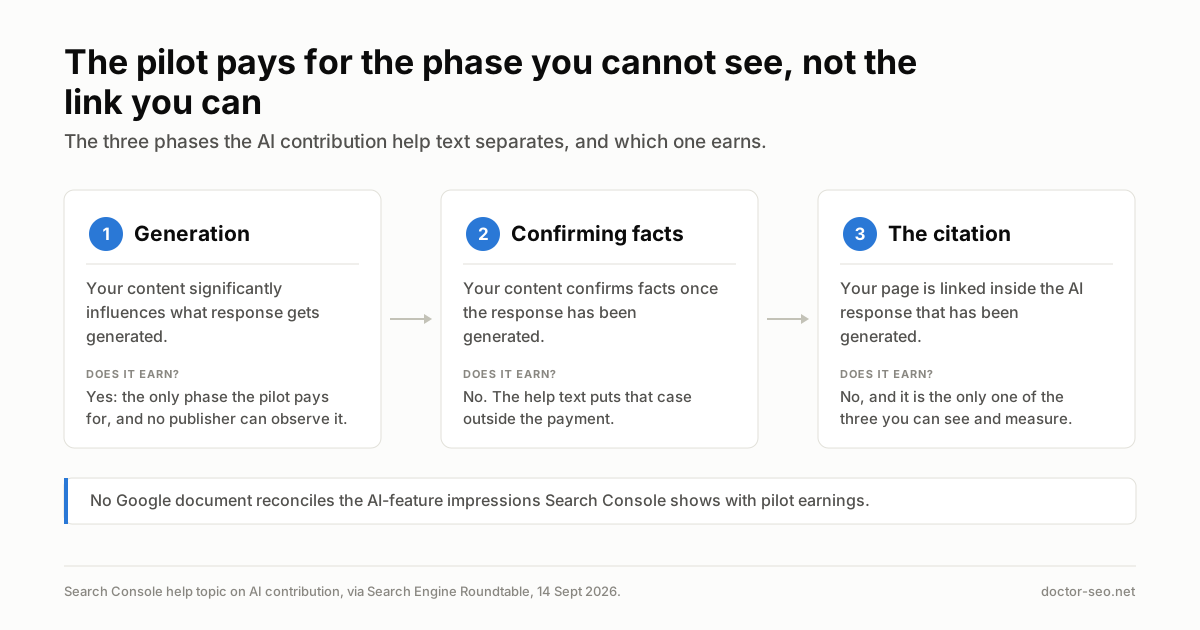
“AI contribution focuses on the phase of generation where web content can significantly influence what response is generated.”
“Web content may also confirm facts or be linked to within Google’s AI after a response is generated, but those instances don’t qualify for AI contribution.”
Read that against what the GEO industry sells. A citation link under an AI Overview is, by this text, the case that does not earn. The paid event is influence during generation, which no publisher can observe. The panel itself, per the same source, lets a participant accept the Program Terms, track earnings, and check transfers — which “may differ from your estimated earnings due to tax deductions or local payment thresholds”.
I did not read those sentences on a Google page. The help topic the trade press points at returns navigation only; I fetched it twice on 1 October 2026, bare and cache-busted, with no article body either time. The quotations above come from Search Engine Roundtable’s 14 September 2026 reproduction, named and dated in the sources below, and should be treated as such.
The five Google sources I checked
Every date below is the stamp the page itself carries, read on 1 October 2026. Anyone can repeat this check.
| Google source | Date stamp on the page | Does it document the pilot? |
|---|---|---|
| Search Console Help, “AI contribution” help topic | None shown | The only Google document that does — and its body is not publicly readable (navigation only, two fetches) |
| Search Console Help, Generative AI performance report (Search) | None shown | No. No mention of earnings, payments or AI contribution anywhere on the page |
| Search Central, AI Features and Your Website | Last updated 2025-12-10 UTC | No. The words “AI contribution”, “earn”, “payment”, “monetize” and “pilot” do not appear |
| Search Central blog feed | Four posts since 8 September 2026, the most recent 24 September 2026 | No. None of them mentions the pilot |
Search Status Dashboard, incidents.json |
One September 2026 incident, the spam update begun 2026-09-24T16:15:00+00:00 | No. Nothing about publisher payments |
The second row deserves attention. Search Console measures how often your pages appear in Google’s AI features, and separately pays you for contributing to them. Neither document names a metric the other uses, so impressions and earnings cannot be reconciled.
What The Information reported, and what it does not disclose
The figures as the trade reports render them, all attributed to The Information, 29 September 2026:
- About 100 digital publishers are in the pilot.
- One early participant earns more than $1 million a year.
- One publisher who joined later earns roughly $50,000 to $60,000.
- Several smaller sites have earned less than $1,000 over several months.
- For several small and midsize sites, payments amount to less than one-tenth of 1% of advertising revenue.
- Niche-subject sites such as anime and gaming earn proportionally more, and several larger publishers declined to join, hoping for better terms.
No sample size applies to any of this — it is reporting, not a study. The limits still need naming, because they vanish the moment these numbers are repeated. The Information‘s article is paywalled and could not be fetched for this piece, so every figure above arrives through a secondary report. The public renderings disclose no date range for the payments, no basis for the roughly 100 count, no definition of the advertising revenue the 0.1% is measured against, and no account of how the publishers who spoke were selected. The $1 million figure and the sub-$1,000 figure are two points, not a distribution.
Where the industry genuinely disagrees
Four open questions sit under this story. doctor-seo.net holds no position on any of them; this section reports the disagreement rather than settling it.
Is this compensation for a real loss, or a rounding error?
One camp reads a payment worth under 0.1% of ad revenue as an insult priced against a serious loss. Its best evidence is Pew Research Center’s March 2025 browsing panel (900 US adults, 68,879 searches): an 8% click rate on searches carrying an AI Overview against 15% without. The other camp notes that most of the decline predates AI answers and belongs to Google’s own zero-click behaviour — 68.01% of US Google searches ended without a click from January to April 2026 (Similarweb clickstream) — so a licensing payment was never going to replace it. The nearest causal estimate (Wang, Gleason, Bart, Wilson and Metaxa, arXiv:2608.18352v1, 18 August 2026, N=1,100, seven days) measured an 18.8-percentage-point fall in click-through rate under an AI Mode-only condition, but its authors state baseline AI Mode usage was 0.6% of searches, so that arm describes forced full adoption rather than today’s market. Nobody has published what AI answers cost a given site in the current mix — the denominator you would need to call 0.1% fair.
Licence it or block it?
Enrolling in a payment programme is the opposite of blocking the crawler that feeds it. One camp calls that the obvious trade: visibility plus a cheque beats a Disallow nobody can enforce. The other points at Cloudflare Radar’s 31 August 2026 reading of roughly 4,000 robots.txt files — training bots blocked two to three times more often than allowed (GPTBot 2.33:1, ClaudeBot 2.39:1) while answering bots were net-allowed — and argues undisclosed terms weaken everyone still negotiating. No published measurement compares a site that licenses against a comparable one that blocks.
Should you accept a payment whose formula is undisclosed?
Barry Schwartz, quoted by PPC Land on 30 September 2026, said there is “no like formula that Google’s sharing with those publishers”. Greg Finn of Cypress North, in the same report, put the operator’s question bluntly: “do you want the thousand bucks to 50,000 bucks knowing what you’re doing might be used to get you less clicks”. One camp says take it: an undisclosed formula is still money, and the alternative is zero. The other says revenue you cannot forecast, audit or appeal is revenue you will misprice, and reads the publishers holding out as evidence the first movers set the price badly. Google publishes no calculation and no participant a reconciliation, so neither case can be shown.
Is a paywalled single-outlet report evidence of payment levels?
Every figure here traces to one paywalled article, rendered by three secondary reports. One camp calls that ordinary business journalism: sources are confidential and the outlet’s record is the warranty. The other holds that a number which cannot be re-checked, whose sampling is undisclosed and whose subjects sit under commercial terms, is not a measurement and should not be repeated as one. Google has published no aggregate, so there is nothing to validate it against.
What this changes in practice
For almost every site, nothing yet: the pilot is invitation-only and roughly 100 publishers wide.
One piece of strategy does change. The help text says being linked after a response is generated does not qualify for payment. If that wording holds, the citation link the generative-engine-optimisation market sells is the unpaid outcome, and the paid outcome is something you cannot see, measure or optimise toward. Worth knowing before buying a tool that promises more citations.
It also changes how to read your own Search Console. The analytics and measurement level of the course covers why an impression in an AI surface is not a visit; an impression is not an earning either.
What to do this week
- Check Search Console for an AI contribution panel — settings, and the monetisation area if your property has one. Absent means you are not in the pilot; stop there.
- If it is present, export the monthly earnings figure before accepting anything, and record the same month’s AI-feature impressions from the Generative AI performance report. That is the only reconciliation available, and only from month one.
- Write down what would make the offer judgeable — a rate per contribution, a date range, an appeal route — then note which of those the Program Terms give you.
- Do not change your crawler policy on the strength of this story. The pilot has no documented relationship to robots.txt; our lessons on using AI models as working tools set out what crawler directives control. And stop reporting AI citations as revenue-adjacent wins until Google says a citation earns.
- Re-read the GEO and AIO level with the generation-phase distinction in mind. Influence during generation and a visible citation are different events, and almost all tooling measures the second.
What is still unknown
Google has published no eligibility criteria, no rate, no definition of “significantly”, no participant count, no aggregate payout and no appeal process readable from outside the pilot, and no expansion timeline beyond telling Digiday in September that it is at an early stage. The roughly 100 figure cannot be verified from any Google source, and no document reconciles the AI-feature impressions Search Console shows with the earnings it would show a participant.
The author’s opinion — Txema Hermoso
This section is opinion, not reporting. Everything above is sourced; what follows is my own reading.
The documentary gap is the one thing here I will defend. A company that has spent two years telling publishers to trust its measurement has built a payments programme whose rules a publisher cannot read until after being invited in. That asymmetry is not a detail; it is the whole negotiating position.
I will not tell you whether 0.1% of ad revenue is an insult or a fair price for something Google need not pay for at all: no published measurement says what AI answers cost a specific site today, and without that denominator the percentage is rhetoric. Nor will I tell you to hold out — the publishers reported to be doing so have disclosed nothing about what they were offered.
With a panel in front of me, I would treat the first month as an experiment with one job: find out whether the number moves with anything I control. If it does not, I am not being paid for performance — I am on a retainer with a search-engine logo on it.
Sources
- The Information — Google is paying about 100 digital publishers for AI answers, Alix Coutures and Catherine Perloff, 29 September 2026. Paywalled; could not be fetched for this article, so its figures are quoted from the secondary reports below.
- Search Engine Roundtable — Google Paying ~100 Publishers 0.1% Of Ad Revenue In AI Contribution Pilot, Barry Schwartz, 30 September 2026.
- PPC Land — Google pays about 100 publishers for AI answers, some under $1,000, Luis Rijo, 30 September 2026. Source of the Schwartz and Finn quotations.
- Search Engine Journal — Google AI Pilot Pays Some Sites Under 0.1% Of Ad Revenue, Matt G. Southern, 1 October 2026.
- Search Engine Roundtable — Google Search Console Testing Paying Publishers For Use Of Content In AI, Barry Schwartz, 14 September 2026. Source of the verbatim Search Console help text quoted above.
- Digiday — Google rolls out pay-per-value AI licensing program to publishers, Jessica Davies and Sara Guaglione, 14 September 2026. First report of the pilot; source of Google’s statement and the “dozens approached” figure.
- Google Search Console Help — AI contribution help topic. Checked twice on 1 October 2026; returns navigation only, with no article body and no date stamp.
- Google Search Console Help — Generative AI performance report (Search). Checked 1 October 2026; no date stamp, and no mention of earnings or AI contribution.
- Google Search Central — AI Features and Your Website. Last updated 2025-12-10 UTC, checked 1 October 2026.
- Google Search Central blog feed. Checked 1 October 2026; four posts since 8 September 2026, none about the pilot.
- Google Search Status Dashboard, incidents.json. Checked 1 October 2026; one September 2026 incident, the September 2026 spam update, begun 2026-09-24T16:15:00+00:00 and still open.
- Pew Research Center browsing panel, March 2025, 900 US adults and 68,879 searches: 8% click rate with an AI Overview against 15% without.
- Similarweb clickstream, January–April 2026: 68.01% of US Google searches ended without a click. Similarweb publishes no panel size for this series.
- Wang, Gleason, Bart, Wilson and Metaxa, preregistered field experiment on AI search, arXiv:2608.18352v1, 18 August 2026. N=1,100 searching users, seven days; click-through rate to publishers −18.8pp under an AI Mode-only condition (95% CI −22.2 to −15.3, p<0.001), with baseline AI Mode usage at 0.6% of searches.
- Cloudflare Radar, 31 August 2026, roughly 4,000 robots.txt files parsed: GPTBot blocked 2.33:1, ClaudeBot 2.39:1, answering bots net-allowed.