Skip to content
Doctor SEO

Category: News

Verified changes at Google, Bing and in AI search, each traced to a dated primary source.
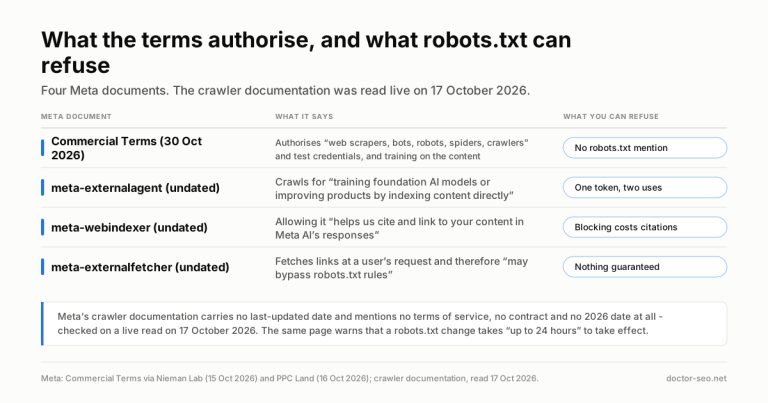
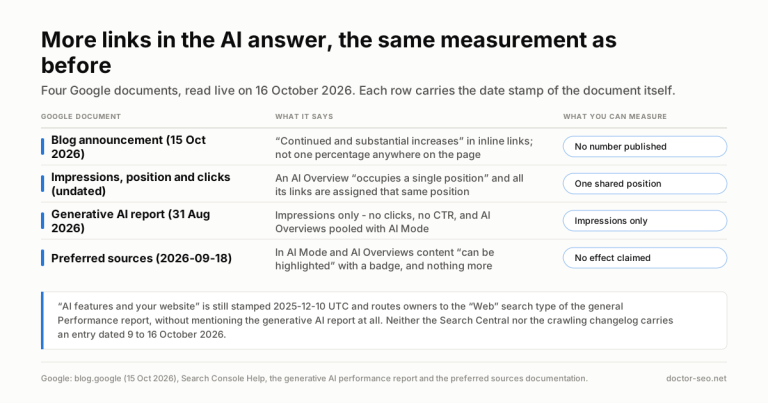
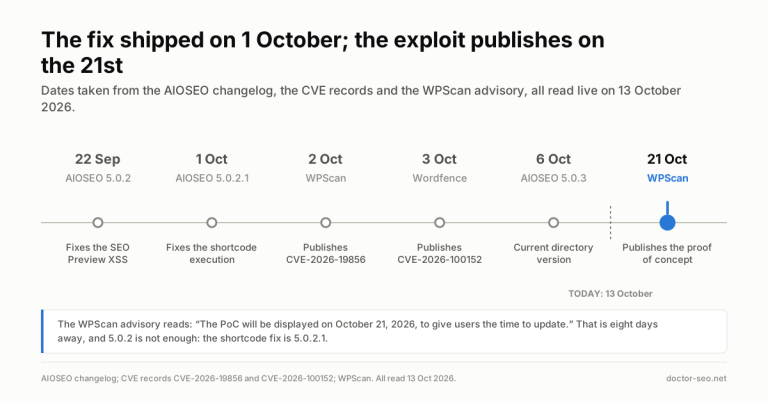
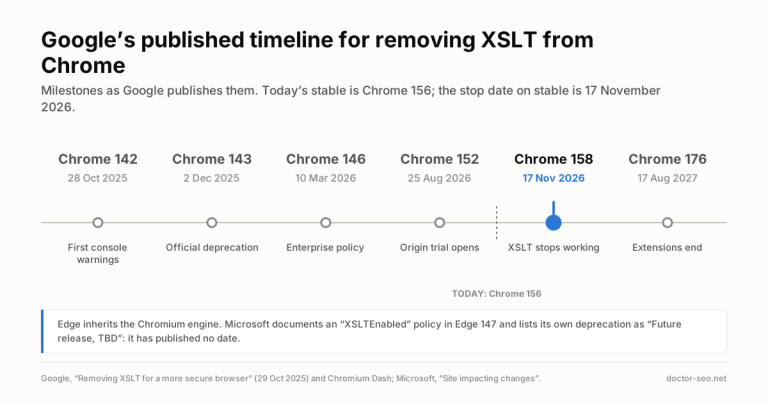
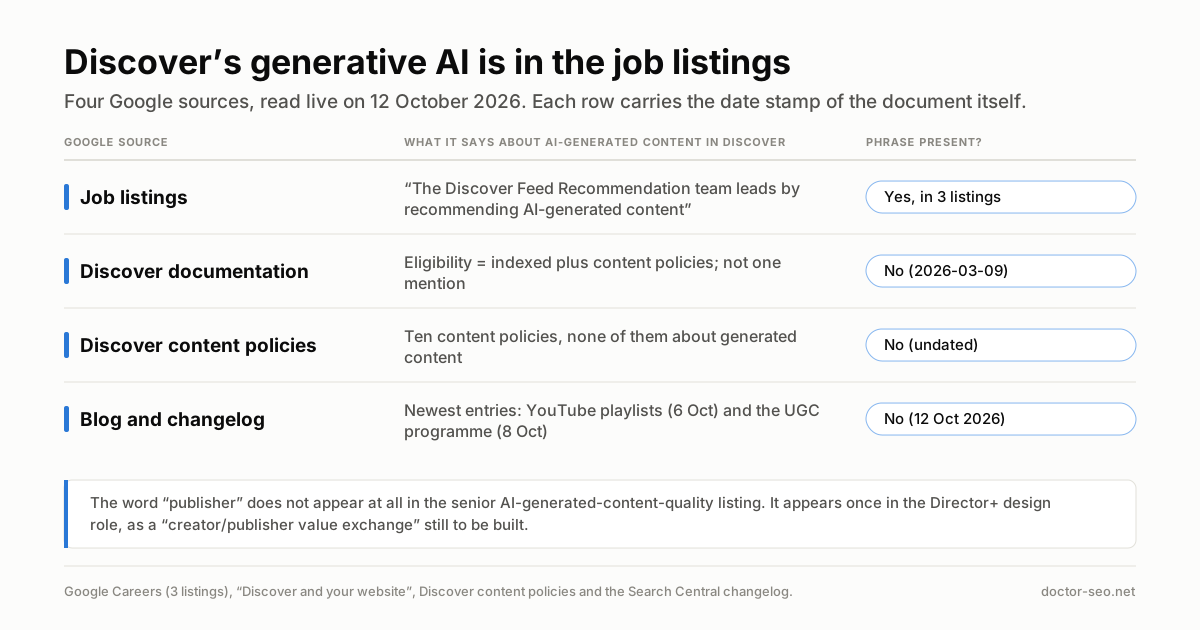
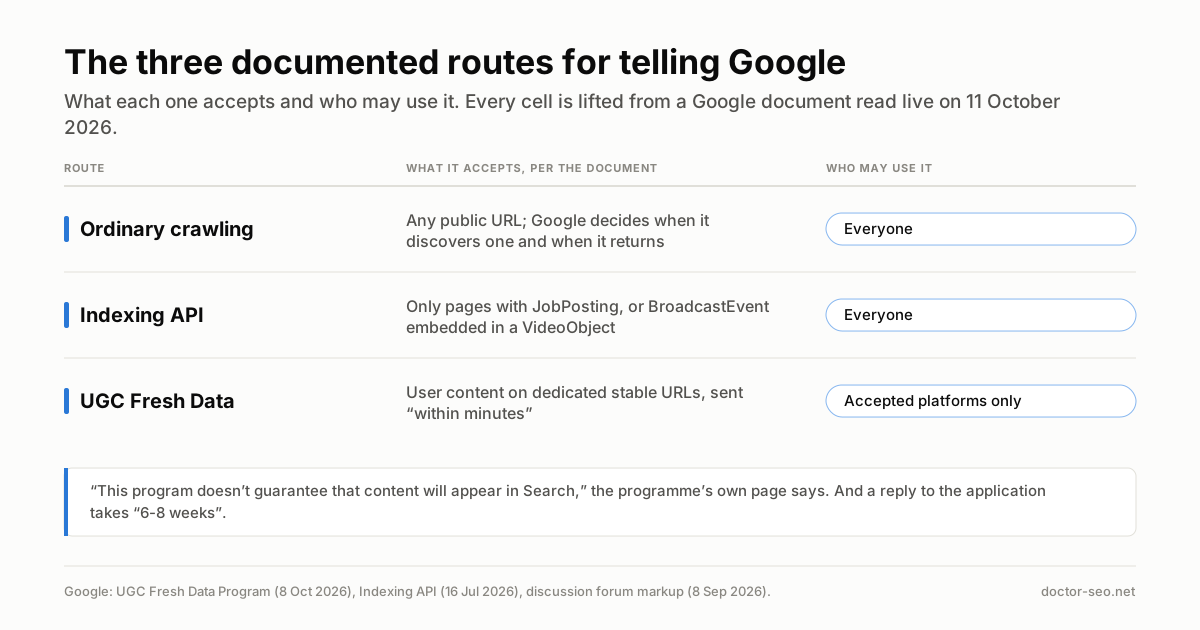
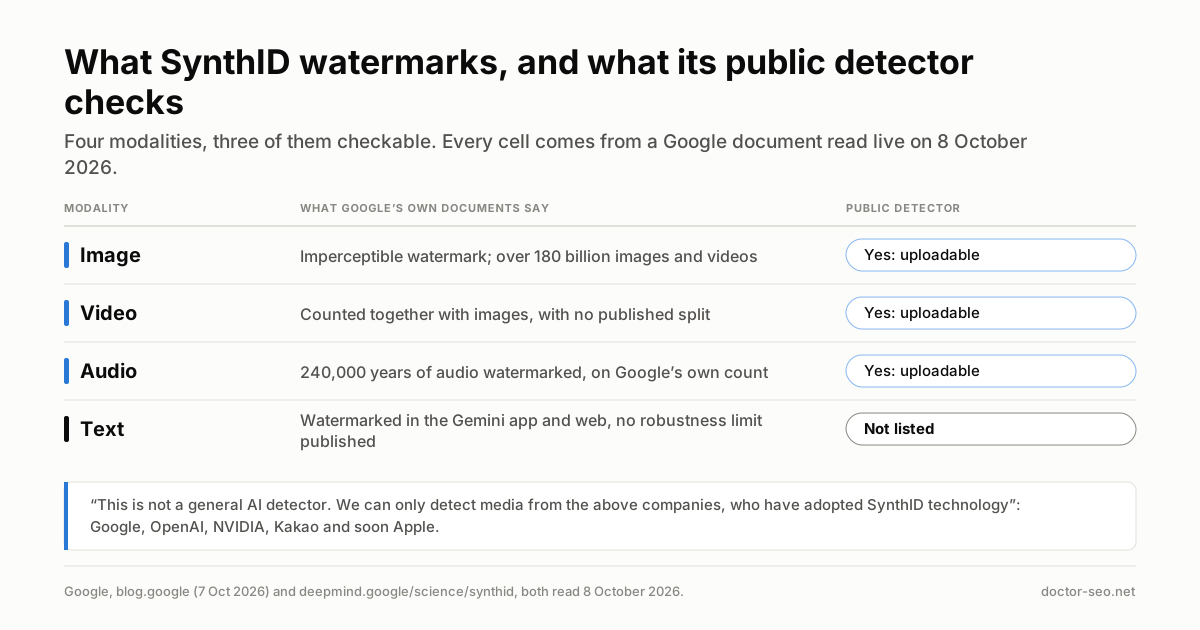
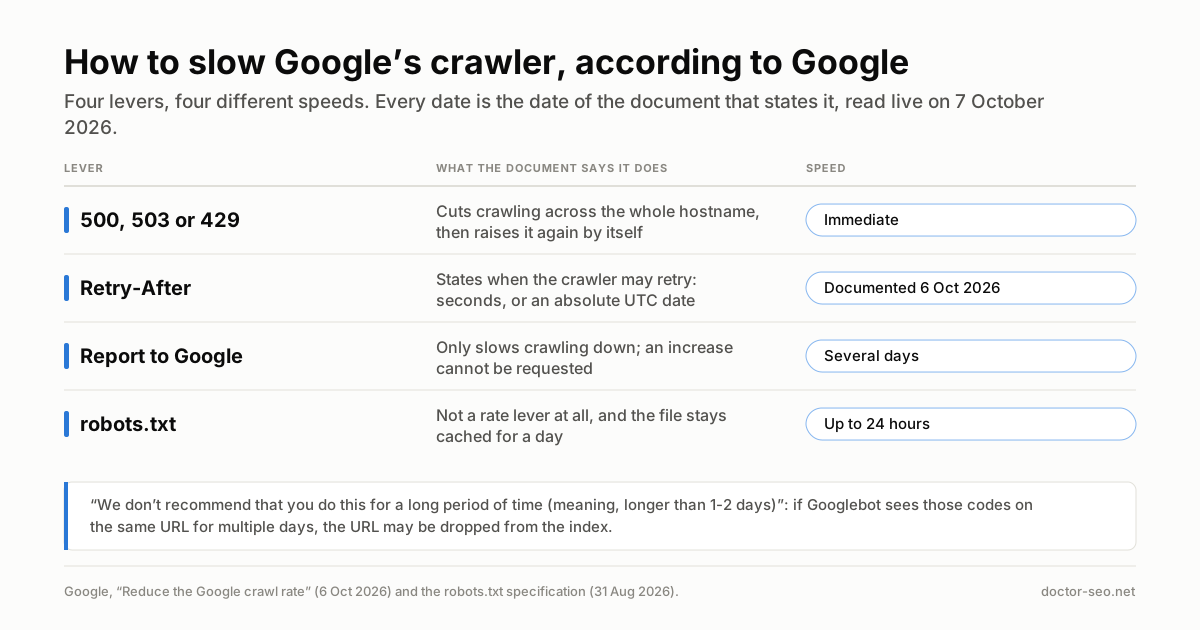
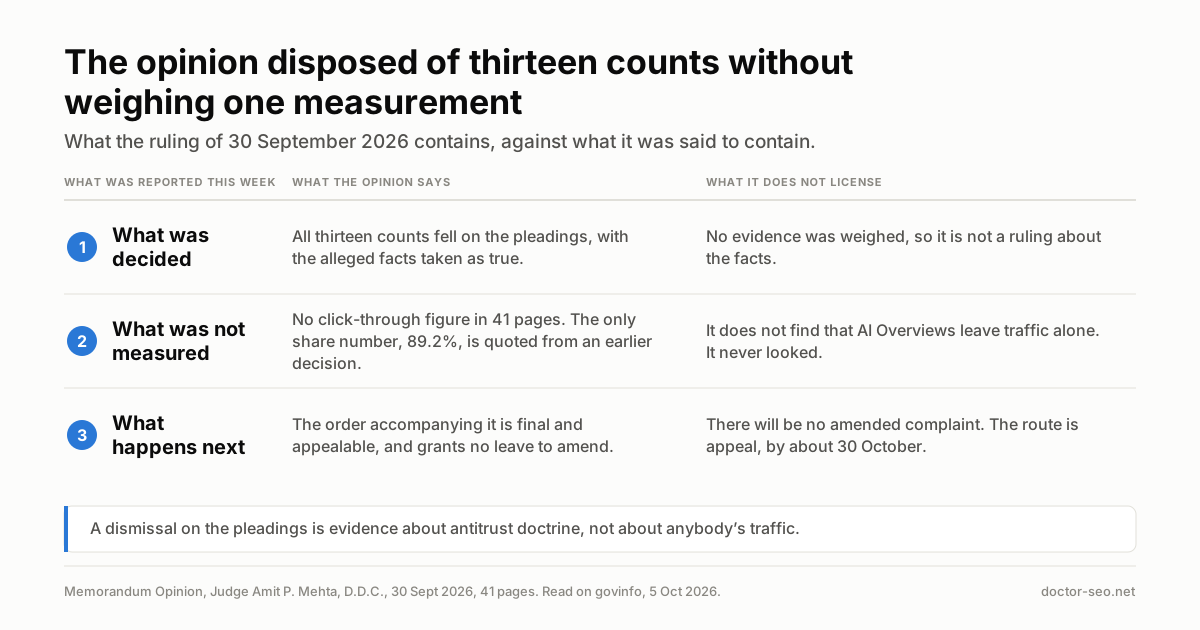
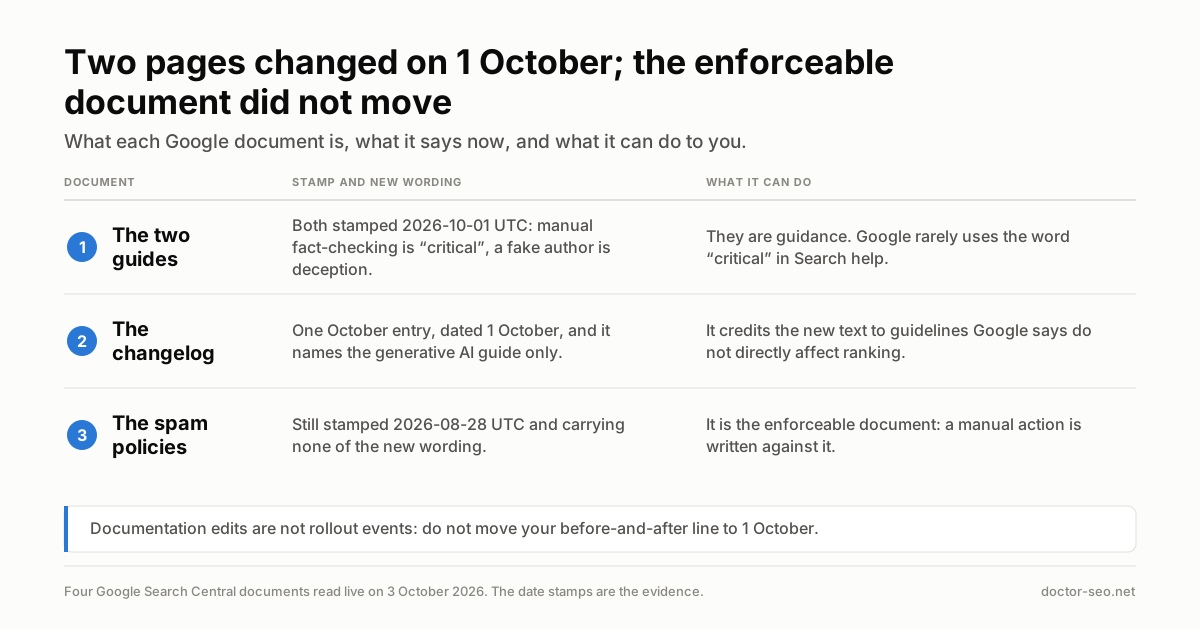
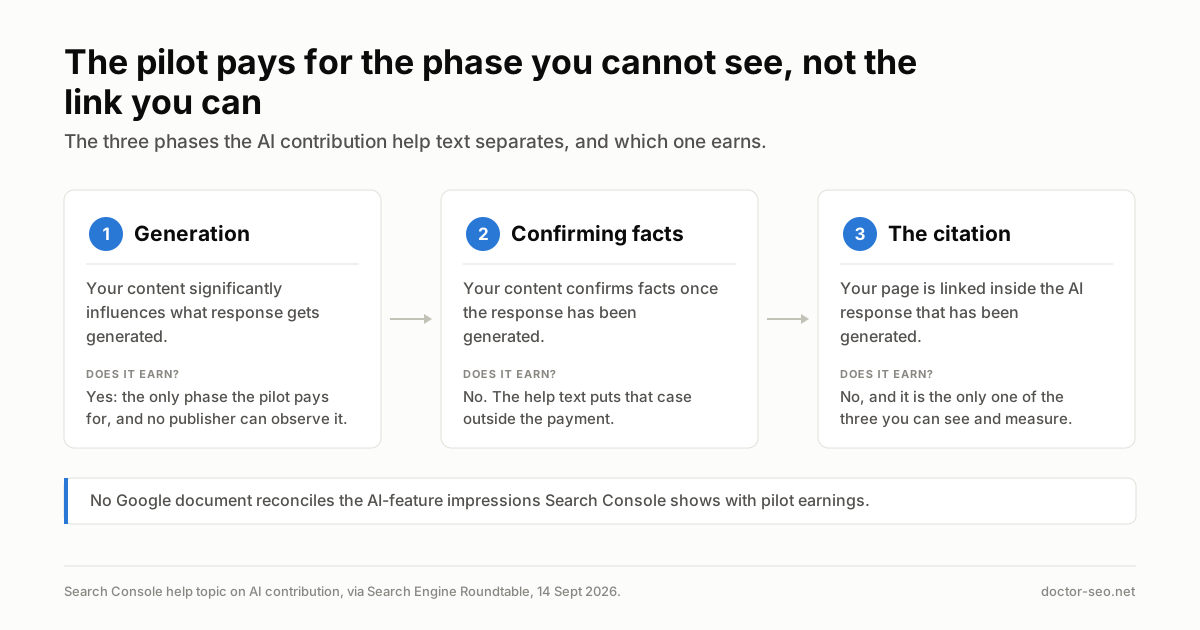
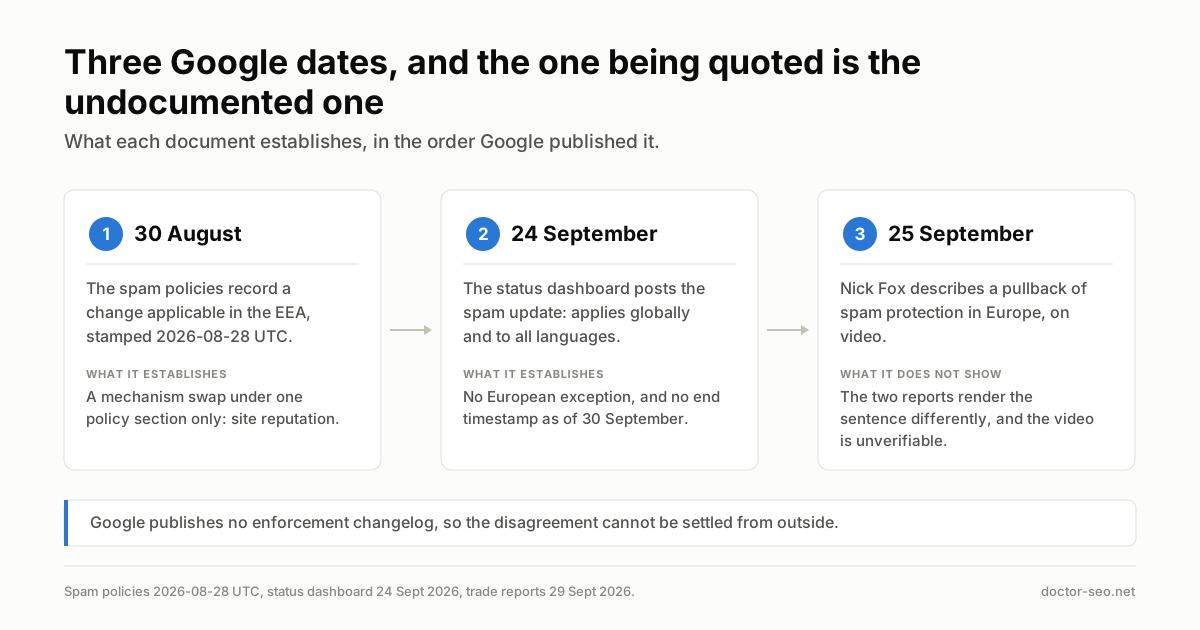
Four-row table: Meta’s Commercial Terms of 30 October 2026 authorise scrapers, bots and crawlers and do not mention robots.txt; meta-externalagent covers training and indexing in a single token; allowing meta-webindexer is what earns citations in Meta AI; and meta-externalfetcher may bypass robots.txt. News Meta Will Crawl Your Site to Train Its AI From 30 October Meta’s revised Commercial Terms take effect on 30 October 2026 and authorise Meta to crawl the websites of any business that uses… 14 min read Four-row table: what each Google document says about AI links and what a publisher can measure. News Google promises more AI links, and publishes no number Google published five changes to links in AI Mode and AI Overviews on 15 October 2026. The post carries no percentage anywhere,… 14 min read Timeline: AIOSEO 5.0.2 on 22 September, 5.0.2.1 on 1 October, the CVE records on 2 and 3 October, 5.0.3 on 6 October and the WPScan proof of concept on 21 October 2026. News All in One SEO 5.0.2.1: the fix is out, the exploit lands on 21 October The fix shipped on 1 October as version 5.0.2.1; WPScan publishes the exploit code on the 21st. What each CVE record says,… 14 min read Timeline of the six Chrome milestones for the XSLT removal, from 142 to 176, with 158 on 17 November 2026 highlighted. News Chrome and Edge are removing XSLT: what breaks and what does not Chrome 158 reaches stable on 17 November 2026 and client-side XSLT stops working. We rendered this site's own sitemap with and without… 14 min read Four-row table. Google’s job listings say the Discover Feed Recommendation team leads by recommending AI-generated content, and the phrase appears in three listings. Google’s Discover documentation, last updated 9 March 2026, defines eligibility as being indexed and meeting Discover’s content policies, and does not mention AI-generated content at all. The Discover content policies page, which carries no last-updated date, names ten content policies and none of them concerns generated content. The Search Central blog and its documentation changelog, read on 12 October 2026, say nothing. News Google is hiring to generate AI content inside Discover Three Google job listings, read live on 12 October 2026, describe a Discover feed team whose work is recommending and quality-controlling AI-generated… 12 min read Three-row table. Ordinary crawling accepts any public URL and Google decides when it discovers one and when it comes back: open to everyone. The Indexing API accepts only pages carrying JobPosting, or BroadcastEvent embedded in a VideoObject, and is also open to everyone. The UGC Fresh Data Program accepts user content on dedicated stable URLs, sent within minutes, but only platforms accepted after an application may use it. News Google documents the UGC Fresh Data Program, and most sites cannot apply Google published documentation for the UGC Fresh Data Program on 8 October 2026, an ingestion pipeline for user-content platforms. What it requires,… 12 min read Four-row table. Image: imperceptible watermark, over 180 billion images and videos watermarked; uploadable to the detector. Video: counted together with images, with no published split; uploadable. Audio: 240,000 years of audio watermarked on Google's own count; uploadable. Text: watermarked in the Gemini app and web experience, with no robustness limit published, and not listed among what the public detector accepts. News Google Opens Its SynthID Detector to Everyone: Image, Video and Audio, Not Text Google opened the SynthID Detector on 7 October 2026. It takes image, video and audio, not text, which is the one modality… 12 min read Four-row table. Returning 500, 503 or 429 cuts crawling across the whole hostname and raises it again by itself: the effect is immediate. The Retry-After header states when the crawler may retry, in seconds or as an absolute UTC date, and was documented on 6 October 2026. Reporting the problem to Google through Search Console can only slow crawling down and takes several days. The robots.txt file is not a rate lever and stays cached for up to 24 hours. News Google documents Retry-After for slowing its crawler: what the page says and what it still does not Google added the Retry-After header to its crawl-rate reduction page on 6 October 2026. It also says that going past 1-2 days… 13 min read Three-row table comparing what was said about the ruling with what it contains. One, what was decided: all thirteen counts fell on the pleadings with the alleged facts taken as true, so no evidence was weighed and it is not a ruling about the facts. Two, what was not measured: there is no click-through figure in 41 pages, and the only share number, 89.2%, is quoted from an earlier decision, so it does not find that AI Overviews leave traffic alone, because it never looked. Three, what happens next: the order accompanying the opinion is final and appealable and grants no leave to amend, so the route is appeal. News A judge dismissed the AI Overviews antitrust suits. What the opinion actually says On 30 September 2026 Judge Amit P. Mehta dismissed all thirteen counts Chegg and Penske Media had brought against Google over AI… 13 min read Table of the three kinds of Google document involved in the change of 1 October 2026. One, the two guides: both stamped 2026-10-01 UTC, they say manual fact-checking is critical and that a fake author is deception, and they are guidance, since Google rarely uses the word critical in Search help. Two, the changelog: one October entry, dated 1 October, naming the generative AI guide only, and it credits the new text to guidelines Google says do not directly affect ranking. Three, the spam policies: still stamped 2026-08-28 UTC and carrying none of the new wording, and that is the enforceable document, the one a manual action is written against. Documentation edits are not rollout events. News Google Now Tells You to Fact-Check Every Line of AI Content Google changed two Search documentation pages on 1 October 2026: fact-check all AI content, and stop inventing authors. What changed, and what… 14 min read Three-phase diagram of what Google's AI contribution pilot pays for, according to its own help text. One, generation: your content significantly influences what response gets generated, and this does earn, although it is the only phase the pilot pays for and no publisher can observe it. Two, confirming facts: your content confirms facts once the response has been generated, and this does not earn. Three, the citation: your page is linked inside the AI response that has been generated, and this does not earn either, although it is the only one of the three you can see and measure. News Google is paying ~100 publishers for AI answers. Nobody can read the rules Google is paying about 100 publishers for content that feeds its AI answers. The rules of the programme live in one document… 15 min read Three-date diagram of what Google has documented about the European spam pullback, in the order it was published. One, 30 August: the spam policies record a change applicable in the European Economic Area, stamped 2026-08-28 UTC, establishing a mechanism swap under one policy section only, site reputation. Two, 24 September: the status dashboard posts the September spam update, which applies globally and to all languages, with no European exception. Three, 25 September: Nick Fox describes a pullback of spam protection in Europe on video, which does not establish a verifiable quotation. News Google Pulled Back Spam Protection in Europe: What’s Documented and What Isn’t Nick Fox says Google pulled back spam protection in Europe. Four Google documents checked on 30 September 2026: only one records it,… 14 min read