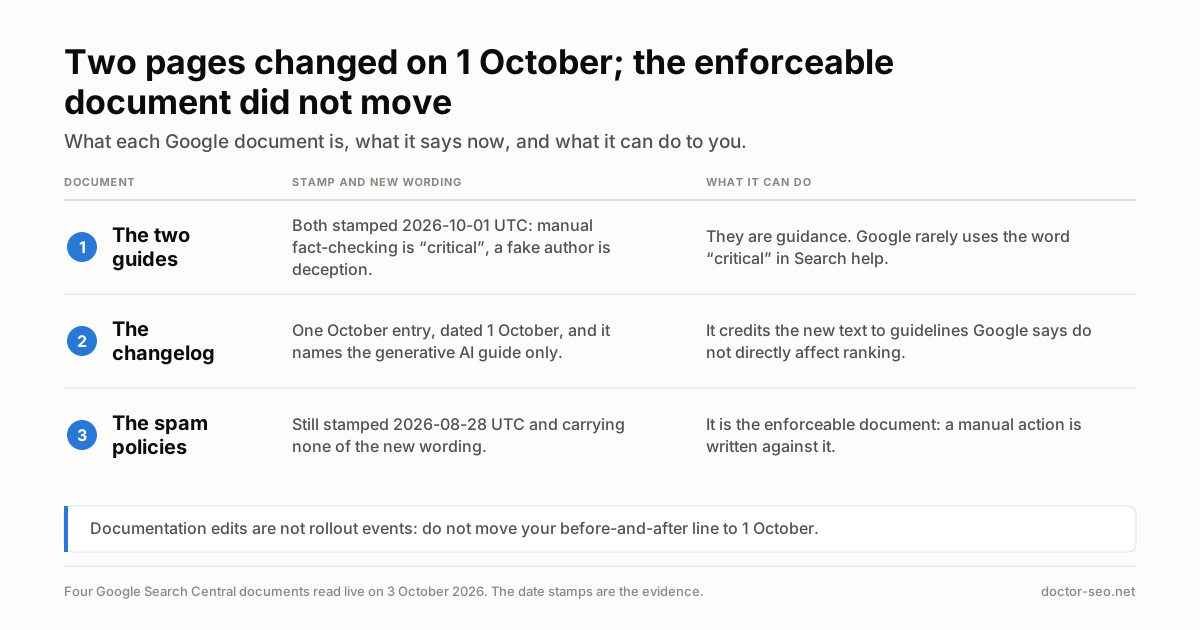
Google changed two Search documentation pages on 1 October 2026. Both now carry the same stamp: Last updated 2026-10-01 UTC. One tells site owners that manually fact-checking AI-generated content before publishing is critical. The other says that inventing an author — an AI-generated headshot, a made-up name, borrowed credentials — is deception and a signal of a low-quality page.
Google’s documentation changelog records one of those two changes. The second appears in it nowhere. And the page that defines what Google actually enforces, the Search spam policies, is still stamped 2026-08-28 UTC and contains none of the new language.
That asymmetry is the story, and every claim below rests on a date stamp any reader can check. All four documents were read live on 3 October 2026, while the September 2026 spam update was still rolling out with no end timestamp on Google’s dashboard.
The four Google documents, with their date stamps
Google’s Search documentation puts a Last updated date at the foot of every page, which makes a documentation change verifiable in a way a conference slide or a social post is not.
| Google document | Last updated, checked 3 Oct 2026 | Carries the new wording? |
|---|---|---|
| Using generative AI content | 2026-10-01 UTC | Yes — the fact-check sentences |
| Creating helpful, reliable, people-first content | 2026-10-01 UTC | Yes — the deceptive-authorship paragraph |
| Documentation updates (the changelog) | One October 2026 entry, dated 1 October | Names the generative AI guide only |
| Google Search spam policies | 2026-08-28 UTC | No |
What the generative AI guidance now says, word for word
Google’s guide Using generative AI content gained three sentences on 1 October 2026. Quoted from the page itself:
Keep in mind that generative models don’t retrieve facts, but predict a likely sequence of words based on their training data. Because of this, generative AI outputs may contain inaccuracies (also known as hallucinations). It is critical to manually factcheck and review all AI-generated content for accuracy and trustworthiness before publishing.
Barry Schwartz at Search Engine Roundtable, who spotted the change on 1 October 2026, observed that Google rarely uses the word critical in Search help documentation, and reported Google’s explanation: the edit was made to get the documentation in sync with the presentations Google uses at its developer events.
A second edit on the same page extends the review requirement past the article body. Search Engine Journal reports the sentence moved from This includes metadata to This review also applies to metadata; PPC Land renders the scope as title elements, meta description elements, structured data and the alternate text attached to images. Search Engine Journal dates the previous version of the page to 10 December 2025 and reports that it carried no instruction to fact-check manually.
What the helpful-content guidance now says about fake authors
The second changed page, Creating helpful, reliable, people-first content, gained a paragraph that names a specific production shortcut. Quoted from the page:
However, avoid using deceptive authorship information. Fabricating creator profiles (such as by using AI-generated headshots, made-up names, or false credentials to make content appear as if it was written by human experts) is a form of deception. Any form of deception makes a page untrustworthy to both users and our automated quality systems, and is a signal of a low-quality page.
Matt G. Southern at Search Engine Journal reported this on 2 October 2026 and dated it by comparison: a copy of the page saved on 8 June 2026 does not contain the paragraph. None of this is a study, so no sample size applies — these are documents, and their dates are the evidence.
What Google’s changelog records, and what it does not
Google maintains a documentation changelog at Search Central. Read twice on 3 October 2026, it carries exactly one entry dated in October 2026, and that entry reads: Updated the using generative AI content guide with information from the Search Quality Raters guidelines.
The deceptive-authorship paragraph is not in that entry. Asked explicitly on both reads, the changelog mentions no creating-helpful-content guide, no deceptive authorship, no fabricated creator profiles and no AI-generated headshots. One of the two 1 October edits is logged; the other is not, though both pages carry the same stamp.
The logged entry also names its own source: the Search Quality Rater Guidelines. That matters, because Google states on its own How Search Works pages that rater ratings do not directly impact ranking, but they do help us benchmark the quality of our results. The new wording is therefore documented as coming from a document Google says does not change rankings by itself.
What the spam policies still say
The Google Search spam policies page is the enforceable document — it is what a manual action or an algorithmic spam system is written against. On 3 October 2026 it was still stamped 2026-08-28 UTC, with scaled content abuse defined as follows:
Scaled content abuse is when many pages are generated for the primary purpose of manipulating search rankings and not helping users.
Its examples include using generative AI tools to generate many pages without adding value for users. Read for the new language, the page mentions manual fact-checking nowhere, deceptive authorship nowhere, fabricated author profiles nowhere and AI-generated headshots nowhere. The guidance changed on 1 October; the policy did not.
Google’s Search Status Dashboard records the September 2026 spam update beginning at 2026-09-24T16:15:00+00:00, noting it applies globally and to all languages and that the rollout may take up to two weeks to complete. Checked on 3 October 2026 it still carried no end timestamp. Two documentation edits landing inside that window is a sequence of dates, not a demonstrated connection.
Where the industry genuinely disagrees
Three questions run underneath this story that the evidence does not settle. This site holds no published position on any of them.
Does a documentation change tell you anything about ranking systems? One camp holds that Google writes its documentation to describe what its systems already reward, so a dated edit is the nearest thing to a release note the industry gets. The other holds that documentation describes guidance, not mechanism — and points at this changelog entry, which traces the new wording to the rater guidelines Google says do not directly impact ranking. Google publishes no mapping from a documentation edit to a serving change, so neither camp can show its case.
Where does scaled content abuse begin? The policy text defines it by purpose, not by volume or production method, and publishes no threshold. One camp reads the new critical sentence as a warning shot about AI production generally; the other reads it as unchanged policy with firmer advice attached. The 1 October edit adds no number, no threshold and no enforcement mechanism, so it does not move this argument.
Is author identity a ranking factor? The paragraph calls fabrication a signal of a low-quality page — stronger than anything in the policy document, weaker than a stated ranking factor. One camp treats author signals as real and measurable; the other treats them as vocabulary for what the systems try to approximate. No published measurement separates the two, and this site presents that disagreement rather than resolving it.
What it changes in practice
The fact-check sentence is hard to audit from outside: nobody can see whether you verified a claim, only whether the claim is wrong. PPC Land’s report of 2 October 2026 makes the same point from the other side — Google published no sampling threshold, no responsible role and no verification record.
The authorship paragraph is the opposite, and it is the part that should change behaviour this week. A fabricated byline is a public artefact: a generated headshot, a name with no footprint anywhere else, a credential nobody can check. Those are visible to a reader, to a competitor filing a spam report, and to a quality rater working from the guidelines this edit was drawn from. Whether or not it moves a ranking, it is now named in Google’s documentation as deception.
The metadata extension is the quietest and the most widely applicable. Titles, meta descriptions, structured data and image alt text generated in bulk by a plugin or a model are the fields nobody rereads after publishing, and they are now explicitly inside the review requirement.
What to do this week
Four checks, in the order that finds the most exposure for the least time.
- Audit every author profile against three questions. Does the person exist outside your site? Is the headshot traceable to them? Is each credential verifiable by a reader? A byline failing all three is the exposure the 1 October paragraph describes. Remove the fabricated identity rather than improving it — publishing under a real name, including the site owner’s, is not a downgrade.
- Sample your machine-generated metadata. Pull twenty URLs at random and read their title element, meta description, structured data and image alt text. Count how many carry a factual claim nobody checked. That count is your exposure under the reworded sentence, and it runs higher than teams expect.
- Write down what verification means on your site, in one paragraph, with a date. Google published no required form, so the standard is yours: which claims get checked, against what, by whom, and where the check is recorded.
- Date your own boundary before you read your analytics. The spam update began 24 September 2026 at 16:15 UTC and had no end timestamp on 3 October. Documentation edits are not rollout events, so do not move your before-and-after line to 1 October because two pages changed that day.
If the sampling step turns up invented figures rather than merely unchecked ones, that is the failure Google’s new sentence describes: a model produces a plausible number instead of retrieving one. Our level on working with AI models on SEO tasks covers where that shows up in practice, and the grey hat, black hat and parasite SEO level covers how Google’s documented policies treat deception once it is on the page. The mechanism is also worth reading alongside how Google actually works.
Txema Hermoso’s opinion
I will defend one claim here, and it is the documentary one: two pages changed on the same day, one is in the changelog and one is not, and the enforceable policy document did not move at all. That is checkable from four date stamps, and it is the part of the story the trade coverage split across separate articles.
My reading of what matters is the authorship paragraph, not the fact-check sentence. A requirement nobody can audit changes less than a prohibition on an artefact anyone can see. If you run a site with invented bylines, the exposure went up on 1 October regardless of what any ranking system does.
What I will not tell you is that this signals a ranking change: Google’s changelog traces the new wording to a guidelines document Google itself says does not directly impact ranking, and no published measurement connects a documentation edit to a serving change. Nor will I tell you where scaled content abuse begins. The policy still defines it by purpose with no threshold, and an edit that adds no number does not let me draw a line Google has declined to draw.
What is still unknown
Why the helpful-content edit is absent from the changelog. It may be an omission, a batching artefact, or a distinction between a logged update and an unlogged clarification. Google published no explanation and the page gives no clue beyond its stamp.
Whether anything changed in serving. No published study isolates the effect of either edit, and none could this week: the spam update running across the same window makes any before-and-after on a live site uncontrolled by construction.
What verification Google expects. No sampling rate, no record-keeping requirement, no named role and no stated consequence for skipping it. Until one of those appears, the critical sentence is an instruction with no test attached.
Sources
- Google, Using generative AI content, Search Central documentation, Last updated 2026-10-01 UTC, read 3 October 2026.
- Google, Creating helpful, reliable, people-first content, Search Central documentation, Last updated 2026-10-01 UTC, read 3 October 2026.
- Google, Search Central documentation updates, entry dated 1 October 2026, read twice on 3 October 2026.
- Google, Google Search spam policies, Last updated 2026-08-28 UTC, read 3 October 2026.
- Google, Search Status Dashboard incident feed: September 2026 spam update, begin 2026-09-24T16:15:00+00:00, no end timestamp as of 3 October 2026.
- Google, How Search Works: rigorous testing, on search quality raters, read 3 October 2026.
- Barry Schwartz, Search Engine Roundtable, 1 October 2026, Google: Manually Factcheck & Review AI-Generated Content For Accuracy.
- Matt G. Southern, Search Engine Journal, 2 October 2026, Google Adds Fake Author Warning To Helpful Content Guidance.
- Search Engine Journal, 2 October 2026, Google Tells Sites To Fact-Check AI Content Before Publishing.
- PPC Land, 2 October 2026, Google tells sites to manually factcheck all AI content before publishing.