Google’s AI Mode can now be told to watch something on the web and report back when it changes, and since Monday 28 September 2026 that capability is being extended from paying subscribers to every Google user globally. The announcement came from Robby Stein, Google’s Vice President of Product for Search, in a post on X.
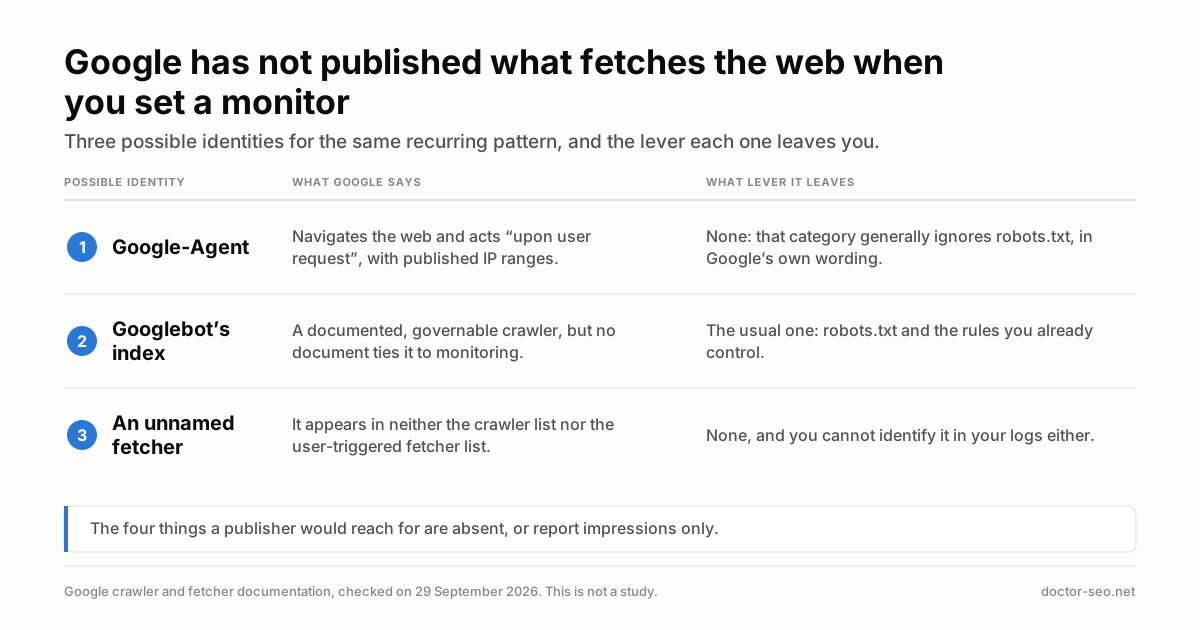
What matters for site owners is what the announcement is not attached to. Checked live on 29 September 2026, Google’s own help page for AI Mode does not mention monitoring anywhere, there is no post about the rollout on blog.google, and Google’s crawler documentation names no fetcher that performs continuous background checking. The closest thing it documents, Google-Agent, is defined as acting “upon user request” and sits in the category of fetchers that “generally ignore robots.txt rules”. A recurring fetch pattern has been pointed at the open web on behalf of a surface Google says passed one billion monthly users, and the four things a publisher would normally reach for — a documented crawler identity, a help-page record, a robots.txt lever and a click metric — are absent or impression-only.
What Google announced, and when
Two dated Google statements exist, four months apart.
The capability was announced on 19 May 2026 by Elizabeth Reid, Vice President of Search, in Google’s I/O round-up on blog.google: “Operating in the background, 24/7, these agents intelligently reason across information to find exactly what you need at exactly the right moment.” On which sources they read, the post is unusually specific: “Your agent will intelligently look across everything on the web, like blogs, news sites and social posts, plus our freshest data, such as real-time info on finance, shopping and sports, to monitor for changes related to your specific question.” That post limited it to a “launch first for Google AI Pro & Ultra subscribers this summer”.
The expansion was announced on 28 September 2026 by Robby Stein on X: “Our Ultra and Pro subs have been using info monitoring capabilities in AI Mode in Search, and now we’re rolling it out to everyone globally.” Stein added: “just tell AI Mode exactly what to look for & Search will continuously check across changing info on the web like sites, forums and social posts”, and said Search will suggest monitoring tasks while you search.
One sourcing caveat: x.com disallows automated fetching in robots.txt, so Stein’s wording is quoted as reported by Barry Schwartz at Search Engine Roundtable on 28 September 2026 and by Search Engine Journal on 29 September 2026, which render the same sentences identically. Neither Google statement is a study — no sample size, measurement or rollout percentage is attached to either.
What Google’s documentation contains — and what it does not
Every document below was fetched on 29 September 2026, its Last updated stamp read from the page.
| Google document | Last updated | Mentions monitoring in AI Mode? |
|---|---|---|
| Get AI-powered responses with AI Mode (Search Help) | No date published | No. Availability, languages and an 18+ Search Labs note only. |
| AI Features and Your Website (Search Central) | 2025-12-10 UTC | No. AI Overviews and AI Mode link behaviour and reporting. |
| Overview of Google crawlers and fetchers | 2026-06-12 UTC | No mention of agents, monitoring or AI Mode. |
| Google special-case crawlers | 2026-09-17 UTC | No. APIs-Google, AdsBot, Google-Safety, Mediapartners-Google. |
| Google user-triggered fetchers | 2026-08-19 UTC | Google-Agent, the only agent fetcher Google names. |
| Generative AI performance report (Search Console Help) | No date published | No. AI Overviews and AI Mode in aggregate. |
Google-Agent is the one entry that touches this story, and its definition is narrower than the feature. Google describes it as “used by agents hosted on Google infrastructure to navigate the web and perform actions upon user request”, using “IP ranges from user-triggered-agents.json”. The page’s framing of the whole category matters as much:
“User-triggered fetchers are initiated by users to perform a fetching function within a Google product. […] Because the fetch was requested by a user, these fetchers generally ignore robots.txt rules.”
Set that beside Google’s description of monitoring as operating “in the background, 24/7” and the classification is unresolved in Google’s own documentation: a standing instruction given once and executed repeatedly for days is neither obviously a user-triggered fetch nor obviously an automated crawl. Google has published nothing saying whether monitoring uses Google-Agent, Googlebot’s existing index, or a fetcher with no public name. Reading logs and robots.txt against an undocumented fetch is the craft taught in the technical SEO level, and pinning an AI bot to a documented user agent before writing a rule is covered in the AI-for-SEO level.
What you can actually measure
Google shipped AI-feature reporting before this rollout, but it has a hard ceiling. The Generative AI performance report in Search Console covers AI Overviews and AI Mode, excludes Search Labs experiments, and reports impressions only — no clicks, no average position. Its help page states the insights reached all websites worldwide as of 31 August 2026 and documents an export button; it names no Search Analytics API access. Separately, AI Features and Your Website (last updated 10 December 2025) states that “sites appearing in AI features (such as AI Overviews and AI Mode) are included in the overall search traffic in Search Console”.
What follows is arithmetic, not opinion. If monitoring-driven appearances count as AI Mode impressions, they inflate your generative-AI impressions with no matching click line, and your click-through rate against the overall total falls for a reason unrelated to your pages. If they do not count, they are invisible. Google has documented neither case, so it is an empirical question about your own property — which is what the analytics and measurement level exists to teach.
What changes in practice
The trigger for a fetch is now decoupled from a search. An AI Mode appearance used to imply somebody typed something; a monitoring task implies somebody typed something once, and Google has been checking ever since. For a page whose value is that it changes — price, stock, schedules, changelogs, job listings — the question stops being “does this rank” and becomes “is this the page Google reads to notice that something changed”.
The answer surface is a notification, not a results page. Google’s May post promises a “synthesized update, with the ability to take action”, and a user who set a monitor is by definition not re-searching, so the visit that would have happened is replaced rather than deferred. Nobody outside Google can size that yet.
The opt-out that exists is blunt and it is not new. The Search generative AI control in Search Console covers AI Overviews, AI Mode and generative AI in Discover, applies at property level, “generally takes a few days”, and carries a sentence worth reading first: “This control only affects whether your content can appear in certain Search generative AI features; this control isn’t used as a ranking or inclusion signal affecting other parts of Search.” Turning it on removes impressions and traffic from all of those surfaces, not from monitoring alone. There is no monitoring-specific switch.
And robots.txt is not the lever here. If monitoring is served by a user-triggered fetcher, Google’s own documentation says that category generally ignores robots.txt, so a Disallow aimed at it is a rule you can write and cannot rely on. That distinction between a crawler you can govern and a fetcher you cannot is the substance of the GEO and AIO level.
What to do this week
- Grep your logs for
Google-Agent. The token is documented, so this is a string match, and the IP ranges are published inuser-triggered-agents.jsonfor verification. Record the count for the week before 28 September and the week after; zero is a finding, not a failed check. - Export the Generative AI performance report today. Impressions only, via the report’s export button. You need a baseline predating any change, and 28 September is the boundary to mark.
- List the pages whose value is that they change. Prices, availability, opening hours, fixture lists, release notes, status pages — Google’s May post named “finance, shopping and sports” as its freshest data.
- Put a machine-readable change signal on those pages. A visible last-updated date, an accurate
dateModified, a changelog entry, correct price and availability. Unproven against monitoring, cheap, and independently useful. - Decide on the generative AI control knowingly, or leave it alone. The cost is every AI Overviews, AI Mode and Discover AI impression and click, it takes a few days, and it will not reduce whatever monitoring does.
Where the industry genuinely disagrees
Four open disagreements run through this story, and this site has no published position on any of them.
How much of a threat zero-click behaviour is. One camp reads a monitoring surface as the clearest case yet of Google answering instead of referring. The other notes that AI referral traffic remains a small fraction of sessions in every published measurement, and that click loss is to Google’s own behaviour rather than to any AI referrer. Neither camp has a measurement of monitoring, because none exists.
Whether sites should block AI fetchers at all. Published robots.txt behaviour shows publishers blocking training bots far more often than answering bots — a revealed preference, not an outcome measurement. Nobody has published a controlled comparison of traffic or revenue between blocking and allowing.
Whether a Google executive’s social post is a primary source for a launch. One view is that a named Vice President stating a rollout is as authoritative as a blog post, and waiting for documentation means reporting nothing. The other is that a launch absent from every help page cannot be dated, scoped or verified later. Both argue from the same absence: Google publishes no changelog for AI Mode features.
Whether a standing background instruction is a “user-triggered” fetch. If yes, robots.txt generally does not apply and site owners have no lever. If no, monitoring is automated crawling arriving under an exemption written for one-off fetches. Google’s two descriptions — “upon user request” and “in the background, 24/7” — point in opposite directions, and no published document reconciles them.
What I think — the author’s opinion
The feature is not the news. Standing alerts on the web are twenty-five years old, and a better Google Alerts inside AI Mode is an obvious product. What is under-reported is that the documentation did not move with the product: a capability that fetches pages repeatedly on a standing instruction went from a paid tier to everyone, and on the day it happened Google’s crawler pages, its AI Mode help page and its publisher-facing AI documentation said nothing about it. That is checkable by you, and it was true this morning.
So my position is narrow: a fetch class a site cannot identify in its logs with certainty, cannot govern with robots.txt and cannot see as clicks is not a channel — it is weather. You do not optimise for weather, you make sure the roof is sound. Accurate change signals on volatile pages, an impressions baseline dated to 28 September 2026 and a log query for Google-Agent are defensible on their own merits and cost almost nothing if monitoring turns out to be small.
Whether this is an emergency I cannot tell you, because the measurement Google publishes gives impressions without clicks and no breakdown by surface — and that is not a gap an opinion can close.
What is still unknown
- Which fetcher serves monitoring:
Google-Agent, Googlebot, or something undocumented. - Whether monitoring-driven appearances are counted as AI Mode impressions in the Generative AI performance report, or excluded from it.
- How often a monitor runs. Google says “continuously” and publishes no interval, rate limit or per-user cap.
- How Search selects which sources to check, and whether a monitoring update links out at all.
- How many users have set a monitor. No adoption figure has been published by anyone, and the one-billion-monthly-users figure for AI Mode overall (blog.google, 3 June 2026, updated 31 August 2026) is a Google claim with no methodology attached.
Sources
- Google Search’s I/O 2026 updates: AI agents and more — Elizabeth Reid, blog.google, 19 May 2026. Primary source for the capability and the “background, 24/7” description.
- Google Rolls Out Monitoring Capabilities In AI Mode To All Users Globally — Barry Schwartz, Search Engine Roundtable, 28 September 2026. Source for the verbatim Robby Stein quotes, which could not be fetched from x.com directly.
- Google Rolls Out AI Mode Info Monitoring To All Users Globally — Search Engine Journal, 29 September 2026. Second independent rendering of the same quotes.
- Google user-triggered fetchers — Google Search Central, last updated 19 August 2026, checked 29 September 2026.
- Google special-case crawlers — Google Search Central, last updated 17 September 2026, checked 29 September 2026.
- Overview of Google crawlers and fetchers — Google Search Central, last updated 12 June 2026, checked 29 September 2026.
- AI Features and Your Website — Google Search Central, last updated 10 December 2025, checked 29 September 2026.
- Generative AI performance report (Search) — Search Console Help, checked 29 September 2026.
- Search generative AI control — Search Console Help, checked 29 September 2026.
- Get AI-powered responses with AI Mode in Google Search — Google Search Help, checked 29 September 2026. Contains no reference to monitoring.
- New opportunities, control and insights for website owners — Mrinalini Loew, blog.google, 3 June 2026, updated 31 August 2026.