On 25 September 2026 the SEO trade press reported that Google had deployed a new AI spam detector called SAFE. Three days earlier, on 24 September at 16:15 UTC, Google had confirmed the September 2026 spam update on its Search Status Dashboard. The two facts arrived close enough together that they are already being told as one story.
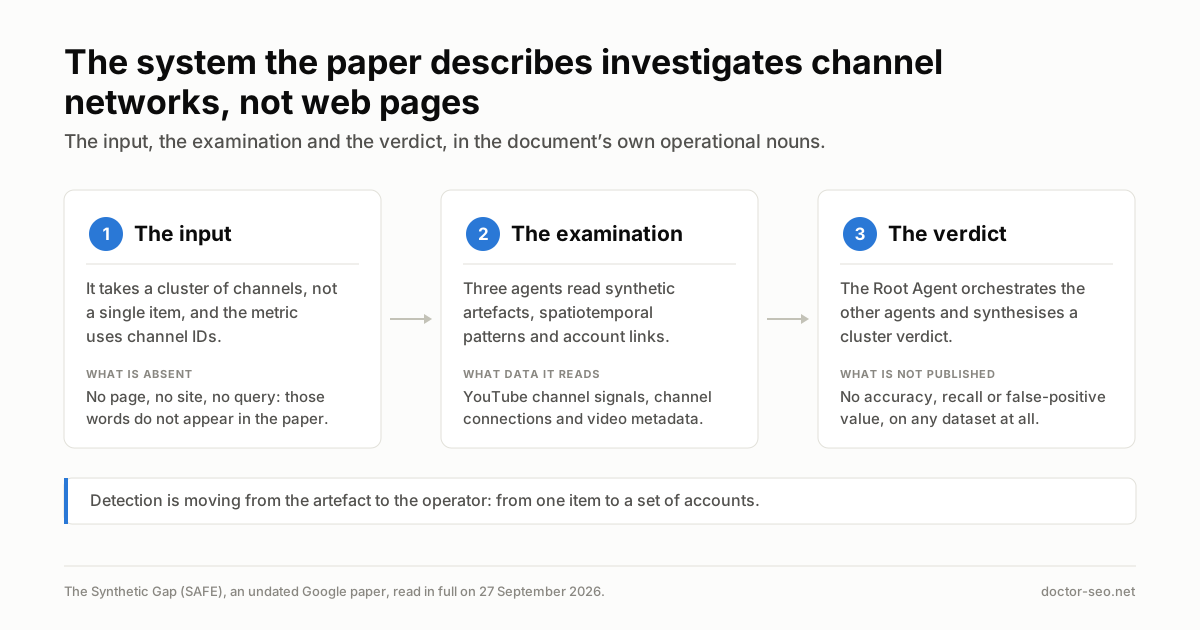
They are not one story. I read the paper itself this morning rather than the coverage of it, and the document describes a forensic system for investigating networks of YouTube channels. The words website, search ranking, SpamBrain and spam update do not appear in it.
The paper is also undated, which matters more than anything else here — and almost nobody has mentioned it.
What the SAFE paper actually says
The primary source is a Google research paper titled The Synthetic Gap: Automating Forensic Investigation of “AI Slop” with the Scaled Abuse Forensics Examiner (SAFE), by Abhinav Mathur, Crystal Zhao, Geethik Narayana Kamineni, Longling Wang, Lucas Liu, Utkarsh Chaudhary and Vahid Jalali, all of Google. SAFE stands for Scaled Abuse Forensics Examiner.
The abstract states the problem in Google’s own words:
Generative AI capabilities have enabled malicious actors to flood online platforms with “AI slop”—mass-produced, low-quality synthetic media designed to overwhelm traditional integrity systems.
The paper names the bottleneck it is trying to close, and the name is the title: the “synthetic gap”—the time between emergence of a new generative attack vector and counter-measure deployment—remains critical
. Its stated reason for automating is capacity, not accuracy: Manual forensic investigations cannot scale to match the velocity of these generative attacks.
SAFE is a multi-agent architecture with four components. It takes, in the paper’s phrasing, a cluster of channels as input.
| Agent | What the paper says it does |
|---|---|
| Root Agent | The central reasoning engine; orchestrates the other agents and synthesises a verdict |
| Content Understanding Agent | Detects synthetic artefacts using LoRA-adapted language models and few-shot learning for policy violations |
| Behavior Understanding Agent | Identifies inorganic spatiotemporal patternsand infrastructure signals such as ASN and device fingerprints |
| Channel Cluster Understanding Agent | Maps inter-account linkages through graph-based relationship analysis |
On deployment the paper offers exactly one sentence: Early deployment results indicate that SAFE significantly accelerates the identification of novel synthetic threats, reducing forensic investigation time.
That sentence is the entire evidentiary basis for every headline saying SAFE has been deployed.
What the SAFE paper does not say
Three absences in the document do more work than anything present in it.
There are no numbers. The evaluation section names the metrics the authors intend to use — accuracy, recall, efficiency — and reports no values for any of them. There is no dataset size, no language or market coverage, no time period, no false-positive rate and no error analysis. By the standard this site applies to a vendor statistic, a claim of acceleration with no measured baseline and no sample is not yet evidence. It is a design document.
The scope markers are video markers. The accuracy metric is defined over a given set of channel IDs. The paper’s own data stores are labelled with YouTube channel signals, channel connections and video metadata. The one concrete precedent the paper cites is that studies have assessed thousands of YouTube channels to find ‘inorganic’ activity used to boost engagement metrics
. Every operational noun in the system — channel, upload timestamp, account linkage — belongs to a video platform’s integrity operation. Luis Rijo reached the same reading at PPC Land on 25 September 2026, and it is the correct one.
Google has not connected SAFE to Search. The Search Status Dashboard entry for the September 2026 spam update names no system and no policy. Its full text is one sentence: Released the September 2026 spam update, which applies globally and to all languages. The rollout may take up to two weeks to complete.
Nothing in that entry mentions SAFE, and nothing in the SAFE paper mentions that update.
The date problem nobody checked
Here is the part that decides the whole question, and I have not seen it raised anywhere.
The SAFE paper carries no publication date. Google Research’s listing for the paper gives the year 2026 and nothing finer — no month, no day, no conference, no venue. The PDF itself carries no date either.
The argument that SAFE powers the September 2026 spam update is built almost entirely on timing. But the only date in that argument is 25 September 2026, and that is the date journalists published, not the date Google wrote, submitted or shipped anything. An undated document cannot anchor a timeline. The paper could have been written in January.
Once the date is removed, the case that SAFE is the engine of this spam update consists of a single hedged sentence about early deployment and the coincidence of a news cycle.
What this changes in practice
For a website owner watching rankings move this weekend, the honest answer is: nothing. The September 2026 spam update is real, it is confirmed, and at the time I checked the dashboard — 27 September 2026, 07:43 UTC — it carried no end timestamp, which puts it on day three of a rollout Google said may take up to two weeks to complete
. That is the event affecting your traffic. SAFE is not documented as part of it.
For anyone publishing video at scale, the paper is more interesting, because it describes the behavioural signals an integrity system looks at when it stops evaluating single items and starts evaluating networks: synchronised upload timestamps, shared ASN and device fingerprints, graph relationships between accounts. That is a coordination model, and coordination is what it is built to catch.
The transferable lesson is about the shape of enforcement rather than this system. Detection is moving from the artefact to the operator — from is this piece of content synthetic
to do these accounts behave like one operation
. Our lesson on grey hat, black hat and parasite SEO covers why footprint, not content quality, is what usually gets a network caught.
What to do this week
- Date your impact from the dashboard, not from the news. Mark 24 September 2026 16:15 UTC as the boundary in your analytics annotations, because that is the only timestamp Google published.
- Do not change anything yet. The rollout has no end timestamp. Reading a partial rollout as a final result is how sites end up reversing work that was fine.
- Check the claim before you repeat it. If a post tells you SAFE is behind the spam update, look for a Google sentence connecting them. There is not one.
- If you run channels as well as sites, audit for accidental coordination footprints: shared hosting or ASN, uploads on a fixed schedule, reused metadata templates across accounts.
- Re-check the dashboard before drawing conclusions, and record the UTC time of your check in the note, so the reading is reproducible later.
Where the industry genuinely disagrees
Two open questions sit under this story, and the evidence available today does not settle either. This site does not hold a position on them.
Whether a Google research paper is evidence about Google’s production systems. One camp treats a Google-authored paper as the best available window into the systems, on the grounds that the people who build them write them, and that Google rarely documents production behaviour anywhere else. The other camp holds that a research publication describes what a team built or proposed, not what runs in production, and that the two have diverged repeatedly. Neither camp can produce what would settle it: Google has never published a mapping from its research output to its deployed systems, so the base rate at which one becomes the other is unknown.
Where scaled content abuse begins. Google’s policy text, last updated 28 August 2026, defines it as many pages generated primarily to manipulate rankings rather than help users. That is a test of purpose, not of volume or production method, and Google has published no threshold. One camp reads this as meaning AI production is irrelevant and only intent and usefulness count. The other holds that volume is a practical proxy the policy declines to name, because purpose cannot be observed from outside. The September 2026 spam update announcement names none of Google’s spam policies, so it adds no evidence either way. Our lesson on using AI models as working tools stays on the documented policy text for that reason.
The author’s opinion — Txema Hermoso
This section is opinion. Everything above it is reporting.
I think this is a sourcing failure more than a Google story, and a useful one to look at closely, because it shows how a claim hardens. An undated PDF with no measurements was found during an active spam update. Search Engine Journal’s report, headlined Google Has Deployed A New AI Spam Detector Called SAFE, is more careful in its body than in that headline: it notes the paper is guarded about its details and that Google gives no explicit confirmation the system is active in search ranking. The headline still states deployment as settled fact, and neither it nor the body mentions that the paper carries no date. Headlines are what travel.
What I would defend: SAFE, as documented, is a video platform’s forensic tooling, and reading it as a Search ranking system is unsupported by its own text. What I will not claim: that SAFE has nothing to do with Search. I cannot show that either, and the paper’s silence is not evidence of absence. The correct position on an undated, unmeasured document is that it does not license a conclusion in either direction.
The broader habit worth keeping is the one in our advanced SEO strategy material: when a claim reaches you through three articles, go and read the thing itself. In this case that took ten minutes and reversed the conclusion.
What is still unknown
When the SAFE paper was written or published. Whether SAFE operates on any surface other than YouTube. Whether it has any relationship to Search at all. What its accuracy, recall or false-positive rate are, on any dataset. Which spam policies the September 2026 spam update enforces, since the announcement names none. And when that rollout will finish — Google said up to two weeks, and as of 27 September 2026 07:43 UTC the dashboard entry has no end timestamp.
Sources
- Abhinav Mathur, Crystal Zhao, Geethik Narayana Kamineni, Longling Wang, Lucas Liu, Utkarsh Chaudhary, Vahid Jalali (Google), The Synthetic Gap: Automating Forensic Investigation of “AI Slop” with the Scaled Abuse Forensics Examiner (SAFE) — PDF, undated; read in full 27 September 2026
- Google Research, publication listing for the SAFE paper — year given as 2026, no month, day or venue; checked 27 September 2026
- Google Search Status Dashboard, September 2026 spam update — begins 2026-09-24T16:15:00+00:00, no end timestamp at the time of checking, 27 September 2026 07:43 UTC
- Luis Rijo, Google’s SAFE uses 4 AI agents to investigate YouTube slop networks, PPC Land, 25 September 2026
- Search Engine Journal, Google Has Deployed A New AI Spam Detector Called SAFE, 25 September 2026
- Google Search Central, spam policies — scaled content abuse definition, policy text last updated 28 August 2026