On 17 September 2026 the public version of the news plaintiffs’ summary-judgment brief was filed in the OpenAI copyright multidistrict litigation in New York. It contains something the search industry has argued about for two years without evidence: a platform’s own measurement of how much traffic an AI answer takes away from the publisher it answers from.
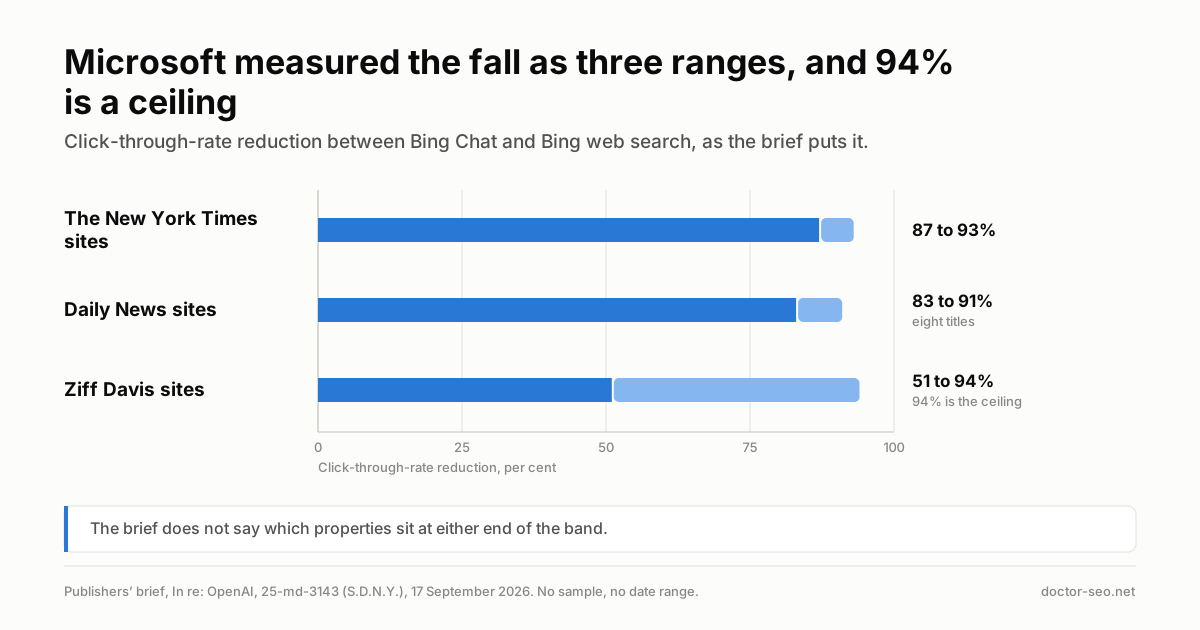
As the brief characterises Microsoft’s internal data, the click-through-rate reduction between Bing Chat and Bing web search was 87 to 93% for The New York Times’s sites, 83 to 91% for the Daily News sites, and 51 to 94% for Ziff Davis sites.
Those are not survey estimates or third-party clickstream panels. On the plaintiffs’ account they are Microsoft’s own numbers, produced in discovery. That is what makes them worth an hour of your week, and why the limits below matter more than usual.
What was filed, and in which case
The document is the public, largely unredacted version of the news plaintiffs’ summary-judgment brief in In re: OpenAI, Inc., Copyright Infringement Litigation, MDL No. 25-md-3143, United States District Court for the Southern District of New York, before Judge Sidney H. Stein. It became public on 17 September 2026.
The news plaintiffs are The New York Times Company, eight Daily News titles, Ziff Davis, the Center for Investigative Reporting and The Intercept; the defendants are OpenAI and Microsoft. Judge Stein has ruled on none of it. A summary-judgment brief is one side’s argument, drawing on documents that side chose from discovery.
Outlets cite different docket entry numbers for the public version, so this article cites the filing by case and date instead.
What the brief says Microsoft measured
The brief compares clicks reaching publisher sites from Bing Chat against clicks reaching them from Bing web search, and describes the underlying figures as Microsoft’s “representative data”.
“Microsoft’s representative data … shows the overall click-through rate reduction between Bing Chat and Bing web search was 87 to 93 percent for The Times’s sites, 83 to 91 percent for the Daily News sites and 51 to 94 percent for Ziff Davis sites.”
| Publisher group | CTR reduction, Bing Chat vs Bing web search | Source of the figure |
|---|---|---|
| The New York Times sites | 87 to 93% | Microsoft internal data, as characterised in the 17 Sep 2026 brief |
| Daily News sites (8 titles) | 83 to 91% | Microsoft internal data, as characterised in the 17 Sep 2026 brief |
| Ziff Davis sites | 51 to 94% | Microsoft internal data, as characterised in the 17 Sep 2026 brief |
Read the Ziff Davis range carefully. A band running from 51 to 94% is not one finding but a spread wide enough to hold two different stories, and the brief does not say which properties sit at either end. The headline number of 94% is the top of that band, not a measured average.
What people inside Microsoft and OpenAI wrote
The brief quotes internal material from both defendants. Brent Hecht, a Director of Applied Science at Microsoft, wrote in a January 2024 internal presentation that the copying involved “an astonishing theft of unprecedented proportions” and “the largest theft of labor in human history”. He described the effect on the web as a “doom loop”.
“It is highly unusual that an end-product threatens the economic foundations of its essential suppliers, but that is the situation we have created.” — Brent Hecht, Microsoft, January 2024 internal presentation, as quoted in the brief
Nick Turley, OpenAI’s Head of ChatGPT, is quoted describing publishers as facing an “existential threat” and the products as “largely substitutive, period”. Satya Nadella, Microsoft’s chief executive, is quoted from a 2026 deposition: “anything that is paywalled should be licensed by anyone who wants to use it…for grounding or training”.
These are employees’ words, selected by opposing counsel to support a motion: evidence of what individuals believed, not a corporate position and not a finding of fact.
What the brief does not contain
Three things are missing from the public version, and each one limits how far the numbers travel.
First, no sample size, no date range and no definition of a click. “Representative data” is the brief’s phrase, not a methodology: we do not know how many sessions were compared, over what period, or whether a click means a visit, a session or a pageview.
Second, the exhibits behind the quotations are largely unavailable, so the quoted material has to be treated as evidence selected and characterised by the plaintiffs.
Third, the brief carries a ChatGPT usage figure, 87.78% of users visiting no external website during a search, whose underlying study, sample and date could not be identified from the public version or from a live search on 21 September 2026. It appears here only as an example of a number not yet safe to repeat.
Separately, the brief alleges 3,924,653 copies of 944,655 unique Times works and 7,387,394 copies of 1,388,384 unique Daily News works. Those are counts of alleged copies, not traffic measurements.
What the community measured, separately from this filing
The filing is about Bing and Copilot. Google has a different interface and roughly an order of magnitude more search volume, so the brief’s numbers do not transfer to Google AI Overviews by arithmetic. The independent measurements that do concern Google point the same way at smaller magnitudes.
Similarweb clickstream data found that 68.01% of United States Google searches ended without a click between January and April 2026, up from 60.45% in 2024. Pew Research Center’s March 2025 browsing panel, 900 United States adults and 68,879 searches, found users clicked a result on 8% of searches that returned an AI Overview against 15% of searches that did not. Semrush data covering January to July 2026 put AI referral traffic at roughly 0.5% of sessions.
The SEO industry does not agree on what that combination means. One camp reads the Bing figures as confirmation that AI answers are an extinction-level event for referral traffic, with Google simply earlier on the same curve. The other points out that the measured click loss on Google is overwhelmingly Google keeping the user on Google, not AI referrers replacing search, and that a 0.5% referral share does not justify rebuilding a content strategy around chat platforms.
Both readings are consistent with the evidence now public. What the data cannot settle is the causal question: whether an AI answer destroys a click that would otherwise have happened, or absorbs a click that was already low-intent. Nobody has run the experiment that would separate those, and a litigation brief does not run it either. If you want the underlying model of how retrieval and citation actually work across these surfaces, that is the subject of the GEO and AI search level of the course.
Txema’s take
My view, separated from the reporting above: what matters about these numbers is not their size, it is their provenance. For two years every figure in this argument came from a vendor with a product to sell or a panel nobody could inspect. This is the first time the operator of the answer engine has been shown measuring substitution on named publishers, in a document it did not write for publication.
What I would not do is let it settle an argument it cannot settle. A brief written to win a motion is not a study, and Bing Chat is not Google AI Overviews. The useful response is not to pick a side in the zero-click fight, it is to stop reporting traffic in a way that cannot tell substitution apart from a ranking loss. Most reporting I see still cannot.
What this changes in practice
It changes your measurement before your tactics. If AI answers remove clicks from queries where you still rank, that shows up as impressions flat or rising while click-through rate falls. It looks nothing like a ranking problem, yet most monthly reports present the two identically.
It also changes the internal conversation. Until this week, arguing that AI answers suppress clicks meant citing a vendor. Now it means citing a court filing containing a named company’s own data.
The audit to run this week
This diagnostic separates substitution from ranking loss using data you already have, in about ninety minutes for a mid-sized site.
- In Google Search Console, compare the last 28 days against the same 28 days a year earlier. Export queries with clicks, impressions, CTR and average position.
- Split the queries in two: informational queries answerable in one or two sentences, and transactional or navigational queries that are not.
- For each group compute the relative CTR change: (CTR now − CTR a year ago) divided by CTR a year ago.
- Discard any query whose average position moved more than one place: it is telling you about ranking, not about answers.
- Read the result against the thresholds below.
- Cross-check against the generative AI performance reports Google added to Search Console on 3 June 2026.
- Pull server logs for GPTBot, OAI-SearchBot, ClaudeBot and PerplexityBot and compare request volume against referral sessions from those platforms. A wide gap means you are read but not sent traffic.
| Impressions | CTR | Position | Most likely cause |
|---|---|---|---|
| Flat or up | Down more than 20% | Stable | Substitution: the answer is being given above you |
| Down | Flat | Down | Ranking or coverage loss, not AI |
| Down | Down | Stable | Demand loss or seasonality |
| Up | Down under 10% | Up | Normal: you are ranking for broader terms |
If the first row describes your informational content, the fix is a measurement and content question rather than a technical one. The SEO analytics level covers how to build that segmentation so it survives a year of comparisons, and the definition of SEO used throughout this course explains why traffic was always a proxy rather than the goal.
What is still unknown
Four things, none of them small. Whether Microsoft’s figures survive the defendants’ own experts, since OpenAI and Microsoft have moved for summary judgment in the same case. What period and sample those figures cover. Whether the pattern holds on Google, where interface, volume and link treatment all differ. And whether Judge Stein treats substitution as relevant to fair use at all, which is a legal question rather than an SEO one.
This site will not be writing that 94% is what AI search does to publishers. It is the top of one range, for one set of properties, on one platform, in a document written to persuade a judge.
Frequently asked questions
Does the 94% figure apply to Google AI Overviews?
No. The figures in the 17 September 2026 brief compare Bing Chat with Bing web search, and no equivalent internal Google measurement is public. The closest independent Google evidence is Pew Research Center’s March 2025 panel of 900 United States adults and 68,879 searches: an 8% click rate on searches with an AI Overview against 15% without.
Is this a court ruling?
No. It is a summary-judgment brief filed by the news plaintiffs on 17 September 2026 in MDL 25-md-3143 before Judge Sidney H. Stein. He has not ruled on it, and OpenAI and Microsoft have filed their own motions in the same case.
Can I use these numbers in a client report?
Yes, if you cite them accurately: Microsoft internal data as characterised by opposing counsel, Bing Chat versus Bing web search, no disclosed sample or date range, no judicial finding. Presenting 94% as the effect of AI search on publisher traffic would be wrong on four counts at once.
Sources
- News plaintiffs’ summary-judgment brief, public version, In re: OpenAI, Inc., MDL No. 25-md-3143, S.D.N.Y., 17 September 2026.
- TechCrunch, 17 September 2026, on the unredacted filings.
- PPC Land, 20 September 2026, on the click-through-rate ranges.
- Similarweb clickstream data, January to April 2026, on US zero-click searches.
- Pew Research Center browsing panel, March 2025, 900 United States adults, 68,879 searches.
- Semrush AI referral traffic data, January to July 2026.
- Google Search Central, 3 June 2026, on generative AI performance reports in Search Console.
- Google Search Status Dashboard,
incidents.json, checked 21 September 2026, 07:39 UTC: no confirmed ranking update in progress.