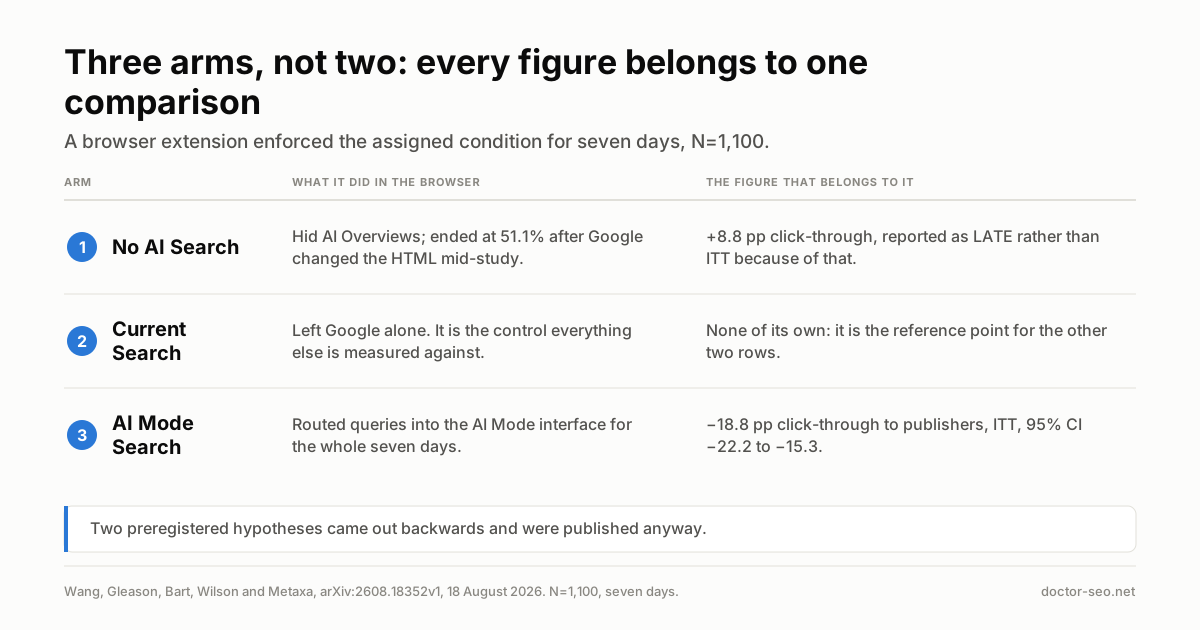
A preregistered field experiment run by researchers at the University of Pennsylvania and Northeastern University assigned 1,100 Google users to three randomly allocated versions of search for seven days. Assignment to an AI Mode-only experience cut the share of visits producing a click to a publisher by 18.8 percentage points.
The size of that number matters less than how it was produced. Almost every figure in the zero-click argument so far has been observational. This one is a randomised comparison with a preregistration, published confidence intervals, and an implementation failure the authors declare themselves.
The paper also reports findings nobody in the AI search market is selling. Users assigned to AI Mode searched less, trusted what they found less, and were significantly more likely to try a competing search engine.
The preprint went up on arXiv on 18 August 2026 and reached the search trade press on 21 September 2026.
What the paper is, and where to read it
The paper is AI in Search Reduces Publisher Referrals Without Improving User Experience: Experimental Evidence (arXiv:2608.18352v1), by Stephanie T. Wang, Jeffrey Gleason, Yakov Bart, Christo Wilson and Danaé Metaxa of the University of Pennsylvania and Northeastern University, submitted 18 August 2026. Its abstract states the design and the claim in one passage:
We conduct a preregistered field experiment (N=1,100) on Google Search, the dominant online search platform, to estimate the causal effects of AI Overviews and AI Mode on user behavior, perceptions, and publisher traffic. We show that removing AI Overviews and AI Mode increases click-through rates to publishers, while an AI Mode-only experience reduces click-through rates and erodes user experience and trust in information found on Google.
Participants were recruited between 17 and 19 March 2026. Of 1,444 enrolled (1,387 via the Prolific research panel, 57 via a Northeastern work-study programme), 1,100 searched during the experiment and 956 completed the exit survey: 343 in No AI Search, 304 in the Current Search control, 309 in AI Mode Search. A browser extension enforced the assigned condition for seven days.
The three arms are the part most coverage skipped. No AI Search hid AI Overviews; Current Search left Google alone and is the control; AI Mode Search routed queries into AI Mode. Every number below belongs to one comparison, and a figure quoted without its arm is meaningless.
The numbers, with their comparisons attached
The paper’s outcomes as reported, with 95% confidence intervals. ITT is intention to treat; LATE is the local average treatment effect, used for the No AI arm because its implementation degraded mid-study.
| Outcome | Comparison | Effect | 95% CI | p |
|---|---|---|---|---|
| Click-through rate to publishers | AI Mode vs Current (ITT) | −18.8 pp | −22.2 to −15.3 | <0.001 |
| Click-through rate to publishers | No AI vs Current (LATE) | +8.8 pp | +2.3 to +15.3 | 0.008 |
| Search sessions per day | AI Mode vs Current (ITT) | −0.92 | −1.30 to −0.55 | <0.001 |
| Trust in information found (7-point scale) | AI Mode vs Current (ITT) | −0.34 | −0.47 to −0.20 | <0.001 |
| Used a competitor engine (Bing, DuckDuckGo, Yahoo) | AI Mode vs Current (ITT) | +11.2 pp | +6.4 to +16.0 | <0.001 |
| Satisfaction (standardised) | AI Mode vs Current (ITT) | −0.73 SD | −0.88 to −0.59 | <0.001 |
Two results contradict the study’s own preregistered hypotheses: the authors expected AI Mode to raise searches per day and perceived personalisation, and both fell (−0.92 sessions, −0.42 SD). Preregistration is what makes a failed hypothesis visible instead of quietly dropped.
Which destinations lost the clicks
The losses under AI Mode were not spread evenly. The paper reports click reductions by destination, all against the Current Search control: Reddit −21.2 pp (95% CI −27.5 to −14.8), news sites −12.5 pp (−18.7 to −6.3), Wikipedia −9.9 pp (−14.7 to −5.0), all at p<0.001. Clicks on ads fell 42.7 pp, because AI Mode did not surface ads during the study period.
What Google has said, and what it has not
Google has published no response to this paper. A check of the Search Central blog feed and blog.google on 22 September 2026 found no statement referencing it, and no trade coverage carries a Google comment.
Google’s standing public position on AI search and clicks is a post by Liz Reid, VP and Head of Google Search, on 6 August 2025:
Overall, total organic click volume from Google Search to websites has been relatively stable year-over-year. […] Average click quality has increased and we’re actually sending slightly more quality clicks to websites than a year ago.
These are not the same measurement and do not directly contradict each other. Google describes aggregate click volume across all of Search over a year; the experiment describes per-user click-through rate inside a randomly assigned condition over seven days. An aggregate can hold steady while the rate for a given user on a given surface falls, if the query mix and the population shift underneath it. Reconciling them needs Google’s own logs segmented by arm.
What the community has measured separately
Pew Research Center ran a browsing panel of 900 US adults covering 68,879 Google searches in March 2025, published 22 July 2025: “Users who encountered an AI summary clicked on a traditional search result link in 8% of all visits. Those who did not encounter an AI summary clicked on a search result nearly twice as often (15% of visits).” Of the 12,593 searches producing an AI summary, 1% of visits produced a click inside the summary.
Similarweb clickstream data for January to April 2026 put 68.01% of US Google searches ending without any click, against 60.45% in 2024. Similarweb publishes no panel size for that series.
Microsoft’s internal click-through-rate figures were unsealed on 17 September 2026 in the news plaintiffs’ summary-judgment brief in MDL 25-md-3143 (S.D.N.Y.). They measure Bing Chat against Bing web search, not Google, and the public version discloses no sample size, no date range and no definition of a click.
What the authors say their experiment cannot show
- The No AI arm broke mid-study. On day one the extension hid about 90% of AI Overviews; by the end it hid none. Overall 51.1% were hidden. The authors state the cause plainly: “A change to AI Overview HTML rolled out by Google during the study period broke our extension’s logic.” That is why the +8.8 pp result is a LATE rather than an intention-to-treat effect.
- The sample is not the US population. The authors describe it as skewing “younger, more highly educated, and more left-leaning than the general US population”.
- Seven days is seven days. The design detects short-term behavioural and attitudinal shifts, “but not longer-run adaptation”.
- The AI Mode arm is forced adoption. Baseline AI Mode usage before the intervention was 0.6% of searches. The experiment moved users from roughly zero to near-total exposure in one step, measuring full adoption rather than the gradual opt-in uptake happening in the market.
The qualitative responses complicate the headline: 33.6% of comments on AI Mode were coded negative (n=103), 29.3% positive (n=90), 13.7% mixed (n=42). This was not a population that uniformly hated it.
Where the industry genuinely disagrees
Three questions are contested, and this site has not ruled on any of them. What follows is the disagreement, not a verdict.
Does a forced-adoption result transfer to gradual adoption? One camp argues the mechanism is indifferent to how the user arrived: an answer above the links suppresses clicks whether you chose it or were routed into it, so the direction holds and only the magnitude is uncertain. The other argues that a jump from 0.6% to near-total exposure is a dose no real population will receive soon, and that the trust and satisfaction penalties are what you would expect from an interface imposed on people who did not ask for it. Nobody has published a dose-response measurement.
How alarmist should the profession be about zero-click? One camp reads 68.01% no-click plus a causal −18.8 pp as an existential trend for referral-dependent publishing. The other points to Google’s stated year-over-year stability in total click volume and argues the loss is distributional, not aggregate. No public dataset reconciles the two.
Do platform-internal figures from one engine describe another? The Microsoft ranges unsealed on 17 September 2026 are by some distance the largest numbers available to quote, and they are Bing numbers. One camp treats any platform-internal substitution measurement as the best read on where Google is heading; the other treats the read-across as untested, since interface, link treatment and query mix all differ. No paired measurement exists, and doctor-seo.net has not settled it.
What to do this week
- Segment your own click-through rate by query class first. Export 16 months of Search Console query data, split informational head terms from branded and transactional terms, and compare clicks, impressions and average position year over year within each class.
- Apply this threshold. If click-through rate on informational queries at average positions 1 to 3 has fallen more than about 3 percentage points year over year while average position held steady, you are seeing the pattern this experiment produces. If position moved too, you have a ranking problem instead.
- Weight by destination type, not by the headline. If your traffic profile resembles a news site, −12.5 pp is a closer analogue than the aggregate.
- Check your competitor-engine trend. AI Mode raised the share of users touching Bing, DuckDuckGo or Yahoo by 11.2 pp in one week. Look at your Bing Webmaster Tools impression trend.
- Write the arm down whenever you cite this. “AI Mode cuts clicks 18.8 points” is not a claim. “Assignment to AI Mode reduced click-through rate 18.8 pp against a current-Google control, ITT, 95% CI −22.2 to −15.3, seven days, N=1,100” is.
For the mechanics rather than the news, the GEO and AIO level of the course covers how AI search surfaces select and cite sources, and the SEO analytics and measurement level covers the segmented Search Console reporting step one needs. Start with the definition of SEO in 2026 if this is new ground.
The author’s opinion
This section is opinion, separated from the reporting above.
What is remarkable here is not the 18.8 points. It is that a study about AI search arrived with a preregistration, confidence intervals on every estimate, hypotheses the results contradicted and which were reported anyway, and a paragraph from the authors explaining how their own instrument broke halfway through. That combination is rare enough in this field that the evidentiary standard is the story.
My practical position is narrow on purpose: weight this above any vendor chart, below your own server logs, and do not convert it into a traffic forecast. I will not tell you how much of a forced seven-day result transfers to a market where AI Mode was 0.6% of searches at baseline. Nobody knows, and this site’s position on that question is deliberately open.
The thing worth changing in most teams is citation discipline: a year of this debate has run on headline numbers stripped of their comparison, sample and date.
What is still unknown
- The dose-response curve between 0.6% AI Mode usage and full adoption. Untested.
- Whether the click, trust and satisfaction effects persist past seven days.
- Whether the results replicate outside a Prolific-recruited US sample.
- What the ad figure becomes once AI Mode carries advertising; −42.7 pp measured an unmonetised surface.
- Whether Google’s own segmented data agrees. Only Google can answer that, and it has not.
Sources
- Stephanie T. Wang, Jeffrey Gleason, Yakov Bart, Christo Wilson, Danaé Metaxa, AI in Search Reduces Publisher Referrals Without Improving User Experience: Experimental Evidence, arXiv:2608.18352v1, 18 August 2026.
- Roger Montti, Research Shows Google AI Mode Sends Less Clicks & Is A Poor User Experience, Search Engine Journal, 21 September 2026.
- Liz Reid, AI in Search is driving more queries and higher quality clicks, Google, 6 August 2025.
- Pew Research Center, Google users are less likely to click on links when an AI summary appears in the results, 22 July 2025. Browsing panel of 900 US adults, 68,879 searches, March 2025.
- Similarweb clickstream, zero-click share of US Google searches, January to April 2026. No panel size published.
- Google Search Status Dashboard, incidents.json, checked 22 September 2026: no confirmed Google ranking update in progress. The most recent confirmed incident is the August 2026 spam update, 18 to 21 August 2026.
- News plaintiffs’ summary-judgment brief, MDL 25-md-3143 (S.D.N.Y.), unsealed 17 September 2026.