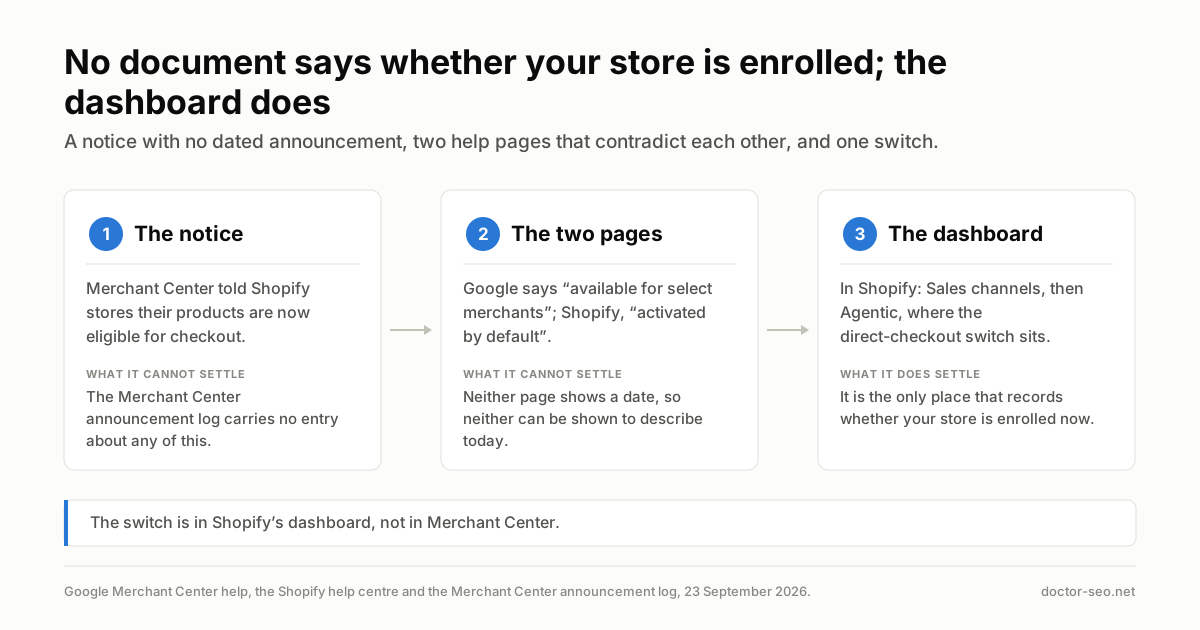
Shopify stores in the United States began receiving a Google Merchant Center notification on 22 September 2026 telling them their products were already selling inside Google’s AI surfaces. Barry Schwartz published the message at Search Engine Roundtable the same day, from screenshots posted by the merchants Menachem Ani and Nic McDonough: “Your products are now eligible for native checkout. Your Shopify store was matched to your Merchant Center, enabling native checkout on Google AI Mode and Gemini.”
The operative sentence is the next one: “Eligible products are automatically included. There’s nothing for you to set up.”
That is a default-on change to where the transaction happens. A shopper who finds your product inside AI Mode or the Gemini app can pay for it there with Google Pay, without loading your store. It is not an algorithm update: a read of Google’s Search Status Dashboard incidents.json at 07:40 UTC on 23 September 2026 showed no incident recorded for September 2026 at all, the most recent entry being the August 2026 spam update that closed on 21 August 2026.
Underneath the notification sits a second story most of this week’s coverage skipped. Google’s help documentation and Shopify’s help documentation describe this feature in incompatible terms. One says invitation-only. The other says on by default.
What Google’s own documentation says
Google’s Merchant Center help page on the Universal Commerce Protocol describes UCP-powered checkout as restricted and opt-in. It states that “the checkout feature enabled by UCP is available for select merchants at this time” and directs interested merchants to meet a set of requirements and then fill out an interest form. It limits the feature to “products with eligibility in the United States, Canada, and Australia”, places the entry point as a “checkout button on eligible product listings in AI Mode in Google Search and on Gemini”, and says customers “can checkout quickly with Google Pay”. The page carries no publication or last-updated date, and describes no opt-out.
The protocol underneath it is properly documented and dated. On 11 January 2026, Amit Handa and Ashish Gupta published “Under the Hood: Universal Commerce Protocol (UCP)” on the Google Developers Blog. It describes an open standard in which businesses “publish the services they support and corresponding capabilities in a standard JSON manifest located at /.well-known/ucp”, and it is explicit about ownership: “With UCP, you own your business logic, and you remain the Merchant of Record.” Google names Shopify, Etsy, Wayfair, Target and Walmart as collaborators. Its merchant developer documentation repeats the point: “You remain the Merchant of Record. Keep all of your customer data and relationships.”
One absence changes how this week should be reported. The Merchant Center announcements change log, where Google dates its merchant-facing product changes, carried no entry for UCP or native checkout when read on 23 September 2026; its nearest entries are AI performance insights (27 May 2026) and the performance reporting update (11 August 2026). There is no dated Google announcement of this enrolment. What exists is a notification sent to merchants and reported by the people who received it.
What Shopify’s documentation says, and why it contradicts Google’s
Shopify’s help centre answers the question Google’s page leaves open. Its page on selling through Google AI Mode and Gemini states flatly: “Purchasing in direct checkouts is activated by default for eligible stores.”
Those two descriptions cannot both be complete. The likeliest reconciliation is that Google’s restriction operates on the platform rather than the individual store, and that Shopify’s eligible catalogue was enrolled wholesale. Neither company has said so, and until one does the gap between the pages is a fact about the documentation, not a mechanism anyone outside those companies can describe.
Shopify’s eligibility conditions are also narrower: a store based in the United States selling to United States customers, a valid Merchant Center account, and products eligible for the Shopify Catalog. Shopify says “direct checkout is displayed only to customers based in the United States”, while Google’s page names the United States, Canada and Australia.
| Question | Google Merchant Center Help | Shopify Help Centre |
|---|---|---|
| On by default? | No — “available for select merchants”, interest form required | Yes — “activated by default for eligible stores” |
| Countries | United States, Canada, Australia | Store and buyer in the United States |
| Where you switch it off | Not described | Shopify admin, Sales channels > Agentic |
| Page date | None shown | None shown |
What it changes in practice: your analytics stop seeing the order
The consequential detail is not the checkout button but what Shopify documents about measurement when a purchase completes inside an AI channel rather than on the storefront.
Shopify’s documentation for AI channels with direct checkout states that “custom pixels” and “Google Analytics” do not function in that flow, and that only server-to-server pixels fire, carrying started and completed events. It also lists capability gaps: subscriptions, product bundles, customisable products, local delivery, pickup in store and pickup points are unsupported.
Read that against how most teams report. If revenue attribution runs through GA4 on the client side, an order placed inside AI Mode is an order the analytics never observes. The money arrives in Shopify; the session that produced it does not arrive in reporting. An SEO manager asked at quarter end what AI search is worth will answer from a dataset with a hole in it, and the hole is exactly the shape of the channel in question. That is the case for treating AI-surface measurement as its own discipline, which is the argument the SEO analytics and measurement level of the course is built around.
Where the industry genuinely disagrees
Two questions here are contested, and this article settles neither. They are reported as disagreements because the evidence does not support a verdict.
Whether a merchant should accept default-on agentic checkout
One camp holds that placement inside the answer is the whole game: a checkout button beside your product in AI Mode is distribution no amount of on-site work buys, and both companies state the merchant remains Merchant of Record and keeps the customer data. Their best evidence is Google’s developer documentation, which says exactly that, plus the observation that a redirect to a storefront is itself a conversion step with known drop-off.
The other camp holds that a channel you cannot measure is a channel you cannot manage, and points at Shopify’s documented limitation that Google Analytics and custom pixels do not fire. Their best evidence is that same page: the restriction is documented by the platform itself, not inferred. They add that post-purchase merchandising and the checkout experience are surfaces the merchant loses by definition when the checkout is not theirs.
What the data cannot settle: nobody has published a controlled comparison of conversion rate, average order value, refund rate or repeat purchase between direct checkout in an AI surface and a redirect to the storefront, and neither company has disclosed how many stores this enrolment affects. Both positions are arguments from first principles.
How much of the zero-click argument this supports
The second disagreement is broader: how alarmed a site owner should be about transactions completing inside Google rather than on their property. One camp reads default-on checkout as the clearest confirmation yet that the destination site is being disintermediated. The other reads it as a payment convenience layered on listings already appearing in AI surfaces, changing where a card is entered rather than where a decision is made.
What the data cannot settle: there is no published measurement of whether a listing with a checkout button converts differently from the same listing without one, on any surface. The strongest adoption signal available is thin and negative. Writing at Search Engine Journal on 21 September 2026, Slobodan Manic noted that Google names only Wayfair, Chewy and Quince plus “select Shopify merchants” as live, while Visa, Mastercard, PayPal and Stripe name no live merchant at all in their own documentation, and compared it with OpenAI’s Instant Checkout reaching roughly thirty Shopify merchants in six months. Those are counts of named implementations, not a sample, and no methodology accompanies them: they record an absence of disclosed adoption, not a measurement of low adoption. That problem runs through the whole GEO and AIO level of the course: the surfaces move faster than anyone measures them, and the loudest numbers come from whoever is selling the change.
What to do this week
- Check whether you are enrolled. In Shopify admin, open Sales channels, then Agentic. If “Allow Shopify to manage for me” is active, Shopify is making this choice for you.
- Record the date you decided. When the quarter’s numbers are argued over, the date this was switched on is the variable everyone will want.
- To opt out: deactivate “Allow Shopify to manage for me”, click Google AI Mode and Gemini, deactivate “Direct checkout”, save. Those are Shopify’s documented steps, and the switch is in Shopify’s admin, not Merchant Center.
- To stay in, fix measurement first. Confirm the server-to-server pixel configuration, which Shopify documents as the only one that fires, then reconcile Shopify order data against GA4 since 22 September 2026 and quantify the gap.
- Audit the catalogue. Shopify documents that products relying on subscriptions, bundles or customisation cannot transact through direct checkout.
- Check geography. Shopify’s page says direct checkout is not shown to buyers outside the United States.
What is still unknown
- No dated Google announcement exists. The Merchant Center announcements change log, read 23 September 2026, contains no UCP or native checkout entry.
- Neither company has disclosed how many stores are affected. Any figure circulating without Google or Shopify behind it should be treated as invented.
- The contradiction between the two help pages is unresolved. Because neither shows a last-updated date, the documents cannot establish which description is current.
- No comparative performance data exists for direct checkout against a redirect, from either company or an independent source.
The author’s opinion
This section is opinion. Everything above it is sourced reporting, and the two should not be read as the same thing.
The documentation contradiction is the part I would lead with in a client meeting, and not because it embarrasses anyone. It is a diagnostic. When a platform’s help page calls a feature invitation-only while its partner’s calls it on by default, and neither carries a date, the operator is being asked to decide from documents that disagree. Verify state in the admin rather than trusting either page, and build that habit for every AI surface.
On the merits of agentic checkout I hold no position, and I do not think the evidence licenses one. Both camps above argue from plausible first principles, and the measurement that would separate them has not been published. What I will say is narrower: a channel whose revenue does not appear in the analytics stack a team reports from will be systematically misvalued, in one direction or the other, until someone reconciles it by hand. That is not an argument against the channel, but for doing the reconciliation in the week the default was applied rather than the week the board asks. The same discipline belongs in the advanced SEO strategy level rather than in a tooling checklist.
Sources
- Google Developers Blog, “Under the Hood: Universal Commerce Protocol (UCP)”, Amit Handa and Ashish Gupta, 11 January 2026.
- Google Merchant Center Help, “About the Universal Commerce Protocol (UCP) and UCP-powered checkout feature on Google”. Undated; read 23 September 2026.
- Google for Developers, “Getting started with Universal Commerce Protocol on Google”. Undated; read 23 September 2026.
- Shopify Help Centre, “Selling on Google AI Mode and Gemini”. Undated; read 23 September 2026.
- Shopify Help Centre, “Using AI channels with direct checkout”. Undated; read 23 September 2026.
- Google Merchant Center announcements change log. Read 23 September 2026; no UCP or native checkout entry.
- Search Engine Roundtable, “Google Merchant Center Auto Enables Native Checkout: Buy On AI Mode & Gemini”, Barry Schwartz, 22 September 2026, from merchant screenshots posted by Menachem Ani and Nic McDonough.
- Search Engine Land, “Google opens native AI checkout to eligible Shopify merchants”, 22 September 2026.
- Search Engine Journal, “Agentic Commerce Is Not The Next Voice Shopping, But It Is Still Unproven”, Slobodan Manic, 21 September 2026.
- Google Search Status Dashboard,
incidents.json, read 23 September 2026 at 07:40 UTC. No incident recorded for September 2026; most recent entry the August 2026 spam update, completed 21 August 2026.