Google confirmed the September 2026 spam update on its Search Status Dashboard at 16:15 UTC on 24 September 2026. It is the fourth spam update Google has recorded on that dashboard in 2026, and the first of the four announced with a rollout window of two weeks instead of a few days.
That wording change is the most informative thing in the announcement. Every other element of it repeats the template Google used in March, June and August 2026.
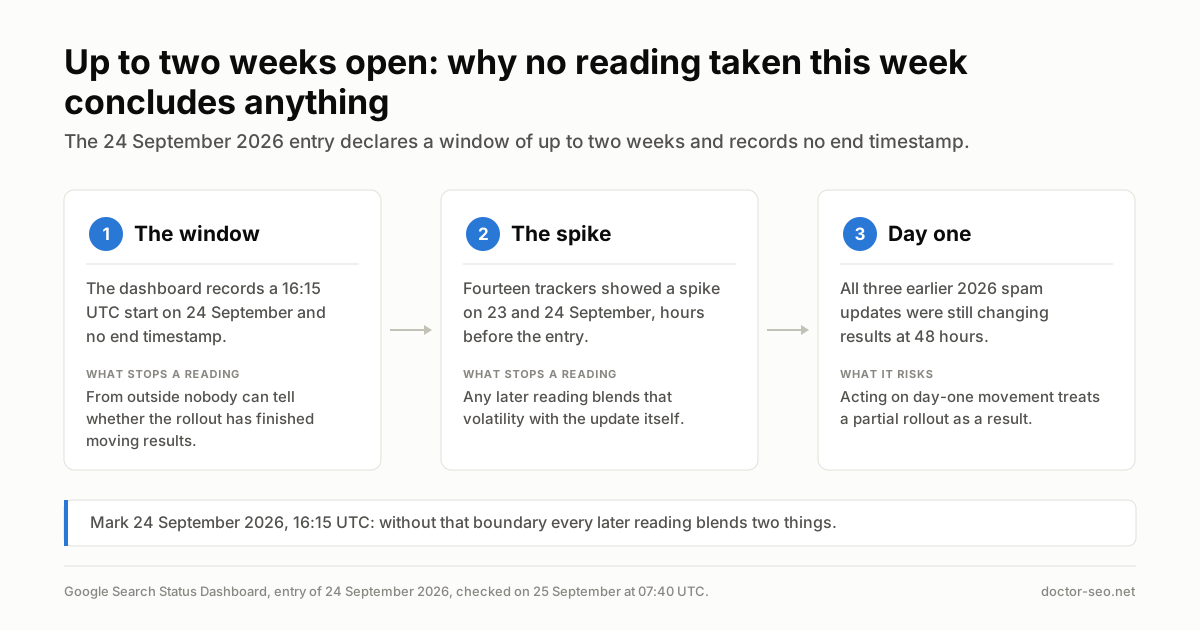
The update was still open when this article was checked against the dashboard at 07:40 UTC on 25 September 2026, roughly fifteen hours after it began.
What Google actually published
Google’s Search Status Dashboard carries one machine-readable entry for the September 2026 spam update. Its text, in full, is:
Released the September 2026 spam update, which applies globally and to all languages. The rollout may take up to two weeks to complete.
The entry records the affected product as Ranking, a begin timestamp of 2026-09-24T16:15:00+00:00, and no end timestamp. Google publishes no further detail there and has not added a Search Central blog post about this update. Search Engine Land reported the release the same day and quoted the identical sentence, which is the whole of Google’s public statement rather than an excerpt from a longer one.
The wording changed, and only the wording
Google’s three earlier spam updates of 2026 each carried the sentence “The rollout may take a few days to complete.” The September 2026 entry replaces “a few days” with “up to two weeks”. Comparing the dashboard’s own timestamps shows what those earlier phrases were worth in practice.
| Spam update | Announced start (UTC) | Recorded end (UTC) | Stated window | Actual elapsed |
|---|---|---|---|---|
| March 2026 | 24 Mar, 19:00 | 25 Mar, 14:30 | a few days | 19.5 hours |
| June 2026 | 24 Jun, 16:00 | 26 Jun, 17:00 | a few days | 49.0 hours |
| August 2026 | 18 Aug, 16:27 | 21 Aug, 08:49 | a few days | 64.4 hours |
| September 2026 | 24 Sep, 16:15 | not yet recorded | up to two weeks | ongoing |
Two things fall out of that table. Each 2026 spam update has taken longer to complete than the one before it, and none of the first three reached three days despite the “a few days” phrasing. If the September 2026 update uses its stated window in full, Google would close it on or about 8 October 2026.
The gap between updates has also narrowed. Google recorded the August 2026 spam update as complete on 21 August at 08:49 UTC and opened this one 34 days later. That is the shortest interval between two spam updates in the 2026 dashboard record.
Both figures come from Google’s own incident feed, read on 25 September 2026. They are arithmetic on published timestamps rather than a measurement, so they carry no sample size and no margin of error, and they describe announcement behaviour rather than ranking behaviour.
What Google did not say
Google’s spam policies documentation, last updated 28 August 2026, names sixteen policies: cloaking, doorway abuse, expired domain abuse, hacked content, hidden text and link abuse, keyword stuffing, link spam, machine-generated traffic, malicious practices, misleading functionality, scaled content abuse, scraping, the site reputation policy, sneaky redirects, thin affiliation and user-generated spam.
The September 2026 announcement names none of them. It does not say which policies the update enforces, which sites it targets, or what changed in Google’s systems.
Two of those sixteen policies attract most of the speculation after any spam update. Google defines scaled content abuse as “when many pages are generated for the primary purpose of manipulating search rankings and not helping users”, and link spam as “the practice of creating links to or from a site primarily for the purpose of manipulating search rankings”. Both definitions are stable documentation, not statements about this update.
An announcement that names no policy is not evidence about which policy it enforces. Coverage that fills that gap is inferring, and the inference should be labelled as one. Our course level on grey hat, black hat and parasite SEO covers which of these policies produce visible enforcement and which are handled quietly.
What the community measured
Barry Schwartz reported at Search Engine Roundtable on 24 September 2026, seven hours before Google’s announcement timestamp, that ranking volatility had spiked across 23 and 24 September. That report charted fourteen third-party volatility trackers, including Semrush, Mozcast, Advanced Web Ranking, Sistrix, Algoroo, Wincher and SimilarWeb, and summarised them as “Many of the tools are showing a spike in volatility over the past 24-hours”.
Two limits on that evidence matter and are rarely stated. The Search Engine Roundtable report published no numeric index values, only charts. And the trackers themselves publish no sample size, no keyword set and no methodology for their indices, so a reader cannot tell whether a given spike represents a hundred keywords or a hundred thousand, nor in which verticals.
The same report quoted site owners describing losses: one wrote “Discover down 70%”, another reported traffic at “-60%” moving to “-80%” within eleven hours, and a third said they were “down 48%” with advertising revenue “literally been cut in half”. These are self-reported forum posts with no verification and no denominator. Site owners whose rankings improve rarely post, so this kind of thread is selected toward losses by construction.
Google said nothing about the 23 and 24 September volatility. The dashboard entry begins at 16:15 UTC on 24 September and makes no claim about anything before that time.
Where the industry genuinely disagrees
Three questions sit behind this story that the available evidence does not settle. Doctor SEO does not hold a position on any of them, and this section reports the disagreement rather than resolving it.
Whether pre-announcement volatility belongs to the announced update
One camp holds that Google routinely begins a rollout before the dashboard entry appears, so volatility in the preceding day is the same update arriving quietly. The other holds that third-party trackers register movement almost continuously, that Google publishes no start signal before the dashboard timestamp, and that attributing a particular day’s movement to a later-named update is unfalsifiable. Neither camp can point to a measurement, because no one has published a paired series of tracker readings against confirmed rollout windows with the sample sizes disclosed.
Where scaled content abuse begins
Google’s policy defines scaled content abuse by purpose rather than by volume or production method, and Google has stated that using automation is not itself a violation. One camp reads that as meaning a verified, useful page is compliant at any scale. Another reads the enforcement pattern as showing that volume itself draws scrutiny regardless of the per-page quality claim. Google has published no threshold, so neither reading can be tested against a number.
Whether to disavow after a spam update
Google has said repeatedly that its systems ignore most low-quality links rather than penalising for them, and that the disavow tool is for sites with a manual action or a known paid-link history. A large part of the agency world disavows routinely after any spam update and sells link audits on that basis. No published study isolates the effect of a disavow file on recovery, so the argument runs on Google’s statements against practitioner case reports, which are uncontrolled. The off-page SEO level of the course sets out what each side’s evidence actually is.
What to do this week
The September 2026 spam update may run until about 8 October 2026 by Google’s own stated window, which makes the next fortnight a measurement period rather than a repair period. A concrete sequence:
- Mark 24 September 2026, 16:15 UTC in your analytics annotations. Without the boundary marked, any later reading of the data will blend this update with the 23 September volatility that preceded it.
- Segment Google organic from Google Discover before drawing any conclusion. The loudest reports in the 24 September thread were Discover losses, which move independently of core ranking.
- Do not act on day-one or day-two movement. All three earlier 2026 spam updates were still changing results at 48 hours, and this one is announced at up to fourteen days.
- Check Search Console for a manual action. A spam update is algorithmic. A manual action is a separate, visible notice and needs a different response.
- Record per-template rather than per-site losses. Export impressions and clicks by page type for 10–24 September as a baseline, so the comparison after the rollout closes has something to sit against.
- Read the sixteen named spam policies against your own site once. Google’s list, last updated 28 August 2026, is the only document that says what counts as spam.
- Re-check the dashboard entry for an end timestamp before concluding anything. A rollout that is still open has not finished moving.
Understanding which of those signals Google can actually act on is easier with the mechanics in hand, which the lesson on how Google works sets out.
What is still unknown
Google has not said which spam policies the September 2026 update enforces, whether it is a new system or a refresh of an existing one, or why the stated rollout window quadrupled from the phrasing used in March, June and August 2026. Google has also not commented on the 23 and 24 September volatility.
No independent party has published a measurement of this update with a disclosed sample size. Nothing available on 25 September 2026 supports a claim about its size, its targets or its winners.
The author’s view
This section is opinion, not reporting. The facts above stand without it.
The “up to two weeks” phrasing is the only new information Google released, and I would not read it as a signal of severity. A longer stated window is cheap for Google to write and it buys room: it reduces the number of people declaring the update finished on day three, which is what happened in March 2026 when the actual rollout lasted under twenty hours. Read it as expectation management first and as scope second, because Google has given no evidence for the second reading.
The more useful observation for anyone running a site is the interval. Four spam updates in seven months, with the gap down to 34 days, means the industry practice of treating each one as a discrete event to be diagnosed and recovered from is drifting out of step with how often Google now ships them. On that cadence, the interval between updates is shorter than the time most sites need to implement and see the effect of a content fix.
I hold no position on where scaled content abuse begins or on whether a disavow file helps after a spam update, and I do not think the evidence published to date licenses one.
Sources
- Google Search Status Dashboard, incident feed, entry “September 2026 spam update”, begin 24 September 2026 16:15 UTC, read 25 September 2026.
- Google Search Status Dashboard, incident feed, entries for the March 2026, June 2026 and August 2026 spam updates, read 25 September 2026.
- Google Search Central, “Spam policies for Google web search”, last updated 28 August 2026.
- Search Engine Land, “Google releases September 2026 spam update”, 24 September 2026.
- Search Engine Roundtable, Barry Schwartz, “Google Search Ranking Volatility Hits September 23rd & 24th”, 24 September 2026.
- Search Engine Roundtable, Barry Schwartz, “Google September 2026 Spam Update Has Been Unleashed”, 24 September 2026.