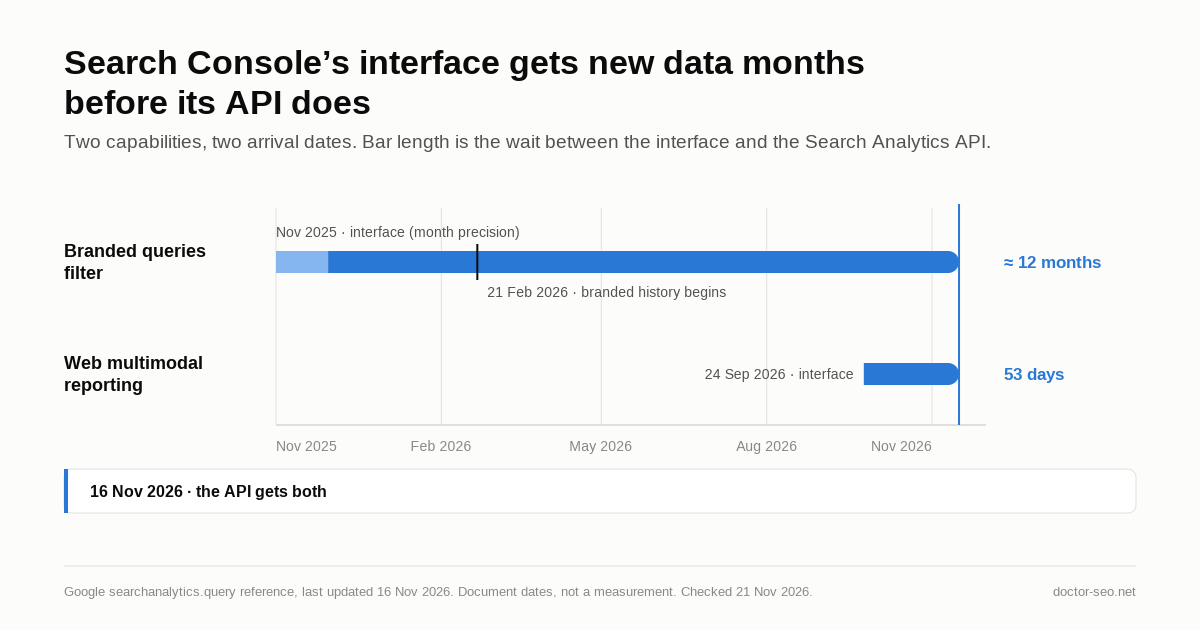
Google added three things to the Search Analytics API on 16 November 2026: a branded-versus-non-branded query filter, a multimodal search type, and multi-value country and device filtering. The announcement went out on the Search Central blog as New filtering and reporting capabilities in the Search Analytics API, dated 16 November 2026 in the blog feed.
Two of those three already existed in the Search Console interface. The branded filter has been there since a November 2025 announcement. The multimodal split arrived on 24 September 2026. The API caught up with both on the same day, about twelve months later for one and fifty-three days later for the other.
That is the part worth your attention, and it is not a complaint about Google’s roadmap. If your reporting runs through the API and your spot-checks happen in the interface, the two have been answering different questions, and you had no field to tell you so.
What Google actually documented
The specifics live in the searchanalytics.query reference, which carries the stamp Last updated 2026-11-16 UTC — the same date as the blog post. Everything quoted below comes from that reference, read live on 21 November 2026 by two independent agents who agreed on every string.
One disclosure first. The announcement post itself could not be read: three fetches across two agents returned the blog’s archive sidebar and no article body. Its title and 16 November 2026 date are confirmed from the blog feed, but its prose is not reproduced here, because it was not read.
The branded filter is a dimensionFilterGroups[].filters[].dimension value called brandedClassification, accepting BRANDED and NON_BRANDED, and the reference states that “only the equals operator is supported”. On availability it says:
Data is available starting February 21, 2026, and only for top-level properties with sufficient query and impression volume
Two things follow. The first is a windfall: 21 February 2026 to 16 November 2026 is 268 days of branded history arriving at once, so nobody waits to build a baseline. The second is a gate with no number behind it. “Sufficient” is defined nowhere on the page, and Google publishes no way to learn which side of the line you are on except by asking for the data.
Then the constraint that shapes everything else:
Filtering or grouping by
brandedClassificationcan’t be combined with aqueryfilter in the same request.
You can have the split or you can have the queries, not both in one call. So you cannot pull the queries Google counted as branded and check them against your own definition.
The three additions, and what each one costs you
| What was added | What the reference says | The limit that matters |
|---|---|---|
brandedClassification filter dimension |
Accepts BRANDED and NON_BRANDED; equals only; data from 21 February 2026 |
Cannot be combined with a query filter; eligibility gated on undisclosed “sufficient” volume |
webMultimodal as a type value |
“Search results from Google Lens, Circle to Search on Android, and image uploads in Google Search” | The reference gives no data start date for it, unlike the branded dimension |
filterLists[] in the request body |
Matches a row if its dimension value equals any of the supplied expressions |
Accepts country and device only; groupType still takes and, with or marked “not yet supported” |
filterLists[] is the least glamorous addition and will save the most engineering time: five countries used to mean five requests, and now it is one request with five expressions. One rule to read before you refactor — a single request cannot filter on the same dimension in both filters and filterLists.
The missing start date on webMultimodal is a real gap. Google documented 21 February 2026 for the branded dimension in the same table and nothing for this one, so how far back multimodal data reaches is unstated. The 24 September 2026 interface rollout is the obvious guess, and it remains a guess.
The gap between the interface and the API, with dates on both ends
On 26 September 2026 this site published a post on the multimodal reporting arriving in Search Console. It recorded, against a reference then stamped 11 August 2026, that the API’s search type parameter allowed six values — discover, googleNews, news, image, video and web — and that the word “multimodal” did not appear on the page at all. It listed, under what was still unknown, this exact question: whether the API would gain a multimodal value, and when.
Fifty-one days later the answer is on the page. webMultimodal is an accepted type value and the reference is stamped 16 November 2026. Two dated readings of the same document, by the same site, with the change in between.
That matters beyond the satisfaction of a closed loop. Google’s reference pages are overwritten in place and carry one stamp, the current one, so nobody can reconstruct in November what the page said in August. A dated record of a vendor’s documentation is an asset, and the course covers the habit in the lesson on connecting your own Search Console and GA4 data through MCP.
What Google did not do: log the change anywhere
Neither of Google’s two documentation changelogs records this. developers.google.com/search/updates carries three November 2026 entries, dated 18, 12 and 9 November, covering the Data Feed validation tool turndown, a page on identifying traffic from Google Search, and “things to do” query support in the aggregator and supplier units. None of them names the Search Analytics API. The crawling changelog’s newest entry is 17 November, on allowing Google-Agent. Both were checked live on 21 November 2026.
So a change to the API that every automated Search Console report in the world talks to shipped with a blog post and a reference edit, and no changelog line. If you watch the changelogs to know when your pipelines need attention, which is what a changelog is for, this one went past you.
Where the industry genuinely disagrees
The branded split raises a question this site has not ruled on, and it is not going to be settled in this post.
One camp holds that this is the best branded data that has ever existed. It comes from Google’s own impression logs rather than from a third party guessing which queries contain a brand token. It is free. And refusing it does not get you out of classifying queries — it just means you do the same job worse, by hand, with a regular expression that cannot tell a misspelling of your brand from a competitor’s.
The other holds that a count produced by an unpublished classifier is a label wearing the clothes of a measurement. Google publishes no definition of “branded”, no accuracy or error rate, no appeal route for a query it classifies wrongly, and no threshold for the eligibility gate. Because the dimension cannot be combined with a query filter, the opacity is enforced by the API rather than merely incidental. A practitioner watching branded share move cannot separate a real shift in brand demand from a change inside Google’s model.
What neither camp has: any ground truth outside Google. There is no external corpus of correctly-classified queries against which the split could be scored, and Google has published neither a classifier description nor an accuracy figure. This is not a disagreement waiting on more data. It is waiting on a disclosure that may never come.
A second, narrower question sits underneath it. Because eligibility depends on an undisclosed volume threshold, any cross-site aggregate of branded share published from now on is drawn only from properties large enough to qualify, and will not say so, because the analyst cannot know which were excluded. Whether a metric gated that way can serve as an industry benchmark is a separate argument from whether it describes one property correctly. Both are open; neither gets a verdict here.
What to do this week
- Find out whether your property is eligible. Issue one
searchanalytics.queryrequest with abrandedClassificationfilter and see what comes back. There is no settings page for this and no eligibility indicator; the request is the test. - If it is, pull the full history to 21 February 2026 now, and store it. You are holding 268 days that arrived in one go, and a baseline you capture today is one nobody can take away by changing a classifier later.
- Run the reconciliation. Pull
webfor a single day through the API and compare it with the interface total for the same day, then do the same forwebMultimodal. Record both numbers with the date. That comparison is the only evidence you will ever have about your own property. - Label every branded chart at the point of use. “Branded, as Google classifies it, pulled 21 November 2026” costs six words and survives the chart being pasted into a deck by somebody who was not in the room.
- Collapse your country and device loops into
filterLists, and check the same-dimension rule before you do: one dimension cannot appear in bothfiltersandfilterListsin one request. - Do not rebuild keyword strategy on the branded split. You cannot see which queries are on which side, by design, so there is nothing in it to action at the query level.
What is still unknown
How Google defines a branded query, and with what accuracy. What volume counts as “sufficient”. How far back webMultimodal data reaches, since the reference gives it no start date. Whether or will arrive for groupType, marked “not yet supported” without a date. And whether the interface will keep receiving capabilities first — two instances is a pattern worth watching, not a policy anyone has stated.
The author’s opinion
This section is opinion. The reporting above is separate and sourced.
I think the filterLists[] addition is the one that will actually change anybody’s week, and it is the one nobody will write about. Fewer requests means fewer rate-limit retries, fewer partial pulls and fewer silently incomplete dashboards. That is a real improvement to the plumbing and it arrived with no caveats attached, which is rare enough to say out loud.
On the branded dimension I will take it and I will not call it a measurement. That is a position on how to report it, not a verdict on the argument above, which the published evidence does not settle. My practical rule: use it to watch a trend on one property over time, never to compare two properties, and never to set a target somebody’s bonus depends on. A number you cannot audit is fine as a signal and dangerous as a goal, which is the reasoning the course applies to tool-reported volumes in the lesson on why every chatbot invents search volumes.
What I will not say is that the twelve-month and fifty-three-day lags mean Google deprioritises API users. I have no evidence for that. Two capabilities reaching the interface first is two data points: it happened twice, it is worth knowing if you run API reporting, and it explains nothing about why. The fuller treatment of what Search Console can and cannot tell you is in the Search Console guide and across the analytics and measurement level of the course.
Sources
- Search Analytics API:
searchanalytics.query— Google for Developers, Last updated 2026-11-16 UTC. Read live twice on 21 November 2026 by two independent agents, agreeing on every quoted string. - New filtering and reporting capabilities in the Search Analytics API — Google Search Central blog, 16 November 2026. Title and date confirmed from the blog feed; the body could not be retrieved on three fetches across two agents, so it is not quoted.
- Search documentation changelog and crawling documentation changelog — Google for Developers, both checked 21 November 2026: November entries dated 18, 12 and 9 November, none naming the Search Analytics API, and a newest crawling entry of 17 November.
- Multimodal reporting arrives in Search Console — doctor-seo.net, 26 September 2026, recording the same reference at Last updated 11 August 2026 with six search type values and no multimodal value.
- The date arithmetic here (268 days, 53 days, about 12 months) is calculated from those published dates. No study is involved, so no sample size applies.