Google published five changes to the way links appear in AI Mode and AI Overviews on 15 October 2026, in a post titled More ways to connect with the web from Search, written by Hema Budaraju, VP, Product Management. It is aimed at publishers: more inline links, links placed higher in the response, news carousels rolling out globally, thumbnails on the related-article block, and a test that turns creator names in video results into links.
The post contains no percentage. Asked explicitly on two separate reads on 16 October 2026, the page carries no numeric percentage anywhere, and the words traffic, referral, visits, impressions and Search Console do not appear on it at all.
That gap matters more than it sounds, because of a rule Google documents elsewhere. Inside an AI Overview, every link shares one position. Moving a link higher inside the answer — which is change number one — cannot show up in a publisher’s own Search Console data at all.
What Google said, in its own words
Two of the five changes are described as tests rather than rollouts, a distinction most coverage flattened. Google’s own status language is in the right-hand column.
| Change | Google’s wording | Status |
|---|---|---|
| Inline links | “continued and substantial increases to the presence of inline links” | Launching |
| Top section for official pages | “We’ll be testing a new display… in a dedicated section” | Test, future tense |
| News carousels | “We’re starting to roll out the prominent carousels” to more locations and languages | Rolling out |
| Related-article links | Thumbnails and “a more clickable design” | Shipping |
| Creator names on video | “This week, we started testing clickable creator and publisher names” | Test, this week |
The one number in the post is about Preferred Sources, not about links: “the number of people who now use our Preferred Sources feature has grown by more than 7x since the start of the year”. Google publishes no user count, no base figure, no date range beyond “since the start of the year” and no method. A multiple without a base is not a measurement, and this site will not repeat it as one.
Nick Fox, Google’s senior vice-president for knowledge and information, posted the same list on X that day. X blocks automated retrieval, so his wording reaches this article through Barry Schwartz at Search Engine Roundtable, not from the post itself. Fox adds one thing the Search blog does not: “over 400 publications worldwide are part of our News AI pilot licensing program”.
The number that is not there
“Continued and substantial increases” is the entire quantitative content of the announcement on its central claim. No percentage, no multiple, no before-and-after count, no date range, no query sample. A publisher who wants to know whether their site now gets more inline links than it did in August has nothing from Google to check against.
This is not a complaint about marketing language. It is the practical problem a publisher has on Monday: a platform says it is sending more clicks, and the only independent check is their own analytics, where AI Mode and AI Overviews arrive inside ordinary organic Search traffic and cannot be separated out.
What Search Console can and cannot show you
Google documents the measurement rules in two Search Console Help pages, neither of which carries a Last updated stamp. Read together they explain why the headline change is invisible in a publisher’s own data.
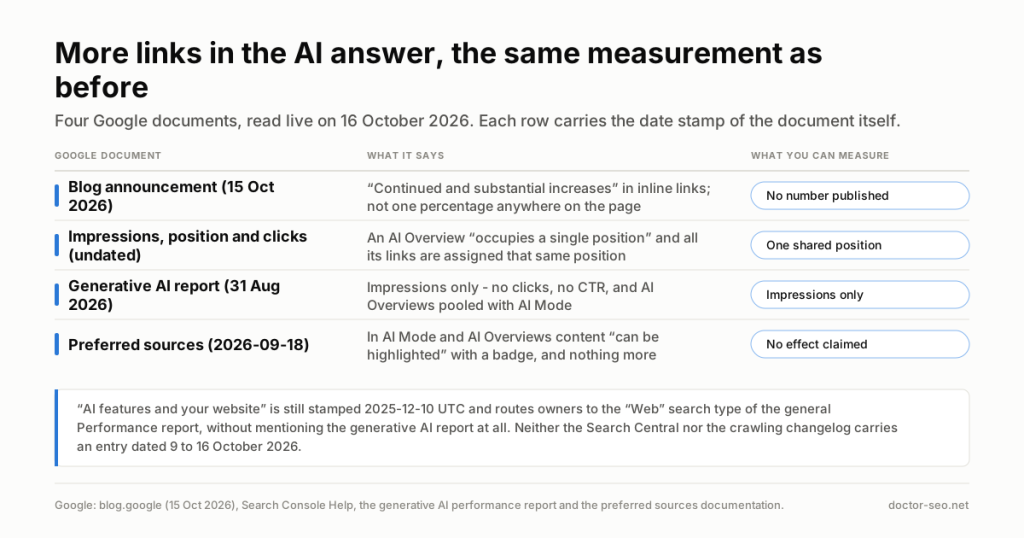
What are impressions, position, and clicks? states that “An AI Overview occupies a single position in search results” and that “all links in the AI Overview are assigned that same position”. Clicks are counted — “Clicking a link to an external page in the AI Overview counts as a click” — but position is not differentiated. A link that moves from the bottom of an AI Overview to the top reports the same position before and after.
AI Mode is documented differently on the same page: “Position in AI Mode follows the same methodology as a Google Search results page.” The identical change is therefore measurable in one surface and invisible in the other. That asymmetry is documented, checkable, and almost never mentioned.
The second page is the generative AI performance report, the only AI-labelled report Google gives site owners. An in-body note dates its general availability: “As of August 31, 2026, we’ve rolled out these insights to all websites worldwide.” It reports impressions only — no clicks, no click-through rate, no position — and it pools AI Overviews with AI Mode into one figure with no dimension that separates them, which is precisely the dimension on which the position rule differs.
Google’s developer guidance has not caught up with its own report. AI features and your website, last updated 2025-12-10 UTC, still tells owners only that AI-feature appearances are “reported on in the Performance report, within the ‘Web’ search type”. It does not mention the generative AI report at all.
Asked by Search Engine Roundtable about click data for AI surfaces, Google answered: “We’re continuing to work with website owners to understand what insights will be most helpful” and “we’ll introduce additional metrics over time.” That is not a refusal. It is also not a commitment to clicks, and it carries no date.
Preferred Sources: read the verb carefully
The preferred sources documentation, last updated 2026-09-18 UTC, is careful in a way the announcement is not. For Top Stories, a user’s selection makes your content “more likely to appear”. For AI Mode and AI Overviews, the page says only that your content “can be highlighted with a ‘preferred’ badge”. A likelihood effect on one surface, a badge on the other — and no sentence anywhere on that page about clicks, traffic, click-through rate or ranking.
There is also a prerequisite that is easy to miss: “To make your site eligible for display as a preferred source in these features, you must make sure your site is included in Search generative AI features in Search Console.” The same setting is what makes the generative AI report appear at all.
A link to the publisher that lands on Google
Google says the creator and publisher names it is testing on video results “link directly to their Search profiles” — and a Search profile is hosted by Google, at profile.google.com. The destination of that click is a Google page, on which the publisher’s own site is one field among several: the June 2026 launch post lists what a creator can customise as “an avatar, bio, website, social media and video platforms, and other important content”.
Google’s Search profile help page, read live on 16 October 2026 and carrying no date stamp, adds two facts. Profiles exist in Canada, India and the United States, and need 10,000 followers on one of YouTube, Instagram, X or TikTok plus a Google Account owned by an adult. And — asked explicitly — the page does not name AI Mode as a surface anywhere; it names Search, the knowledge panel, Discover and the profile URL. It states plainly that “Creation of a Search profile doesn’t directly affect your content’s ranking on Google Search.”
Separately on 15 October, an unbylined Google post confirmed “more than 400 publications worldwide are now participating” in its News AI pilot, and that “we pay participating news publications for the delivery and use of enhanced content”. It names Axios, CNN, The Financial Times, Forbes and The Washington Post among others, and discloses no rate, no formula, no aggregate and no route to apply.
What else happened, and what did not
Google’s Search Status Dashboard, read twice with a cache-busting query string on 16 October 2026, carries no incident with a begin timestamp in October 2026 at all; the September 2026 spam update remains closed at end: 2026-10-08T08:00:00+00:00. The Search Central documentation changelog’s newest entry is 8 October, and the crawling changelog is stamped 2026-10-06 UTC. So a change to the surface where publishers lose clicks was announced on a corporate blog and recorded in none of the documentation a site owner is told to watch.
Where the industry genuinely disagrees
Does an unquantified platform claim count as evidence when the platform withholds the metric that would test it? One camp says a company owes nobody its internals, and refusing to credit a change without a number means never reporting anything. The other says a claim of improvement from the party that controls the measurement and declines to publish it is not evidence, and that the asymmetry is the story. Google has published no click figure for AI surfaces at any point, so neither camp can show its case.
Is a link to a platform-hosted profile a link to the publisher? One camp says a page carrying a creator’s name, work and website link is distribution, and a page the audience chose to open is not an interception. The other says a click that terminates on google.com is a click the publisher did not receive. No party has published how many Search profile visitors go on to the creator’s own site.
How alarmist to be about zero-click, and what a documentation record establishes, are both open here too. Nothing was measured this week in either direction, and this is the eighth consecutive run on this blog to find a Google change announced outside the documentation a site owner is told to watch.
What to do this week
- Annotate 15 October 2026 in your reporting as the date Google changed link placement in AI Mode and AI Overviews. Not as a cause of anything — as a boundary.
- Check one setting. In Search Console, confirm your site is included in Search generative AI features. It gates both the generative AI report and preferred-source eligibility in the AI surfaces.
- Export your generative AI impressions now, either side of that boundary, and accept what the report is: impressions only, both surfaces pooled, no clicks.
- Do not build a position narrative on AI Overviews. Every link in an overview shares one position, so a placement change inside the answer will not move it. AI Mode follows ordinary page methodology; treat the two separately.
- Decide about Preferred Sources on its documented effect — a badge in the AI surfaces, a likelihood effect in Top Stories — not on a 7x figure with no base.
- If you qualify for a Search profile, fill in the website field, and treat the profile as a Google-hosted landing page whose analytics you do not own.
What I think
The most defensible thing to say about this announcement is that it is an announcement. Google has published five product changes and no measurement, and I am not going to invent a mechanism to fill that gap.
What I will say is narrower and documentary. The change Google leads with — inline links moved higher inside the response — is the one change Google’s own position rule makes invisible in an AI Overview, and the only AI-labelled report a publisher gets carries no clicks and does not separate the two surfaces. That is not an accusation of bad faith. It is the reason nobody outside Google, including me, can tell you whether this week left publishers better or worse off. I will not call the changes cosmetic either, because I cannot measure them. I will say that “more than 7x” with no base is not a statistic, and that the distance between Google’s documentation verbs and its blog-post verbs is where a reader’s expectations get set wrongly.
What is still unknown
The size of the inline-link increase, in any unit. Whether clicks from AI surfaces rose, fell or held. How many users Preferred Sources has. Whether either test ships. What Google pays its 400 News AI pilot publishers. And whether the additional metrics Google mentioned will ever include clicks.
The course covers the ground this post stands on: GEO and AIO for how AI surfaces select sources, SEO analytics and measurement for reporting that survives a platform changing what it counts, getting cited by Claude for the same question asked of a different engine, and how Google works for the ranking stack underneath it.
Sources
- Google, More ways to connect with the web from Search, Hema Budaraju, VP, Product Management, 15 October 2026. Read twice on 16 October 2026.
- Google, 400 publications are now partnering with us on our News AI pilot program., 15 October 2026, no byline.
- Google Search Console Help, What are impressions, position, and clicks? — no date stamp. Read 16 October 2026.
- Google Search Console Help, Generative AI performance report (Search) — no date stamp; in-body note dated 31 August 2026.
- Google Search Central, AI features and your website — Last updated 2025-12-10 UTC.
- Google Search Central, Preferred sources in Google Search — Last updated 2026-09-18 UTC.
- Google Search Help, Create a new Search profile — no date stamp. Read 16 October 2026.
- Google, A new profile to help publishers and creators highlight their work on Search, Ibrahim Badr, 4 June 2026.
- Barry Schwartz, Google Updates Links In AI Mode & AI Overviews Again, Won’t Show Click Data, Search Engine Roundtable, 15 October 2026 — source for Nick Fox’s wording and Google’s statement on additional metrics. X blocks automated retrieval, so Fox’s post was not read directly.
- Matt G. Southern, Google Puts Inline Links Higher In More AI Search Responses, Search Engine Journal, 15 October 2026.
- Google Search Status Dashboard,
incidents.json, read twice with a cache-busting query string on 16 October 2026.