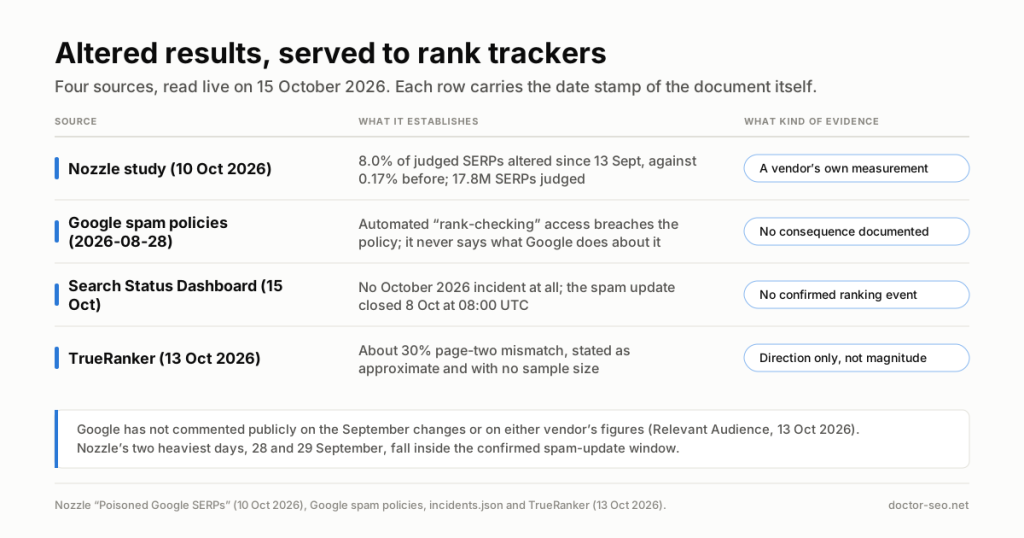
On 10 October 2026, Nozzle, an enterprise rank-tracking company, published research saying that Google had begun answering a measurable share of its automated result-page requests with pages that look complete and normal but carry the wrong sites. Nozzle calls them poisoned SERPs. The figure it reports is 8.0% of judged result pages since 13 September 2026, against 0.17% in the baseline period.
If that holds, it is not a ranking story. It is a measurement story, and it reaches every ranking report and every “we dropped on Tuesday” conversation you have had since mid-September. This article separates three things being mixed together this week: what Nozzle measured, what Google has published, and what you can check on your own property today.
What Nozzle actually published
Nozzle’s research page, titled “Poisoned Google SERPs” and dated 10 October 2026, covers 20 August to 9 October 2026 across 49 countries on desktop, iPhone and Android. Read live on 15 October 2026, the page states that the window holds 63.1 million result pages, 43.9 million of them judged, and that the 27.5 million collected since 13 September include 17.8 million judged. The 8.0% figure is a share of those 17.8 million judged pages, not of the whole sample.
That distinction matters because the trade coverage flattened it. Search Engine Journal’s report of 14 October 2026 describes a study of 27.5 million pages, dates the start of the phenomenon to 20 September and gives a peak of “as high as 25%”. The primary says 13 September, and its daily table peaks at 27.0% on 29 September, with 26.7% the day before. Both readings of this site’s two separate fetches of the Nozzle page agreed on the primary figures, so this article uses them.
Nozzle’s detection rule is published, which is more than most vendor research offers. A keyword’s usual sites are those in its top 10 on at least 60% of its result pages between 20 August and 9 September. A page counts as poisoned when, in Nozzle’s words, “fewer than half of its keyword’s usual sites appear anywhere on it, and they come back on a later SERP”. That return condition is what separates this from an ordinary ranking change: at least 80% of the missing sites must come back within fourteen days, or most of them within three.
The other numbers Nozzle publishes, all read directly from its page on 15 October 2026:
- Continuity collapses. A poisoned page keeps 20.7% of the previous page’s organic sites, against 88.5% before.
- It reverses fast. 77.9% of poisoned pages have their usual sites back within three days, and 80% of episodes last a single collection.
- It looks like a catastrophe in a tracker. On keywords where a tracked site is a usual site, that site is outside the top 10 on 58.6% of poisoned pages, against 2.7% in the baseline.
- It is uneven by country. Since 13 September: Australia 11.5%, the United States 8.5% (10,855,400 judged pages), the United Kingdom 3.0% (1,727,225).
- Collection route changes the answer. Between 30 September and 9 October, one of the routes Nozzle collects through returned 1% to 7% poisoned pages and another returned 9% to 30%.
Search Engine Journal’s rendering adds figures this site did not surface in either direct read, so they are reported as that outlet’s rendering: AI Overviews on 34.9% of poisoned pages against 54.2% at baseline, and a local-versus-national comparison across 21,508 phrase pairs that came out the same either way, 7.5% and 7.4%.
What Google has published, and what it has not
Google’s spam policies page, last updated 2026-08-28 UTC and read twice on 15 October 2026, has a section called Machine-generated traffic. It defines the behaviour as “sending automated queries to Google”, says that such traffic “consumes resources and interferes with our ability to best serve users”, and states that “such activities violate our spam policies and the Google Terms of Service”. It names the exact activity at issue: “This includes scraping results for rank-checking purposes or other types of automated access to Google Search”.
So automated rank checking has been against Google’s published rules for years, and nobody in the industry disputes that. Here is the part worth writing down, verified on both reads of the page: the policy states no consequence. It does not say Google blocks these requests, rate-limits them, serves them a challenge, or alters what it returns. There is no documented sanction of any kind attached to the rule.
The Search Status Dashboard is equally quiet. Read live on 15 October 2026, incidents.json carries no October 2026 incident of any kind, and the September 2026 spam update is closed, with a begin of 2026-09-24T16:15:00+00:00, an end of 2026-10-08T08:00:00+00:00 and the note “The rollout was complete as of October 8, 2026”. The Search Central documentation changelog, read live the same day, carries two October entries — the 1 October generative-AI guidance and the 8 October UGC Fresh Data Program — nothing dated 9 to 15 October, and nothing about automated queries, scraping or altered results.
A vendor reports a consequence; Google documents a rule with no consequence. Neither contradicts the other, and neither confirms it.
What the community measured independently
One other vendor has published its own observation. TrueRanker, on 13 October 2026, reports roughly 30% page-two mismatch in its own collection as of that date, and is careful about what that is worth: it says “That 30% is approximate”, publishes no sample size, and states that it is a different measure from Nozzle’s 8.0%. Of its one worked project, 156 keywords, the article says “That isn’t a rate.” So TrueRanker corroborates a direction and not a magnitude.
Relevant Audience’s report of 13 October 2026 reproduces Nozzle’s five headline figures at the values this site read from the primary, and adds the sentence that defines the state of play: “Google has not commented publicly on the September changes or on either vendor’s figures.”
The overlap nobody is reporting
Here is the arithmetic, and it is reproducible by anyone from two public sources. Nozzle’s two heaviest days are 28 and 29 September 2026. Google’s confirmed September 2026 spam update ran from 24 September 16:15 UTC to 8 October 08:00 UTC. Those two days sit inside that window, and so does most of the episode Nozzle describes.
So any movement a third-party tracker recorded between 24 September and 8 October has two candidate causes: a confirmed spam update, and a collection anomaly one vendor measures at 8.0% of its judged pages. No published measurement separates them. Nobody has released a paired series with the poisoned collections removed, which is the one analysis that would settle how much of the autumn’s volatility was ranking and how much was collection.
What to do this week
- Cross-check every ranking claim against Search Console. The average position in the Performance report comes from Google’s own impression logs, not from scraping, so it is the one series this phenomenon cannot touch. If your tracker shows a collapse and Search Console’s average position for the same queries and dates does not, believe Search Console.
- Re-date your reports. Mark anything covering 13 September to 9 October 2026 as collected during a period with a documented collection anomaly. That is a note in the report, not a reason to withdraw it.
- Do not file a recovery or a penalty story dated inside 24 September to 8 October without the Search Console cross-check. Two candidate causes overlap in that window.
- Put three questions to your rank-tracking vendor, in writing. What share of your account’s collections in that window did they judge anomalous? How do they detect it? Do they discard, flag or silently keep them?
- Expect two tools to disagree, legitimately. Nozzle’s own routes differed by a factor of four to thirty in the same ten days. A gap between two vendors is now evidence about collection, not about your site.
- Keep a dated capture of the raw result page for any keyword you are about to act on. 80% of Nozzle’s episodes lasted exactly one collection.
If you are rebuilding how you measure rather than patching it, the course level on SEO analytics and measurement is the right starting point, and the lesson on why every chatbot invents search volumes covers the same failure in a different tool: a number that was modelled rather than counted, presented as a count.
Where the industry genuinely disagrees
Three questions are open, and this site does not have a position on any of them.
Is a vendor’s measurement of its own collection pipeline evidence about what Google serves to users? One camp says the pipeline is the only window anyone has, that Nozzle published its detection rule and its denominators when it did not have to, and that refusing the evidence means having none. The other says a rank tracker measuring its own scraping measures its own scraping: nobody outside Nozzle can reproduce it, Nozzle sells SERP data, and the page gives no total keyword count. Nothing published tells you what a human in Brisbane saw on 29 September.
Should practitioners keep reporting tracked positions while this runs? One camp says yes with a caveat line, because positions remain the only competitor-visible metric and 77.9% of episodes reverse within three days, so a weekly average absorbs most of it. The other says a series whose error rate the vendor cannot quantify per account should not carry a target, and that a client who later learns a reported drop was an artefact will not distinguish the tool’s failure from yours. No published measurement gives the per-account error rate.
Does movement observed inside a confirmed update window belong to that update? This site has raised that before and it is sharper now, with a second candidate cause in the same fourteen days. Google published a begin timestamp, an end timestamp and two sentences; no phases, no named policy, no measurement.
What I think
I think this is a measurement-layer event and not a ranking event, and that the distinction is the whole story. Nothing in the published record says a human saw a different Google in late September. Everything in it says some machines did.
I will not tell you that Google is deliberately poisoning rank trackers. Nozzle writes that this “is Google’s response to AI scraping and grounding”, and that is its inference from the timing, not something Google has confirmed; the company has said nothing at all. Nor will I tell you to stop using a rank tracker, because no published measurement says how much of any particular account’s series is affected, and acting on a number nobody has is the error this article is about.
What I will defend is narrower and checkable: Google’s spam policies name automated rank-checking and attach no consequence to it, verified on two reads of a page stamped 2026-08-28 UTC; the dashboard records no October 2026 event; and the heaviest reported days sit inside a confirmed spam-update window. If you dated a client impact to late September from tracker data alone, you cannot currently say which of two things you measured. That is uncomfortable, and better than a confident answer nobody can support.
The practical consequence holds regardless of how this resolves: first-party data outranks third-party data when they disagree. Search Console and your analytics are logs of what happened on your property. A rank tracker is a report of what a machine was shown. Those have always been different objects, and this autumn is the first time the difference has had a number attached to it.
What is still unknown
- Whether Google is doing this on purpose. No Google statement exists, on this or on either vendor’s figures.
- Whether any human user saw an altered page. Nozzle’s data is about collected pages. It contains no user-side observation.
- How many keywords were analysed in total. The page gives page counts, and only the count of keywords that had a poisoned page.
- Whether it is still running. The data stops on 9 October 2026, and the page warns that “the last three days are still filling in”.
- How much of the autumn’s tracked volatility was collection. That needs a paired series with poisoned collections removed. Nobody has published one.
Sources
- Nozzle, “Poisoned Google SERPs”, 10 October 2026. Read twice on 15 October 2026. 63.1 million result pages, 20 August to 9 October 2026, 49 countries; 17.8 million judged pages since 13 September. Nozzle is a SERP-data vendor publishing its own research; it discloses its detection rule and its denominators, and does not disclose a total keyword count, and its statement of cause is its own inference with no Google confirmation.
- Google, Spam policies for Google web search, Last updated 2026-08-28 UTC. Read twice on 15 October 2026, the second read as an explicit yes/no check on the named terms.
- Google, Search Status Dashboard,
incidents.json, read live 15 October 2026 with a cache-busting query string. - Google, Search Central documentation changelog, read live 15 October 2026.
- Roger Montti, “Analysis: Google Is Poisoning Search Results For Rank Trackers”, Search Engine Journal, 14 October 2026. Its rendering of the sample and the start date differs from the primary, as noted above.
- Sergio Pérez, “Google is feeding rank trackers the wrong SERPs”, TrueRanker, 13 October 2026. Its own figure is stated as approximate and carries no sample size.
- Antonio Fernandez, “Rank trackers are getting ‘poisoned’ Google results, Nozzle data shows”, Relevant Audience, 13 October 2026.