Google logged fewer AI impressions than it should have for three days, and those three days contain the opening of the first confirmed core update since May. The Search Console data anomalies page, read live on 13 November 2026, carries one entry for November: “A logging error caused a decrease in impressions on the Generative AI performance report in Search for data from November 9 – November 11, 2026.” It adds one sentence: “This issue affects data logging only.”
The November 2026 core update began at 18:06 UTC on 10 November, inside that window. So the one Google report that counts how often a site appears in AI Overviews and AI Mode was under-counting on the day the rollout started, and for most of a day afterwards.
On the same day, Google published a new documentation page telling site owners how to count Google Search traffic themselves, from the HTTP Referer header. That page is dated 12 November 2026 and it never mentions AI Mode or AI Overviews. Nothing Google has said connects the two, and this article does not join them: it reports what each document contains, on the date it was read.
What Google published, and when
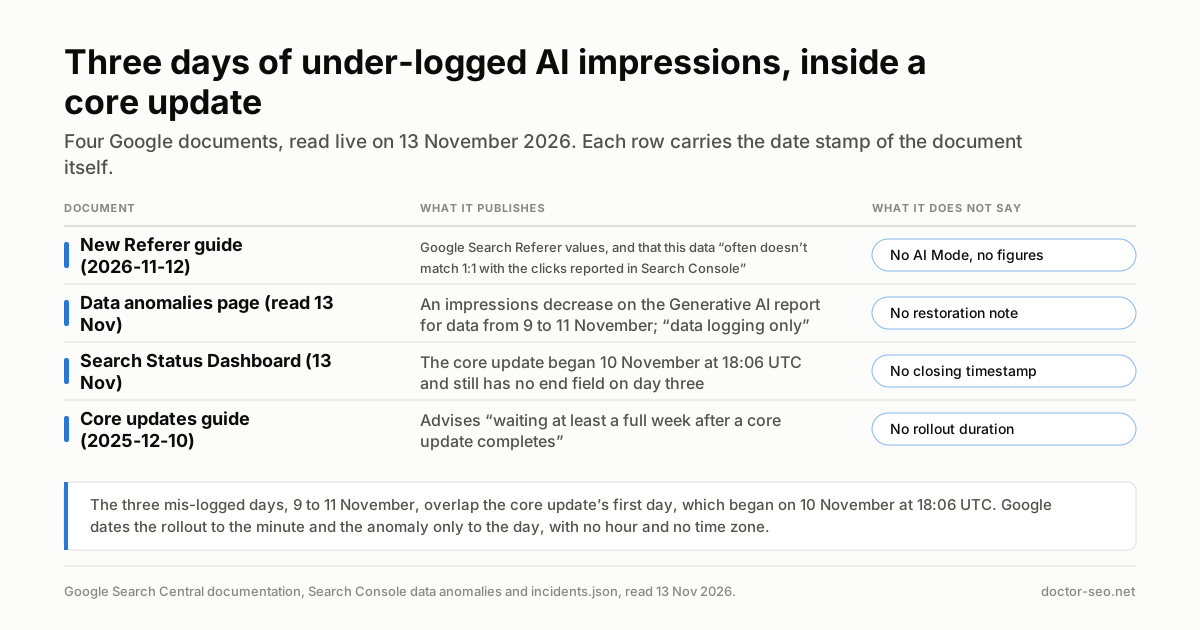
Four Google surfaces bear on this story, each read live on 13 November 2026. The dates below are the stamps the documents carry, not the dates they were reported.
The new page is Identify Google Search traffic in your web analytics or server logs, stamped Last updated 2026-11-12 UTC. The Search Central documentation changelog records it the same day in one line, “Added documentation on identifying traffic from Google Search”, and the Search Central blog carries nothing about it at all.
The anomaly sits on the Search Console help page Data anomalies in Search Console, which carries no last-updated stamp of its own. Its “Product-wide notes” section reads “No recent issues”, and it says so while a live logging error with no restoration note sits on the same page: the document does not reconcile the two. The November entry is the newest on the page, confirmed here on two separate cache-busted reads on 13 November 2026 and again on 17 November 2026, which returned exactly the same text.
The overlap, and why nobody can measure it exactly
Google publishes the start of the November 2026 core update to the minute. The Search Status Dashboard entry gives begin: 2026-11-10T18:06:00+00:00, with a status note created seventy seconds later saying the update “applies globally and to all languages” and that “The rollout may take up to 2 weeks to complete.” Read three times on 13 November 2026, the entry still carried no end field, the only one of the file’s ten incidents without one. Read again on 17 November 2026, it was still open: day seven, 6 days and 13 hours from the start. That is worth stating plainly, because an open window on day seven is not in itself a signal of anything — the file’s three closed core rollouts ran 11 d 21 h, 12 d 4 h and 18 d 1 h 35 m, all longer than that. The two-week ceiling the note promises falls on 24 November 2026 at 18:06 UTC.
Google publishes the logging error only by date. The entry says “data from November 9 – November 11, 2026” and gives no hour and no time zone. If those are whole UTC days, the defect covers the rollout’s first 1 day, 5 hours and 54 minutes. That conditional is the honest statement, and it is the point: Google dates the ranking event to the minute and the measurement defect to the day, so the two cannot be aligned from anything published.
Every past rollout in incidents.json carries both timestamps, so the table below is subtraction anyone can reproduce from Google’s own file.
| Core update | Begin (UTC) | End (UTC) | Rollout |
|---|---|---|---|
| November 2026 | 2026-11-10 18:06 | no end field; still open on 17 Nov | open |
| May 2026 | 2026-05-21 15:40 | 2026-06-02 12:40 | 11 d 21 h |
| March 2026 | 2026-03-27 09:00 | 2026-04-08 13:00 | 12 d 4 h |
| December 2025 | 2025-12-11 17:25 | 2025-12-29 19:00 | 18 d 1 h 35 m |
Two things follow. 173 days and 2 hours separate the May and November core-update starts, the longest such gap in the file. And of the three core rollouts with both timestamps, one ran past the same two-week promise: December 2025 took 18 days and 1 hour, four days beyond fourteen.
What the new Referer documentation says
The new page tells site owners to identify Google Search visits from the Referer header the browser sends on a click. Google states that “Google Search uses the origin referrer policy”, so the header carries the scheme and host and nothing else, and that “The Referer header doesn’t include the search query that the user entered”. The values it documents are https://www.google.com/ or a local Google domain such as https://www.google.co.uk/, plus one app value for Android, android-app://com.google.android.googlequicksearchbox/https/www.google.com, used when the Google app opens a link in a browser tab. The iOS app sends the web value.
The page is explicit that this measurement is approximate. It says identifying Search traffic this way “isn’t exact” and “often doesn’t match 1:1 with the clicks reported in Search Console”, and it names the reasons. “Search Console records a click when a user selects a link in Google Search”, while analytics records a visit only once the destination page has loaded and run its tracking code. Privacy settings, extensions and consent choices “can block analytics scripts, strip URL query parameters, or suppress the HTTP Referer header”, and client-side redirects “may replace the Referer with your own page’s URL”. The one piece of plain log-reading advice: “To count visits from Google Search, only look at requests for the landing pages themselves.”
What the new documentation does not say
Asked explicitly on two separate reads, the page contains no mention of AI Mode and no mention of AI Overviews, and no figure, percentage or sample size of any kind. Google gives no estimate of how many clicks arrive without a referrer, and no typical size for the Search Console gap it describes.
The page also says traffic from Discover “uses the same values as the surface where the user viewed Discover”, and that other Google services served from the same origins send the same values. So a google.com referrer counts web Search, Google Images and Discover together, and nothing in the page separates generative AI surfaces from ordinary results. The independent measurement Google published on 12 November cannot stand in for the report Google said was under-logging on the same days. It was not built to.
The Generative AI performance report counts one metric. Its help page says “Impressions are how many times links to your site were shown to a user in a generative AI feature on Google Search”, covers AI Overviews and AI Mode, and excludes Search Labs experiments. It does not mention the November issue at all.
What the community reported
Barry Schwartz reported the anomaly at Search Engine Roundtable on 12 November 2026 at 2:55 pm Eastern, quoting the same help-page sentence this article quotes. Two sentences in that report are his own rather than Google’s, and the distinction is worth keeping: that the core update started “right during this data logging bug”, and that “This is just a reporting bug and had no impact on your performance in Google Search.” Google’s own wording is narrower. Google says the issue “affects data logging only”, which is a statement about the report, not a measurement of anything that happened in ranking.
Luís Rijo covered the new Referer page at PPC Land on 12 November 2026 at 21:13 UTC, and marks the missing AI Mode and AI Overviews guidance as his own observation rather than Google’s.
Where the industry genuinely disagrees
Three arguments run under this story, and nothing published this week settles any of them. They are reported here, not resolved.
Whether movement inside a rollout window belongs to the update. One camp holds that a confirmed window is the only defensible boundary a practitioner has, and that dating an impact inside it is what the timestamps are for. The other holds that trackers register movement almost continuously and that attributing a particular day to the update is unfalsifiable. The dashboard entry read today names no phases and no ranking systems, so neither camp gains anything from it.
Whether a platform’s account of its own data is admissible. One camp takes Google’s statement at face value: the team that owns the pipeline says the error touched logging only, and nobody outside can know better. The other holds that a claim about a platform’s own historical collection cannot be verified from outside, and that the admissible evidence is a property’s own export either side of the dates. Nobody has published a paired series across 9 to 11 November, so neither camp can show its case.
Whether a dated documentation change says anything about Google’s systems. One camp reads a dated edit as the closest thing to a release note the industry gets. The other holds that guidance and mechanism are separate objects that have diverged repeatedly. This week favours neither: Google published a page about measurement and changed no policy, and the core-updates guide that governs the event is still stamped 2025-12-10 UTC.
What to do this week
- Annotate 9 to 11 November in any report built on the Generative AI performance report, and do not run a before-and-after comparison across those dates.
- Re-read the data anomalies entry before concluding your AI impressions fell. The precedent is on the same page: the 13 to 17 August entry gained an update dated 21 August saying “Missing data for this period has been restored.” That took four days: August’s window ended on the 17th and the note is dated the 21st. November’s window ended on the 11th, so the equivalent fourth day was the 15th. On 17 November 2026, day six, the entry still carried no restoration note — two days past August’s own turnaround. Google dates both the window and the note by day only, so “two days” is the whole of the honest precision available here. And the only way to know whether that changes is to look again.
- Mark two boundaries for the core update: 10 November 2026 at 18:06 UTC, and the published ceiling of 24 November 2026 at 18:06 UTC. Google’s guidance adds a third date, recommending “waiting at least a full week after a core update completes before analyzing your site in Search Console”.
- Build an independent count of Google Search visits from the Referer values in Google’s new page, and write down in the same document that it cannot separate AI surfaces, Images or Discover from web Search. The SEO analytics and measurement level of the course covers what Search Console does and does not tell you.
- Check where Google traffic lands in your analytics. If it is arriving as referral or direct rather than organic search, Google’s page points at custom channel rules, referral exclusions and filters as the place to look.
- Count landing pages only in server logs, and audit your client-side redirects. Requests for images, CSS and JavaScript carry your own page URL as the referrer, and a JavaScript or meta-refresh hop turns a Google visit into direct traffic before anything counts it. Both are covered in the technical SEO level.
What is still unknown
Google has not published the size of the shortfall: no percentage, no affected-property count, no absolute number of impressions. It has not said whether the missing data will be restored, and the entry carries no restoration note today. It has not given the hour or the time zone of the window, and it has not published an end timestamp for the core update, so the rollout’s length is not yet a measurable quantity. Nothing in any of these documents says that anything changed in how Google ranks pages during those three days.
The author’s view
What I will defend is the documentary claim and the arithmetic, and nothing beyond them. Google published a measurement defect dated by day and a ranking event dated to the minute, and the first overlaps the second. That is checkable by anyone with a browser, and it is the whole of what this week established.
What I will not say is that the logging error tells you anything about the core update, in either direction. A report that under-counted impressions is a defect in a report: it is not evidence that rankings moved, nor that they did not. I also will not say the data will be restored. There is one precedent on the same page, from August, and one precedent is not a policy.
The underrated part is the timing of the Referer page. For three days the one first-party number describing AI-surface visibility was knowingly wrong, and Google’s answer to “how do I count Google traffic myself”, published inside that window, documents a method that cannot see AI surfaces at all. I am not claiming Google intended a connection, and I have no evidence of one. I am saying that if your measurement plan for generative AI rests on a single Google report, this week showed what that dependency costs, and the alternative Google documented does not remove it.
Sources
- Identify Google Search traffic in your web analytics or server logs — Google Search Central documentation, Last updated 2026-11-12 UTC, read twice on 13 November 2026.
- Search Central documentation changelog — entry dated 12 November 2026, read 13 November 2026.
- Data anomalies in Search Console — Google Search Console Help, entry “November 9 – November 11 (Generative AI in Search)”, confirmed on two cache-busted reads on 13 November 2026. No last-updated stamp published.
- Generative AI performance report (Search) — Google Search Console Help, read 13 November 2026.
- Google Search Status Dashboard, incidents.json — November 2026 core update, begin 2026-11-10T18:06:00+00:00, no end field; read three times on 13 November 2026, all reads identical.
- Google Search core updates and your website — Last updated 2025-12-10 UTC, read 13 November 2026.
- Google Search Console Generative AI Performance Report Data Bug Nov 9 – 11 — Barry Schwartz, Search Engine Roundtable, 12 November 2026.
- Google explains why analytics won’t match Search Console click counts — Luís Rijo, PPC Land, 12 November 2026.
No study is cited in this article and no sample size applies to any of it: every claim above is a dated document or a subtraction between two timestamps Google published. Google publishes no magnitude for the logging error, which is stated above rather than estimated.