On 16 September 2026 Google lowered the follower requirement for Search profiles to 10,000, and on the same day Google Search Central published documentation for putting a Search profile badge on your own website. Two small changes pointing the same direction: Google wants people to follow publishers and creators inside Search, not merely find them.
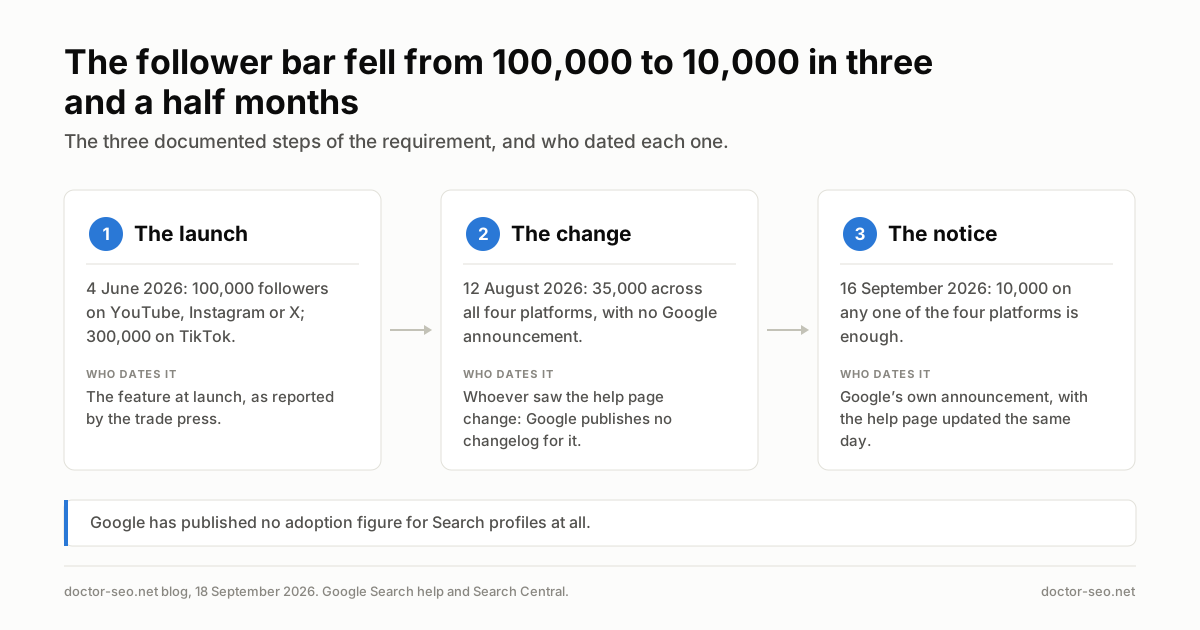
The number is the headline. When Search profiles launched on 4 June 2026, the bar was 100,000 followers on YouTube, Instagram or X, and 300,000 on TikTok. Three and a half months later it is 10,000 on any one of the four. The requirement that has not moved at all is geographic, and that is the one deciding whether this touches you today.
This post keeps three things apart, because most coverage does not: what Google documented, what the community observed, and what I think. Each is labelled.
What Google’s documentation actually says
There are two primary sources, both from Google and both dated. The first is Google’s Search help page on Search profiles, which sets eligibility. The second is Google Search Central’s developer documentation, last updated 16 September 2026, which explains what a profile is and how to link to it from your site.
Google defines the profile in one sentence:
“A Search profile brings together your content from across the web and social platforms into a single destination on Google.”
On what a follow does, Google’s Search Central documentation says the content linked on your Search profile — your material on Instagram, TikTok, YouTube, X, Facebook and your own website — becomes “more likely to appear for your audience on Google Discover”.
Eligibility, per Google’s help page as read on 18 September 2026, has four conditions:
- A minimum of 10,000 subscribers or followers on at least one platform: YouTube, Instagram, X or TikTok.
- You must be at least 18 years old.
- Your content must meet Google’s policy guidelines.
- You must be in the United States. Google’s wording: “Search profiles are currently only available in the United States.” Google says more countries are coming “soon”, with no date.
Claiming happens at profile.google.com/claim, by linking at least one qualifying social account. The badge, per Search Central, requires a claimed profile first. The code Google publishes is an ordinary link to a URL following the pattern https://profile.google.com/@handle, with a downloadable image pack and a text-only variant reading “Find us on Google Search”.
The threshold timeline, with dates
The sequence matters more than the current number, because it describes where the product is heading. Three documented steps so far.
| Date | Follower requirement | Where the figure comes from |
|---|---|---|
| 4 June 2026 | 100,000 on YouTube, Instagram or X; 300,000 on TikTok | Feature launch, as reported by the trade press |
| 12 August 2026 | 35,000 across all four platforms | A change to Google’s help page, spotted by the trade press |
| 16 September 2026 | 10,000 on any one of the four | Google announcement; Google help page updated |
One caveat about that table. Google publishes no changelog for that help page, so the two intermediate steps are dated by the people who watched them change, not by Google. Search Engine Journal published the full sequence on 16 September 2026 and quotes Ibrahim Badr, a product manager for Google Search, saying that “more U.S. publishers and creators are now eligible for Search profiles”. That quotation reaches us through the trade press rather than a signed Google post, and is worth treating accordingly.
What it changes in practice
The first thing that changes is not a tactic but an assumption. For twenty years Google Search has been an intent channel: someone searches, you appear, they leave for your site. A followable profile introduces something else — a relationship that outlives the individual query — and locates it inside Google rather than in your newsletter or your RSS feed.
That lands on a backdrop you already recognise if you have looked at your own numbers: 68.01% of United States Google searches ended without a single click between January and April 2026, according to Similarweb clickstream data published by SparkToro. Search has spent years turning from a waypoint into a destination, and a profile with followers is the explicit version of that idea.
The second change is who this concerns. At 100,000 followers this was a story about large media companies. At 10,000 it takes in an individual creator with a reasonable YouTube or Instagram account, and a great many niche sites. If you do SEO for United States clients, the list of who qualifies just grew by an order of magnitude.
The third is a technical detail nobody will mention and everyone should notice: the badge is an outbound link to a Google property, and the snippet Google publishes carries no rel attribute. Put it in your footer and you have added a sitewide link to profile.google.com. That is not a catastrophe, but it is a linking decision that belongs to you rather than to the documentation.
What to do this week
The answer turns on a single branch. Work through it in order.
- Is your audience, or your client, in the United States? If not, skip to step 5. Search profiles are not available elsewhere as of 18 September 2026.
- Count followers on all four platforms. Clearing 10,000 on one is enough: YouTube, Instagram, X or TikTok. Write down the figure and the date, because this threshold has moved twice in three months.
- Claim the profile at profile.google.com/claim using the Google Account you intend to keep long term. Media companies with several publications can now manage multiple profiles from a single login, per Google’s 16 September announcement.
- Decide where the badge goes before you place it. An author page or an about page concentrates the link; the footer makes it sitewide. Start with the author page and measure.
- If you are outside the United States, this week’s job is inventory rather than implementation: record which social platform you are over or near 10,000 followers on, and which of your own pages a profile would link to. When the feature opens in your market, the groundwork is already done.
- Record your Google Discover baseline today. If your site gets Discover traffic, save the last 28 days of impressions and clicks from Google Search Console. Without a before, any after is an anecdote.
What is still unknown
Three gaps, all of them wide.
There is no measurement. Google’s documentation describes no Google Search Console report for Search profiles: no follower count, no profile impressions, no clicks from the profile to your site. The Discover promise is qualitative — “more likely to appear” — and arrives with no figure and no methodology behind it.
The destination surface is unstable. Barry Schwartz noted at Search Engine Roundtable on 17 September 2026 that Google Discover on the desktop interface of Google.com, which began rolling out last year, has not been seen for several months. That is a community observation rather than a Google confirmation, and it is unresolved. Google is building a follow mechanism whose main stated benefit is Discover distribution, while one of Discover’s two surfaces has been missing for months.
No ranking change sits behind any of this. Worth saying, because the moment anything shifts in Search someone attributes it to an update. Google’s Search Status Dashboard records no confirmed ranking update since the August 2026 spam update, which began on 18 August 2026 and which Google closed with the line “The rollout was complete as of August 21, 2026.” As of 18 September nothing is rolling.
My own read, kept separate
A threshold falling from 100,000 to 10,000 in three and a half months tells me more than the number does. A product that opens up that fast is looking for critical mass, which suggests adoption at the high bar came in below expectations. That is my reading, not a fact: Google has published no adoption figures.
I also think claiming the profile is worth it if you qualify, for a defensive reason rather than an offensive one. It is your name inside a Google surface, and I would rather hold it claimed and empty than leave it available. What I would not do is rebuild a content strategy around a distribution promise that cannot be measured. Until a report exists, the profile and the badge are a cheap bet, and the way to treat a cheap bet is to place it and stop talking about it.
One note on method, which applies even if this product never reaches your country: the distance between “Google said”, “the community measured” and “I think” is the only defence you have when one of the three changes. That distinction runs through the free SEO course at doctor-seo.net, and the lesson on what SEO actually is applies the same test to the definition of the job. If the retrieval and ranking mechanics behind Discover are new to you, start with how Google works; unexplained terms above are defined in the SEO glossary.
Sources
- Google Search Central, “Add a Search Profile Badge to Your Website”, developers.google.com — last updated 16 September 2026.
- Google Search help, Search profiles, support.google.com/websearch/answer/16904498 — read 18 September 2026.
- Search Engine Journal, “Google Search Profiles Now Available At 10,000 Followers”, 16 September 2026 — threshold timeline and the Ibrahim Badr quotation.
- Search Engine Journal, “Google Search Profile Badges Expose The Publisher Traffic Crisis”, 16 September 2026.
- Search Engine Roundtable (Barry Schwartz), “What Ever Happened To Google Discover On Desktop”, 17 September 2026.
- Google Search Status Dashboard, incidents.json — read 18 September 2026. Most recent confirmed ranking update: August 2026 spam update, 18-21 August 2026.
- Similarweb clickstream data on United States Google searches, January-April 2026, published by SparkToro: 68.01% of searches ended without a click.