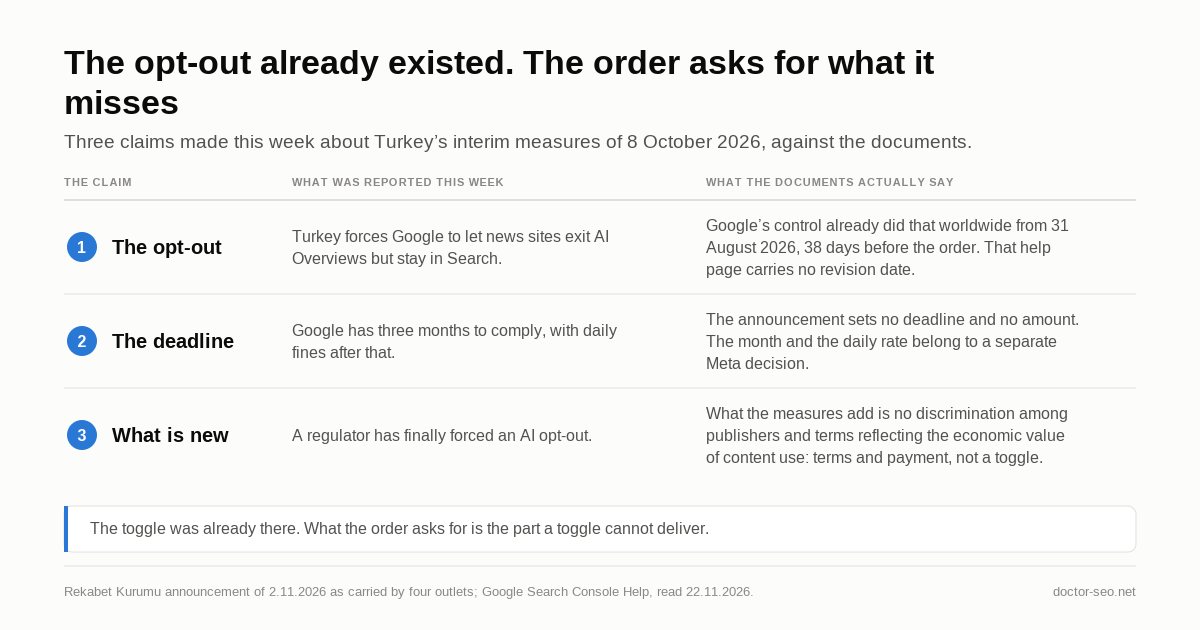
A trade report published on 22 November 2026 put a Turkish competition decision in front of an SEO audience under a headline saying Turkey had forced Google to let news sites leave AI Overviews while staying in Google Search. The decision is real: 8 October 2026, number 26-37/1000-423. That headline sentence is not an obligation written in it.
What the Turkish Competition Authority published is an announcement of interim measures, which rest on suspicion rather than a finding of a breach. And the opt-out the coverage credits to it is not new: Google rolled that out to every website in the world on 31 August 2026, thirty-eight days before the Competition Board met. The genuinely new part of the order is the part no setting in Search Console can deliver.
What the Competition Board decided, and under which powers
The authority is the Turkish Competition Authority, Rekabet Kurumu, and the deciding body is its Competition Board. A preliminary inquiry was opened by decision 26-31/932-M on 27 August 2026. The Board met on 8 October 2026 and imposed interim measures by decision 26-37/1000-423, under Article 9(4) of Act no 4054 on the Protection of Competition. A full investigation was launched under Article 41 into an alleged breach of Article 6, which prohibits abuse of a dominant position. The authority announced it all on 2 November 2026.
The stated ground is suspicion, in the authority’s own words. Daily Sabah quotes it directly on 2 November 2026: the Board acted due to the strong suspicion of discriminatory and exploitative behaviors concerning news publishers
, and the RK decided in its meeting on Oct. 8, 2026, to apply interim measures
.
Four outlets describe the measures identically, converging on three requirements: Google must not discriminate among news publishers; terms must reflect the economic value of the use of their content; and publishers must be able to choose how their content is used in these services independently of their visibility and indexing in Google’s other services. The surfaces named are AI Overviews and AI Mode, and the measures cover news publishers; the wider investigation also reaches other content creators and AI chatbots.
What the announcement does not contain
It sets no compliance deadline, names no fine, and describes no technical mechanism — not robots.txt, not a meta directive, not a Search Console setting. The reasoned decision was published in Turkish only and is not linked from the announcement, so the operative wording a lawyer would argue over is not publicly visible in any language this industry reads.
That matters for the third requirement. The independently of their visibility and indexing
wording describes the aim of the measures. Daily Sabah renders that passage outside quotation marks, as reported speech rather than quoted order text, and the other accounts present it as the measures’ purpose too. A purpose clause and an operative obligation are different instruments, and only one tells you what Google has been ordered to build.
One disclosure, because it bears on all of the above: the authority’s own announcement page would not load for this article on 22 November 2026, on two independent attempts. The primary document was not read here and is not quoted here, and every sentence above is attributed to the outlet that carried it. FourWeekMBA reports the same obstacle.
Google shipped the opt-out part on 31 August 2026
Google documents a Search generative AI control. On its developer page covering what site owners can control, last updated 2026-10-21 UTC and read on 22 November 2026, the entry reads You can manage your site’s inclusion in generative AI features on Google Search, including AI Overviews and AI Mode,
ending in Search Console.
That page labels its applicability, verbatim, Applicable: site-wide
.
The Search Console help page carries the decisive sentence: This control only affects whether your content can appear in certain Search generative AI features;
and this control isn’t used as a ranking or inclusion signal affecting other parts of Search.
It opens As of August 31, 2026, we’ve rolled out this control to all websites worldwide.
So the headline proposition — leave AI Overviews, keep your place in Search — is Google’s own documented behaviour, and has been since August. Three details limit how useful it is. It covers three surfaces together, AI Overviews, AI Mode and generative AI in Discover, so there is no exit from AI Overviews alone. It is set at property level. And exclusion takes 1-2 days after the control goes live
, though some content may take longer to be excluded due to caching and propagation across Google systems.
| What the interim measures ask for | What Google’s control does today | Where that leaves it |
|---|---|---|
| Publishers choose how their content is used in these services, independently of visibility and indexing elsewhere | A property-level setting excluding the site from AI Overviews, AI Mode and generative AI in Discover, which Google says is not a ranking or inclusion signal for other parts of Search | Largely provided, except that the three surfaces move together |
| No discrimination among news publishers | Nothing. One switch for every site is equal treatment, but says nothing about the terms offered | Unaddressed by any setting |
| Terms reflecting the economic value of content use | Nothing. The control is free and carries no payment | Unaddressed. This is remuneration, and no toggle delivers it |
Two of the order’s three requirements are about commercial terms between a platform and publishers — the part a competition authority is equipped to impose, and the part no Google documentation answers.
The three-month deadline is not in the Board’s announcement
Three accounts give three answers on timing, worth spelling out because the number will be repeated. PPC Land relays a Kluwer Competition Law Blog analysis of 19 November 2026 reporting three months to comply with daily fines after, presented as the authors’ account rather than the announcement’s text and with no URL given. MACCUS, which links the authority’s own pages, states flatly that The announcement sets no compliance deadline, mentions no fine and gives no traffic figure
, and places the one-month figure and the Article 17 daily rate of 0.05% of annual gross revenue in the authority’s separate Meta decision. FourWeekMBA carries Forbes Türkiye’s rendering that Google must put fair conditions in place without delay
.
No deadline, three months and without delay are three different facts, and what would settle it is the Turkish-only reasoned decision nobody has linked. Note also what is missing: none of the four accounts carries a Google statement on this matter.
Where the industry genuinely disagrees
Three questions here are contested, and this site has no ruling on any, so none is answered here.
Whether a publisher should accept platform payment for AI contribution on undisclosed terms. A regulator demanding that terms reflect economic value does not settle it. One camp holds that payment with no published formula, no observable qualifying event and no appeal route is not a relationship a publisher can manage, and that ordering payment without ordering disclosure makes the opacity official. The other holds that an enforceable floor beats no floor. No published measurement compares publishers inside and outside such a programme.
Whether to use the generative AI control as a measurement instrument. Switching AI features off is the cleanest way to learn what they contribute, and the instrument damages what it measures, because the exclusion lasts as long as the measurement. This site covered the one published attempt, Zyppy’s twenty-eight-day experiment, on 12 November 2026, and that post sets out why its magnitude does not transfer.
Whether a remedy ordered in one country should change practice advice in another. One camp says Google builds one product and shipped this control worldwide rather than UK-only, so a remedy anywhere is a preview everywhere. The other says Google territorialises when it suits, the European carve-out in its site reputation policy being the precedent. Nobody has measured it.
What to do this week
Nothing here requires action from a site outside Turkey, but it justifies six minutes in Google Search Console, because most owners have never looked at the setting this story is about.
- Find the control and record its state. Settings, then Search generative AI. Note the setting and whether your property inherits it from a parent.
- Assume you are included unless you changed it. Inclusion is the default, worldwide, since 31 August 2026.
- Record your AI impressions baseline now. The control is site-wide today; if a regulator forces a granular version, the only way to know what that bought you is a before. The analytics and measurement level covers the discipline.
- Do not flip it to run an experiment. It costs real organic clicks for the duration, and cannot separate AI Overviews from AI Mode from Discover anyway.
- Know which control does what. Google’s help page says the generative AI control
doesn’t affect AI training
and points to Google-Extended for that. The lesson on separating crawlers in robots.txt covers why the two layers are not interchangeable.
What is still unknown
Nobody outside Turkey has seen the operative wording, no mechanism is named, no deadline is confirmed from the authority’s text, Google has not responded publicly, and it is unknown whether the measures will widen from news publishers to the other content creators the investigation names.
The comparison to watch is the United Kingdom. The Competition and Markets Authority decided on 3 June 2026 that In a world first, publishers will be able to opt out of their content being used to power AI features in Google search
, giving Google nine months to implement all changes
. Read on 22 November 2026, that page shares something with Turkey’s: it does not say whether using the control affects ordinary Search visibility, and the words ranking, visibility and inclusion do not appear on it. Two regulators have ordered a decoupled opt-out and neither stated the decoupling. The only party that put it in writing is Google.
Txema’s take
My opinion, separate from the reporting above: the interesting thing here is not the opt-out, and treating this as an opt-out story gets the direction of travel wrong.
Google answered the opt-out question on its own terms in August, globally, free, and documented that it does not cost you ordinary Search. That was a cheap concession, cheap precisely because it is a switch: whoever uses it gives up AI impressions and gets nothing back, so almost nobody will. The requirements that cost Google something are the other two. A toggle is free. Terms are not.
So what to watch next quarter is not a finer control. It is whether any of the dated obligations now stacking up — Turkey’s 8 October measures, the CMA’s nine-month window — produces a published formula for what publisher content is worth. That number would reset every conversation about AI search economics, because it would be the first that is not a vendor estimate. Failing that, the 2026 pattern holds: regulators order fairness, platforms ship a setting, the setting becomes the documentation, and the terms stay private. For anyone who is not a Turkish news publisher the practical consequence this week is zero, and the GEO and AIO level of the course holds this material unchanged.
Sources
- Daily Sabah, Turkish competition body probes Google over AI features in search, 2 November 2026 — quotes the authority’s statement directly.
- MACCUS, Marc Winer, Turkey probes Google’s AI Overviews and already orders fair terms for news publishers, 2 November 2026 — carries decisions 26-31/932-M and 26-37/1000-423, and states the announcement sets no deadline and no fine.
- FourWeekMBA, Gennaro Cuofano, Turkey Probes Google’s AI Overviews, Orders Interim Measures, 2 November 2026 — relays TRT Haber, Forbes Türkiye and Diken.
- PPC Land, Luís Rijo, Turkey forces Google to let news sites exit AI Overviews but stay in search, 22 November 2026 — relays the Kluwer Competition Law Blog analysis of 19 November 2026.
- Google, Control what you share with Google, last updated 2026-10-21 UTC — read 22 November 2026.
- Google Search Console Help, Search generative AI control — read 22 November 2026. No last-updated date; its only date is the 31 August 2026 rollout note.
- Competition and Markets Authority, 3 June 2026 decision on Google Search and publishers — read 22 November 2026.
- Google Search Status Dashboard, incidents.json — checked 22 November 2026. No confirmed ranking event is tied to this decision.
The authority’s announcement page did not load on 22 November 2026, on two independent attempts, so no sentence of it is quoted here as primary text.