On 5 November 2026, Cyrus Shepard published what happened when he switched his own site out of Google’s AI features for 28 days and watched what disappeared. His estimate: AI Overviews and AI Mode were worth about 21% of the site’s total Google clicks, or 23% counting a knock-on effect on ordinary listings.
That number is being quoted everywhere this week. It is the least useful thing in the piece.
The useful part is that the experiment used a control any site owner can operate, and that Google’s own documentation for that control disagrees with what Shepard observed by a factor of roughly twenty. Both facts are checkable in a browser in about two minutes, which is more than can be said for most AI-search numbers in circulation.
What Zyppy did, and what it found
Shepard used Google’s Search generative AI control, the site-wide setting in Search Console that excludes a property from Google’s generative AI features. His article does not name it — he calls it “the opt-out feature” and “the forbidden button” — but it links Google’s help page for it.
The design was what he calls a “28-day interrupted time-series”. Zyppy was excluded on 1 September 2026 and opted back in on 29 September, giving two adjacent 28-day windows, one with AI visibility and one without.
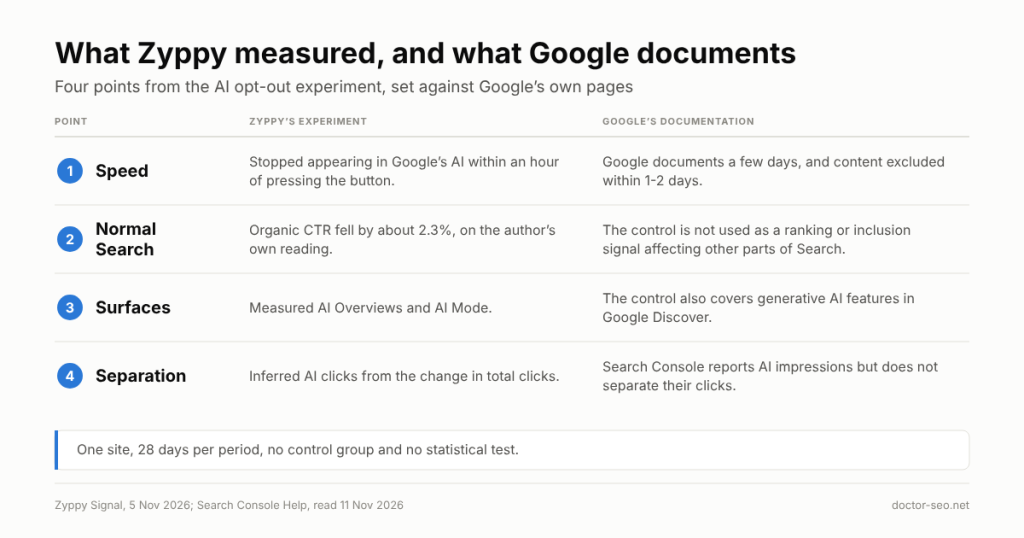
What he reports, in his words: the site had been seeing “500-1000 AI search impressions daily”, and after the switch “AI-feature impressions subsequently fell by more than 99%”. Those impressions “represented about 10% of our site’s total search impressions”. Comparing total clicks across the two windows, he “estimated an AI search CTR of ~0.9%, with a reasonable range of 0.7%-1.1%”, against an overall site click-through rate of “around 0.4%”. That, he writes, “added up to about 21% of our total clicks”.
Three things about those figures deserve stating plainly, because the trade coverage has not. The piece gives no absolute click or impression totals, no sample size in queries or pages, and no statistical test, confidence interval or significance measure — the “reasonable range” is offered without a named method. There is also no control site and no control period other than the adjacent 28 days. All of this was verified on two separate reads of the article, on 10 and 11 November 2026.
The knock-on effect is reported twice and differently: “around 2.3%” as an impact on click-through rate, and “2% more clicks” in the arithmetic that produces the headline 23%. The piece does not show how one becomes the other. Its own section heading gives a third framing again, “20-23% of Our Total Traffic”.
What Google’s own pages say
Google’s help page for the Search generative AI control was read live on 10 and 11 November 2026. It gives a timing for the change taking effect, twice: “it generally takes a few days for your site’s content to be excluded from the applicable Search generative AI features”, and more precisely, “Content will be excluded within 1-2 days after the control goes live, but some content may take longer to be excluded due to caching and propagation across Google systems.”
Shepard observed something far faster. “Within an hour after pushing the button, our website completely stopped showing up in Google’s AI search.” On reversing it: “impressions returned almost as fast”.
That is a gap of roughly twenty times between the only operational number Google publishes and the only observation of it anyone has published. Neither side is obviously wrong, and nobody has a second observation to break the tie.
The same Google page carries a second sentence that matters more than it looks: “this control isn’t used as a ranking or inclusion signal affecting other parts of Search.” Set against Shepard’s report that ordinary organic clicks fell while he was opted out, that reads like a contradiction. It is not one. Google’s sentence denies that the control is a ranking signal; a knock-on effect arriving through lost AI citations is a different mechanism entirely. The two statements are compatible, and the mechanism between them is unmeasured. Expect most coverage of this story to collapse them anyway.
One sourcing note, because it cuts the other way. Search Engine Journal’s report of 9 November 2026 cites Google’s help as saying exclusions take “several days”. Google’s page says “a few days” and “within 1-2 days”; the string “several days” appears on none of the three Google pages checked for this article. The rendering overstates Google’s own documented window, and so overstates the discrepancy it is reporting.
The control covers three surfaces, not two
Google’s help page lists what the Search generative AI control switches off: AI Overviews, AI Mode, and generative AI features in Google Discover.
Shepard measured AI Overviews and AI Mode. His article does not mention Discover at all.
So the headline 21% is a blended figure across three surfaces the experiment cannot separate, and nobody reporting it has said so. For a publisher with meaningful Discover traffic, that is not a footnote — Discover behaves differently from Search, is reported separately in Search Console, and is the one surface where Google has been staffing a team to generate its own content. How much of the 21% is Discover is simply unknown.
Where the industry genuinely disagrees
Whether a single-site opt-out tells you anything about your site. One camp holds that an interrupted time-series on the same property, with matched queries and positions, controls for more than any cross-site study does, and that 500–1,000 daily impressions falling to zero is not noise. The other holds that this is n=1 with no control site, no statistical test and no absolute totals — and points at the author’s own admission: “we’ve done a fair bit of optimizing our site to win AI citations”, and “That may be why so many of our clicks came from AI search.” Nobody has published a multi-site opt-out series, so both camps argue from the same single data point.
Whether the control should be used as a measuring instrument at all. The awkward part is that the instrument destroys what it measures: on Shepard’s own knock-on finding, opting out to discover what AI contributes costs you ordinary organic clicks for as long as the measurement runs. One camp says 28 days of a known cost buys a number Search Console will not give you at any price. The other says you are paying real traffic for a figure with no control and no test, and that Google’s own warning about “caching and propagation” means the window is not clean at either end.
This site does not have a position on either question, and the evidence available does not license one.
What to do this week
- Export your AI-feature impressions, not your clicks. Search Console’s generative AI performance report gives impressions for AI Overviews and AI Mode. Pull the last 90 days. Shepard’s site ran at about 10% of total search impressions; yours is a different number and it is the only part of his arithmetic you can reproduce directly.
- Do not run the opt-out to find out. On the only published attempt it reduced ordinary organic clicks as well. If a 2% click cost for a month is affordable and the number matters to you, that is a business decision, not a technical one.
- If you do run it, record the hour you flip it. The single timing observation in circulation is roughly twenty times faster than Google’s documented window. Yours is a useful data point whichever way it falls.
- Check your Discover traffic first. The control covers Discover generative AI features too, so an opt-out experiment on a Discover-heavy property is measuring something different from one on a property without it.
- Annotate the dates in your reporting. Any AI-impression series that spans a control flip is not comparable across it — the same trap as any reporting change in Search Console.
What is still unknown
Whether 21% generalises to any other site. Nobody has published a multi-site opt-out series, and the one site measured was optimised for AI citations by its owner’s own account.
Whether the knock-on effect is a citation halo, seasonality, or noise. With n=1 and no control period beyond the adjacent 28 days, the data cannot separate them.
Why exclusion took an hour rather than one to two days — whether Google’s help page is stale, deliberately conservative, or whether a single observation of a single property is simply not a measurement of Google’s propagation.
What share of the result belongs to Discover rather than to Search.
Google has published no measurement of any of this, and the help page that documents the control carries no last-updated date at all.
Txema’s read
The number is not the story. The instrument is.
I am not going to tell you that AI features are worth 21% of your clicks, because the author of the experiment tells you himself why they might not be: he optimised that site to win AI citations, and he says so in the piece. That is precisely the selection effect that makes a single-site figure unusable as a market estimate, and his willingness to name it is the reason the article is worth reading at all.
What I will say is narrower and checkable. Google rolled this control out worldwide on 31 August 2026. Its help page gives site owners an operational number — one to two days — that the only published observation contradicts by a factor of twenty. And that help page carries no last-updated date, while Google’s own Search Central page describing the same control carries 2026-10-21. A control that changes what a publisher’s content does across three Google surfaces should be dated.
I am not saying Google’s documentation is wrong. One site’s observation of one flip is not a measurement of Google’s propagation behaviour, and I have no second observation to offer. I am saying that the gap is real, that it is reproducible by anyone willing to press the button, and that the party who could close it in one sentence has not.
If you want the underlying skill rather than the headline, the question this experiment is really asking is how a page earns its way into a generated answer in the first place — which is a different discipline from ranking, and the one worth learning. The measurement side of it starts in Search Console, not in a vendor dashboard.
Sources
- Cyrus Shepard, “We Opted Out of Google AI Search — Here’s What Happened”, Zyppy Signal, 5 November 2026. Read live 10 and 11 November 2026.
- Google, “Search generative AI control”, Search Console Help. No last-updated date on the page; read live 10 and 11 November 2026.
- Google, “Generative AI performance report (Search)”, Search Console Help. No last-updated date on the page; read live 10 November 2026.
- Google, “Control the Content You Share on Search”, Search Central. Last updated 2026-10-21 UTC; read live 10 November 2026.
- Matt G. Southern, “Google’s AI Features Sent One Site An Estimated 21% Of Its Clicks”, Search Engine Journal, 9 November 2026.