Google confirmed the November 2026 core update on 10 November 2026. The Search Status Dashboard puts the start at 18:06 UTC, says it applies worldwide, and says the rollout may take up to two weeks.
Two things about it matter more than the announcement. The first is arithmetic: this is the first confirmed Google ranking event in 47 days and the first core update in 173. The second is that if the rollout runs its full published window it ends on 24 November — three days before Black Friday.
Everything dated below comes from Google’s own timestamps and documentation, read live on 12 November 2026. Nobody has published a measurement of this update’s effect on anything.
What Google actually published
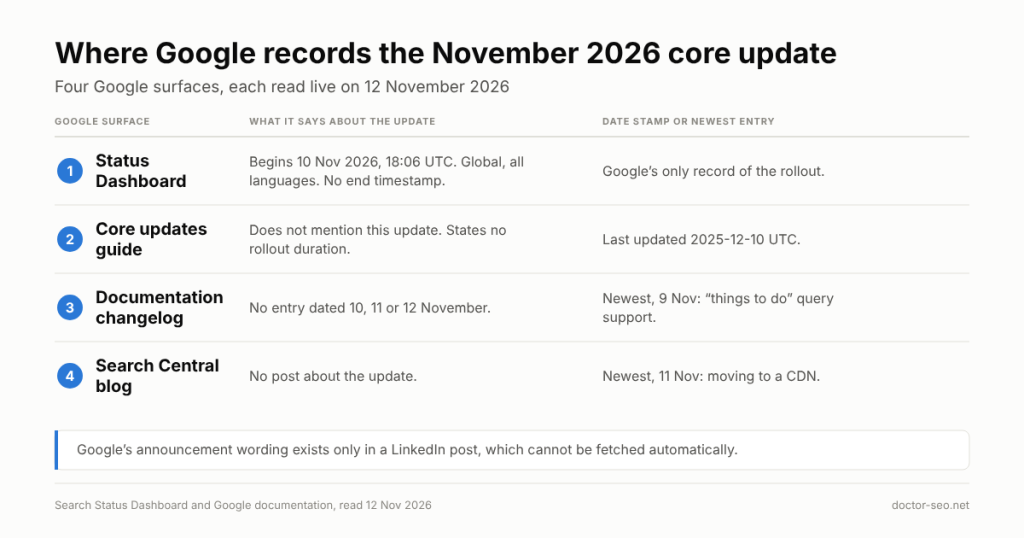
The entry in incidents.json, the machine-readable file behind the Search Status Dashboard, carries id WLxcJyC6jMWMfryxsKMc, service Ranking and status SERVICE_INFORMATION. Its begin value is 2026-11-10T18:06:00+00:00. Its single status note was created one minute and ten seconds later, at 2026-11-10T18:07:10+00:00, and says that Google “Released the November 2026 core update”, “which applies globally and to all languages”, and that “The rollout may take up to 2 weeks to complete.”
That is the whole of it. The entry names no ranking system, no policy, and does not contain the word “phase”. It is also the only one of the ten incidents in the file with no end field — every other, back to the December 2025 core update, carries one. The file was read twice with separate cache-busters and both reads were identical.
One sentence quoted everywhere this week is not in that entry. “This is a regular update designed to better surface relevant, satisfying content for searchers from all types of sites” comes from a post on LinkedIn, which blocks automated retrieval and could not be read from the primary for this article. It reaches this page through two independent trade reports that render it identically: Barry Schwartz at Search Engine Roundtable on 10 November 2026 and Matt G. Southern at Search Engine Journal the same day. Treat it as a statement reported by two outlets, not a document you can check.
Three of Google’s four surfaces say nothing about it
Google’s guide to core updates, at developers.google.com/search/docs/appearance/core-updates, is the page every piece of advice on this subject points at. Read twice on 12 November 2026, it carries Last updated 2025-12-10 UTC — eleven months old — and it does not mention the November 2026 core update. It states no rollout duration at all. Asked explicitly, the page does not contain the word “weeks”.
The Search Central documentation changelog has no entry dated 10, 11 or 12 November 2026. Its newest entry is 9 November, and it is about adding “things to do” query support to the aggregator and supplier units. The Search Central blog has no post about the update either; its newest post, dated 11 November 2026 — the day after the rollout began — is a guide to moving to a CDN without overwhelming your origin.
A fourth documentary fact is the one most likely to cost a reader time. The core-updates guide says “we give notice when they happen on our list of Google Search ranking updates”. That list used to live at developers.google.com/search/updates/ranking; on 12 November 2026 that URL returned HTTP 302 and redirected to the Search Status Dashboard’s ranking history. The page you are told to watch has moved hosts, and the guide sending you there has not been updated since December 2025.
The arithmetic Google’s own timestamps allow
Because incidents.json carries a begin and an end for every past update, the gaps are subtraction rather than opinion. Every figure below is the difference between two timestamps Google published.
| Measure | Value |
|---|---|
| Since the September 2026 spam update began | 47 days 1 h 51 min |
| Since that update finished (8 Oct, 08:00 UTC) | 33 days 10 h 6 min |
| Since the May 2026 core update began | 173 days 2 h 26 min |
| December 2025 core update rollout | 18 days 1 h 35 min |
| March 2026 core update rollout | 12 days 4 h |
| May 2026 core update rollout | 11 days 21 h |
| Two-week ceiling for this rollout | 24 November 2026, 18:06 UTC |
The gap between core updates is the longest in the record. December 2025 to March 2026 was 105 days, March to May 55 days, and May to November 173 days 2 h 26 min — longer than the other two together.
Two weeks is a ceiling Google has already missed once. Of the three core-update rollouts with both timestamps published, two finished inside fourteen days and one did not: December 2025 ran 18 days 1 h 35 min, four days past the fortnight. A published window is intent, not commitment, and this entry has no end field to check yet.
The timing collides with peak retail trading. The full window expires on 24 November 2026 at 18:06 UTC. US Thanksgiving falls on 26 November, Black Friday on 27 November and Cyber Monday on 30 November. And Google’s own core-updates guide advises “waiting at least a full week after a core update completes” before drawing conclusions from Search Console. Add that week to the ceiling and the first clean read-out lands on 1 December 2026 — after the entire peak weekend has been and gone.
What the community has measured: nothing
This is the part most coverage will skip, so it is worth stating precisely. Two days into a confirmed global core update, there is no published numeric measurement of its effect. No percentage of sites affected. No volatility index value with its scale. No sample size.
Search Engine Roundtable’s report of 10 November 2026 displays charts from fifteen named tracking tools — Mozcast, SEMrush, Sistrix and Algoroo among them — as images, and the text gives no reading from any of them. Its description of the movement is “We saw some big movements earlier this week”, which is the author’s own wording. Search Engine Journal’s report names no tracking tool at all.
That is the state of the evidence, not a criticism of either outlet, and it matters more than usual because the instruments that would supply a number are themselves under question: in October 2026 a rank-tracking vendor reported that a measurable share of the result pages it collected came back carrying the wrong sites. Measuring any of this starts in Search Console, which reads Google’s own impression logs rather than scraping results.
Where the industry genuinely disagrees
Whether this week’s volatility belongs to this update. Schwartz reported big movements before the announcement; Google published a timestamp and nothing about what preceded it. One camp holds that Google routinely begins serving a change before posting the entry, so the earlier movement is the same update arriving quietly. The other holds that trackers register movement almost continuously and that attributing a particular day to a later-named update is unfalsifiable. Nobody has published a paired tracker series against confirmed rollout windows with sample sizes disclosed, so both argue from the same absence.
Whether a post on a social platform is a primary source for a Google launch. The dashboard entry is a document; the “regular update” sentence is not, because it sits on a platform that cannot be fetched and that permits silent editing. One camp says a statement from Google’s own account is a statement from Google wherever it is posted. The other says a claim a reader cannot re-check is a report, not a record.
Whether a documentation page is evidence about Google’s systems. Here the question arrives inverted: a confirmed global ranking event is rolling out and Google’s documentation records nothing at all. Whatever a documentation edit does or does not prove, the absence of one plainly does not prove that nothing changed.
Whether a retailer should act during a rollout ending days before its biggest week. One camp says Google’s own advice — wait for completion, then a full week — pushes the first honest read-out past Cyber Monday, which is unaffordable for a business whose year turns on that weekend. The other says mid-rollout changes make the before and after unreadable, and Google documents no mechanism that assesses them faster. No published measurement separates them.
This site does not have a position on any of the four, and the evidence available does not license one.
What to do this week
- Write down two timestamps. 10 November 2026, 18:06 UTC is the boundary for any before-and-after you run. 24 November 2026, 18:06 UTC is the published ceiling, not a promise. Put both in your reporting notes now, while they are cheap to record.
- Export your Search Console data before the holiday distorts it. Pull the 28 days to 9 November as your pre-update baseline, by query and by page. After 26 November your comparison windows contain Thanksgiving, Black Friday and Cyber Monday, and no amount of analysis separates a core update from a seasonal spike after the fact.
- Do not compare the week after the rollout with a pre-update week. That puts holiday traffic against an ordinary week and will tell you whatever you want to hear. If you trade on Black Friday, decide now whether you will act on movement nobody can attribute, or hold to 1 December — it is cheaper than deciding on the day.
- Resist drastic action on a small drop. Google’s guide is explicit: “There’s no need to take drastic action” for a small decline, and recovery, where it comes, “could take several months for our systems to learn and confirm”.
- Leave the foundations alone for the fortnight. A core update is a bad time to ship changes to crawling, indexing or site structure, because they make the one clean comparison you will get unreadable — and check that your rank tracking even covers the window before you quote it, since the measurement question matters more than the dashboard colour.
What is still unknown
Which systems changed: Google named none, and its guide says core updates “don’t target specific sites or individual web pages”.
Whether the rollout finishes inside its published fortnight, given that one of the three core updates in the file ran four days past the same window.
Whether the volatility reported before the announcement belongs to this update, to something else, or to the collection problems rank-tracking vendors documented in October.
How big it is. Nobody has published a number of any kind, and the one party holding the data never has for any core update.
Txema’s read
I am not going to tell you this update is large, aggressive or consequential, because I have no measurement and neither does anyone else. A two-week window says nothing about magnitude: the September 2026 spam update ran 13.7 days and Google published not a single figure about it from start to finish.
What I will say is narrower and reproducible. Google confirmed a global change to its ranking systems and, two days in, the only place it is written down is a status dashboard. The guide telling site owners what a core update is has not been touched since 10 December 2025; the list of ranking updates that guide points at now redirects to a different host; and the one sentence of explanation Google offered lives on a social platform that cannot be fetched or cited reliably. Anyone can verify all three in about five minutes, which is why they are in this article and the volatility charts are not.
On the Black Friday timing the obvious claim is the wrong one. I am not saying Google timed this update to land before Black Friday, and I am not saying it ignored the calendar. I have no evidence either way, and the entry mentions no retail, holiday or e-commerce consideration at all. I am saying the arithmetic is unambiguous: Google’s own ceiling plus Google’s own advice puts the first defensible read-out on 1 December. If your year turns on the last weekend of November, that is a planning fact whatever the intent behind it was.
The honest summary is dull and correct. Record the boundary, export your baseline before the season contaminates it, change nothing structural for a fortnight, and be suspicious of anyone who tells you this week what this update did.
Sources
- Google, Search Status Dashboard, incidents.json, incident
WLxcJyC6jMWMfryxsKMc, “November 2026 core update”. Begin 2026-11-10T18:06:00+00:00; status note created 2026-11-10T18:07:10+00:00; no end field. Read twice live on 12 November 2026. - Google, “Google Search’s core updates and your website”, Search Central. Last updated 2025-12-10 UTC; read twice live on 12 November 2026.
- Google, Search Central documentation changelog. Newest entry 9 November 2026; no entry dated 10–12 November 2026. Read twice live on 12 November 2026.
- Google, Search Central blog feed. Newest item “Moving to a CDN without overwhelming your origin (or blocking Googlebot)”, 11 November 2026. Read live on 12 November 2026.
- Barry Schwartz, “Google November 2026 Core Update Is Rolling Out”, Search Engine Roundtable, 10 November 2026, 1:25 pm ET. Source of the LinkedIn wording and of the fifteen tracker charts.
- Matt G. Southern, “Google’s November 2026 Core Update Starts Rolling Out”, Search Engine Journal, 10 November 2026. Second independent rendering of the same LinkedIn sentence.