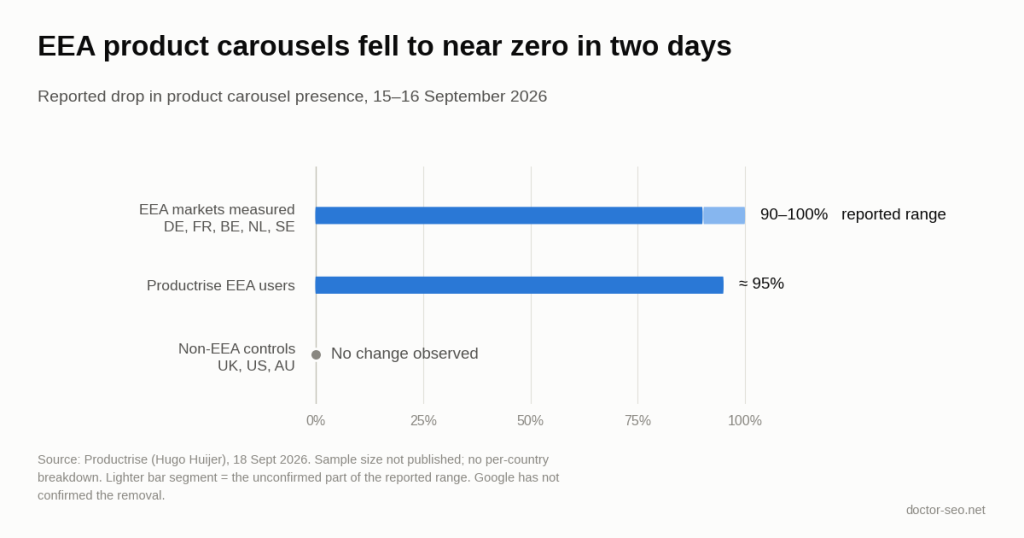
Around 15 and 16 September 2026, free product listings disappeared from Google Search results across the European Economic Area. The organic Shopping carousels that sat above the blue links on commercial queries fell to near zero within hours, and Google announced nothing.
What Google did publish, on 18 September 2026, was an update to its developer documentation describing the units that now occupy that space. Google documented the replacement, not the removal.
If you sell products into Germany, Spain, France or any other EEA market, this is not a ranking drop. It is the loss of an entire surface, and no amount of feed optimisation brings it back. This piece keeps three things apart on purpose: what Google has documented, what the community has measured, and what I think.
What Google has documented
Google documented the units that replace free product listings in the EEA on the Google Search Central page Regional differences in Google Search results, whose stated last-updated date is 2026-09-18 UTC. The document opens with this:
Google is evolving the search results page for certain types of queries to provide new opportunities for Vertical Search Services (VSS), Comparison Shopping Services (CSS), direct suppliers, and content providers.
The feature table on that page assigns two units to the EEA region — the aggregator unit and the supplier unit — and product queries are listed explicitly among the query types they apply to, alongside hotels, flights, ground transportation and local businesses.
The two units have different doors, and that difference is the only actionable thing in the document:
- Aggregator unit: approval required. Per Google’s documentation, a business is eligible when it is approved as a Vertical Search Service, provides the necessary data, and meets the established quality standards.
- Supplier unit: no application. The documentation states that no additional data is needed beyond what is accessible through web crawling.
Here is what Google has not documented. Nowhere on that page does it say free product listings have been withdrawn. There is no launch date and no rollout schedule. The Google Merchant Center announcements change log, checked on 19 September 2026, has 11 August 2026 and 15 July 2026 as its most recent entries, and neither mentions the EEA, the Digital Markets Act or any removal. If VSS and CSS are unfamiliar acronyms, the SEO glossary defines them.
What Google has said in public
Google’s only public statement about the European redesign reached the press rather than its own blog. Nick Fox, Google’s senior vice president, told Reuters — reported by Search Engine Journal on 8 September 2026 — that the changes degrade the user experience for Europeans – boosting online intermediaries at the expense of local businesses, and called the result the largest reduction in quality of service in Search’s 29-year history.
Google pairs that position with a figure of its own: earlier DMA compliance changes, it says, cut free direct-booking traffic to European businesses by 30%. That is a first-party number and Google has published neither the methodology nor the sample size behind it. Treat it as a regulated company’s argument in a live proceeding, not as a measurement.
On the specific removal of free product listings, confirmation is second-hand. Barry Schwartz reported at Search Engine Roundtable on 18 September 2026 that Ginny Marvin, the Google Ads Liaison, confirmed in a comment that the listings were removed because of the DMA ruling in Europe. That attribution belongs to Schwartz, who saw it, not to an official Google communication.
What the community has measured
The sharpest public measurement of the collapse comes from Productrise, a product-visibility tracking tool. In a post bylined Hugo Huijer on 18 September 2026, Productrise reports product carousel drops of roughly 90% to 100% across five EEA countries — Germany, France, Belgium, the Netherlands and Sweden — with the United Kingdom, United States and Australia used as non-EEA controls, where the effect did not appear. For Productrise’s own EEA users the figure is put at roughly 95%. The window: around 15 to 16 September 2026.
Two warnings attach to that number. First, Productrise does not publish a sample size. The post refers to thousands of queries a day, with no exact count and no per-country breakdown. Second, it is a commercial tool measuring the market it sells into. The direction of the finding is independently corroborated — Huijer credits Christian Kunz and Mathias Noyez with flagging it early, and cites observations from Mathias Noyez of the Belgian agency Depends and Paul Schreiner, an ecommerce SEO in Germany — but the decimal precision is not. Treat it as a firm qualitative fact and an approximate magnitude.
One thing not to conflate with it. Barry Schwartz reported unusual ranking volatility on 18 September 2026, following movement already discussed on 4 and 12 September. The Google Search Status Dashboard, checked live on 19 September 2026, shows no confirmed ranking update in progress. The most recent confirmed ranking update is still the August 2026 spam update, which began 2026-08-18T16:27:00+00:00 and ended 2026-08-21T08:49:00+00:00, with Google noting that the rollout was complete as of 21 August 2026. Volatility without a confirmed update and the removal of a surface are two separate stories, and merging them leads people to change things that were never the problem.
What it changes in practice for a European retailer
For a retailer selling into the EEA, this is not a ranking change but a change in the inventory of available surfaces. Here is the picture, surface by surface, combining what Google documented with what the community measured:
| Surface | Before 15 September 2026 | Now, in the EEA | How you get in |
|---|---|---|---|
| Free product listings | Product carousel above the blue links | Absent on the measured queries | No longer applicable |
| Aggregator unit | Did not exist | Live on product queries | VSS approval, data, quality standards |
| Supplier unit | Did not exist | Live alongside the aggregator unit | Crawling only: no feed, no application |
| Shopping Ads via CSS | Paid | No documented change | Bid through a CSS partner |
| Classic organic results | Ten blue links | No documented change | Ordinary SEO |
The operational consequence is uncomfortable: of the two organic product surfaces left in the EEA, neither one is fed by your Merchant Center feed. One is fed by a regulatory approval as a VSS, the other by crawling your own product pages.
What to do this week
- Measure before you opine. Merchant Center, Performance, free listings, segmented by country: compare 8-14 September with 15-19 September 2026. That is the clean signal.
- In Search Console, filter product pages by country, one EEA market at a time, and compare the same two windows. Search Console has no free-listing appearance filter for main Search, so this is context, not diagnosis.
- Confirm your non-EEA markets stayed flat. That is a control group you already own and it costs nothing to read.
- Audit how your product pages are crawled. The supplier unit is fed by crawling alone, so price, availability and Product structured data need to be in the served HTML, not injected by JavaScript after load.
- Decide whether a CSS partner has stopped being optional in your EEA mix, and price it before the Christmas campaign rather than during it.
- Rebuild the Q4 forecast for EEA markets with that surface gone. Do not touch content or internal linking because of this: it is not a quality verdict on your site.
A threshold to settle the argument without a meeting: if free-listing impressions in an EEA market are down more than 60% against the week of 8-14 September while the same catalogue in the United Kingdom stays inside ±10%, the change is regulatory and it is not yours. If the control market fell in parallel, the cause is on your site and crawling and indexing are where you start.
What is still unknown
- Whether the removal covers all 30 EEA countries or only the five measured in public. Spain and Austria appear in no published measurement I could verify on 19 September 2026.
- Whether the Shopping tab keeps free listings, or whether only main Search is affected.
- Whether this is permanent or a transitional state while Google and the European Commission continue to negotiate.
- The real sample size behind the 90-100% figure.
- Whether Google will ever publish a changelog entry acknowledging the removal. As of 19 September 2026, none exists.
My read
This section is opinion, separated on purpose. For a decade, advice on organic product visibility in Europe reduced to one instruction: fix the feed. Titles, GTINs, availability, image quality. In the EEA that lever has just stopped existing. Neither surviving surface reads a feed. One reads a regulatory approval, the other reads your HTML. For the first time since 2020, the markup on a product page matters more than the feed behind it for organic product visibility in Europe, and very few teams are organised for that.
The second detail interests me more than the first. Google updated its documentation the day after the traffic vanished, described precisely what arrives, and gave not one sentence to what left. It is the same pattern as the Search profiles change: the new capability gets documented, the withdrawal gets left for the community to find. When a company documents the replacement and not the subtraction, it is signalling a compliance action it does not want to own. Judge it by the dated document, not by the announcement that does not exist.
The short version
- Free product listings disappeared from EEA search results around 15-16 September 2026.
- Google has not announced the removal. It did update the aggregator unit and supplier unit documentation on 18 September 2026, and both apply to product queries in the EEA.
- Productrise measured drops of 90-100% in Germany, France, Belgium, the Netherlands and Sweden, with no published sample size.
- Ginny Marvin confirmed the DMA as the cause according to Barry Schwartz, not according to an official Google post.
- Neither of the two new surfaces is fed by a Merchant Center feed.
- No confirmed ranking update is running. The most recent is the August 2026 spam update, closed 21 August 2026.
- Immediate action: measure per country against a non-EEA control before changing anything.
Sources
- Regional differences in Google Search results, Google Search Central. Last updated 2026-09-18 UTC.
- Google Search Status Dashboard, checked 19 September 2026.
- Merchant Center announcements change log, Google. Checked 19 September 2026.
- Google Rolls Out Redesigned Search Results Across The EEA, Search Engine Journal, 8 September 2026, quoting Nick Fox to Reuters.
- Google Drops Free Product Listings From European Economic Area, Barry Schwartz, Search Engine Roundtable, 18 September 2026.
- Product carousels are disappearing from Google in the EEA, Hugo Huijer, Productrise, 18 September 2026.